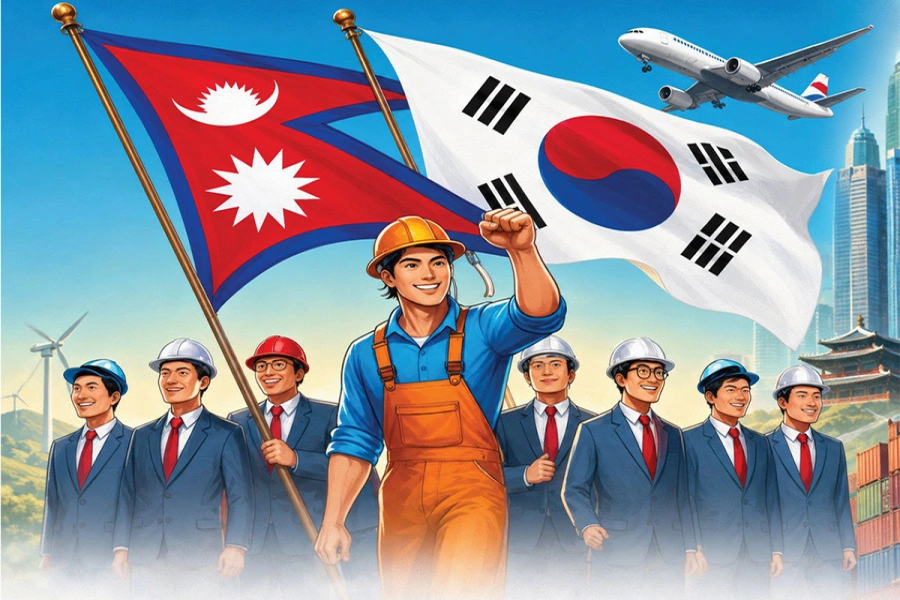
KATHMANDU, July 27: South Korea has emerged as a popular destination for Nepali workers among the 110 countries that issue work permits to foreign workers. Since Nepal began sending workers to South Korea through the Employment Permit System (EPS) in 2008, more than 125,000 Nepalis have secured employment opportunities there.
As in previous years, applications for Nepali workers seeking to take the Korean language test for employment in South Korea in 2026 opened on Monday. The application process will remain open until August 2.
The EPS Korea Section under the Foreign Employment Division of the Ministry of Labour, Employment and Social Security announced the examination schedule. According to the labour agreement between Nepal and South Korea, the latter has opened applications for 7,200 workers under the EPS quota.
The EPS Korea Section said the quota includes 5,000 workers for the manufacturing sector, 2,000 for agriculture and livestock farming, 100 for the service sector, and 100 for shipbuilding-related work as demanded by the Human Resources Development Service of Korea (HRD Korea).
Individuals aged between 18 and 39 years who have not been convicted of criminal offences and have not been deported from South Korea for illegal stay are eligible to apply for the examination online.
Similarly, applicants must not have travel restrictions imposed by the Nepal government and must not have stayed in South Korea for five years or more on an E-9 or E-10 visa, according to the EPS Korea Section.
The next stage of the recruitment process will begin after the publication of the first-stage examination results.
EPS Korea branch announces job opportunities in South Korea

Applicants are required to pay a $28 examination fee. The results of candidates who pass the final examination will remain valid for up to two years from the date of publication.
The schedule for the language examination will be announced after the completion of the application process and finalization of applicants. The number of candidates selected may vary depending on labour demand in South Korea. The EPS Korea Section has clarified that passing the language test does not guarantee employment.
55,000 Nepalis employed in five years
The EPS Korea Section said Nepal has the second-highest number of workers employed in South Korea among countries whose citizens have passed the language test, after Cambodia.
Currently, more than 46,600 Nepalis are working in South Korea, while the number of Cambodian workers exceeds 49,000.
A total of 411,914 workers from 17 countries, including Nepal, have secured employment in South Korea over the past five years. Of them, 55,169 are Nepalis.
According to the EPS Korea Section, Nepal sent the highest number of workers among the 17 source countries in 2022, 2023, and 2024.
Through the EPS, 387 Nepalis went to South Korea in 2021, 14,495 in 2022, 19,738 in 2023, 9,309 in 2024, and 11,240 in 2025.
Nepali workers started going to South Korea after the two countries signed an agreement in 2008. Since then, 900,609 Nepalis have applied for the EPS programme, while 830,117 have appeared in the language examinations. Among them, more than 125,000 have received employment opportunities.
The number of applicants for South Korea generally exceeds the available quota every year. The EPS system has faced criticism due to intense competition among applicants, unemployment caused by the expiry of the roster after two years, and periodic protests.
Considering these concerns, the EPS Korea Section has clearly stated in the application notice that passing the language examination does not guarantee employment.
Minimum wage in South Korea increased
South Korea has increased its minimum wage for 2027. The Minimum Wage Council has fixed the minimum hourly wage for 2027 at 10,700 Korean won, up from the current 10,320 won.
The increase represents a 3.7 percent rise, and the new wage will come into effect from January 1, 2027.
During discussions among representatives of labour unions, employers, and the government, labour representatives had demanded an hourly wage of 12,000 won, while employers had proposed maintaining the current rate of 10,320 won.
After several rounds of negotiations, labour representatives proposed 10,730 won, while employers proposed 10,070 won. The final wage of 10,700 won was approved through a vote.
According to the foreign exchange rate published by Nepal Rastra Bank, 1 Nepali rupee is equivalent to around 9.7 Korean won. With the revised wage, the minimum monthly salary of Nepali workers in South Korea will reach approximately Rs 230,546.
The current monthly salary is around Rs 219,000. Nepali workers in South Korea generally work eight hours a day and five days a week, totaling 209 working hours per month.
The revised wage will increase monthly earnings by around 79,420 won compared to 2026, and the new salary structure will be implemented from January 2027.






-1785142824.webp)