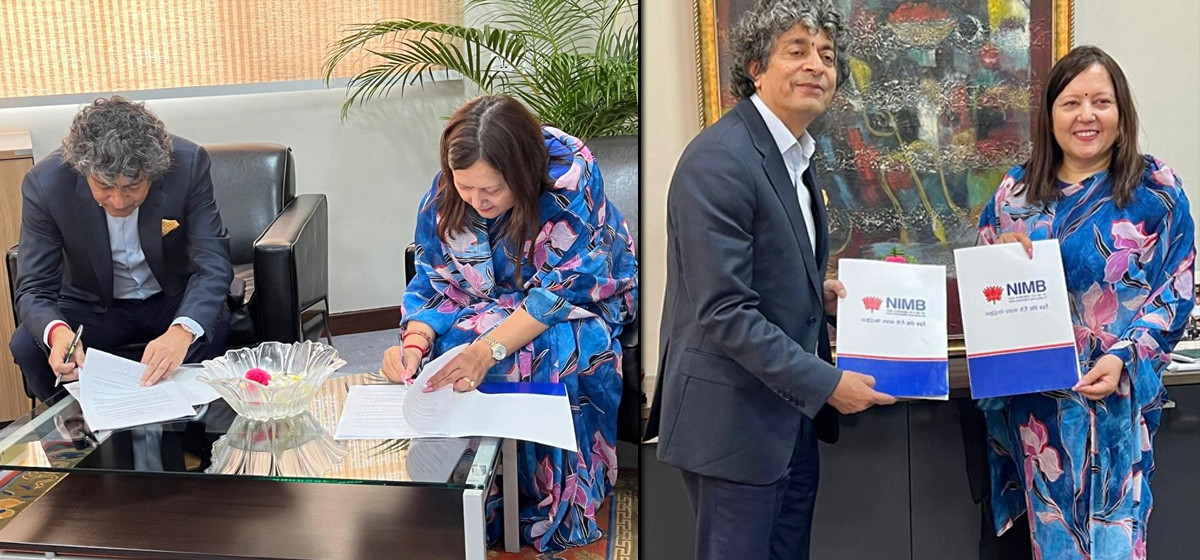
KATHMANDU, May 15: The arrest of Jyoti Prakash Pandey, Chief Executive Officer (CEO) of Nepal Investment Mega Bank (NIMB), has triggered fresh debate over banks’ collateral rights and the legal framework governing loan recovery in Nepal.
Pandey was arrested by the Central Investigation Bureau (CIB) of Nepal Police in connection with the auction and sale of assets belonging to Smart Telecom, a case that has sent shockwaves through the banking, telecommunications and regulatory sectors.
Banking professionals say the incident has created widespread anxiety within the financial sector, raising concerns over investment security and the legal protection available to secured lenders.
“If banks are no longer allowed to auction or sell collateral assets after completing due legal procedures to recover loans, then not only Jyoti Prakash Pandey but CEOs of all banks could face similar consequences in the future,” said the CEO of another commercial bank, speaking on condition of anonymity. “This is not about one individual. It concerns the entire legal and institutional framework governing banking operations and loan recovery.”
Bankers argue that Section 57 of the Banks and Financial Institutions Act, 2017 authorizes banks to initiate collateral auctions once loans become non-performing. They also point to Supreme Court precedents establishing that once a bank’s first charge over a property has been secured, subsequent claims cannot supersede it.
“If that principle no longer holds, banks might as well stop lending,” the banker added.
Under the Banks and Financial Institutions Act, 2017 and the Secured Transactions Act, 2006, banks are legally entitled to auction collateral assets to recover outstanding loans.
Banks further maintain that lenders registered with the Secured Transactions Registry qualify as secured creditors and that no private or regulatory entity can override an existing first charge. In banking terminology, the dispute has evolved into what officials describe as a conflict between “first charge” rights and “regulatory takeover.”
According to bankers, Smart Telecom’s assets had already been pledged as collateral at the time the loans were issued.
A banking expert warned that uncertainty over collateral rights could significantly discourage investment in key sectors.
CEO of Standard Chartered Bank Nepal awarded ‘Banking CEO of th...

“If legally pledged collateral is no longer secure, banks will hesitate to finance projects in energy, telecommunications, infrastructure and aviation,” the expert said. “If the rights of secured lenders are not protected by courts or the law, the entire project financing model could collapse.”
Senior banking executives also argue that without guaranteed protection of collateral rights, banks and financial institutions will be unable to lend with confidence.
“If banks cannot recover loans secured under the law, the future of the banking system itself could be at risk,” they said.
Officials in the banking sector note that while existing laws and the collateral registration system grant banks priority rights as secured creditors, the arrest of a bank CEO has created uncertainty over what can truly be considered secure collateral.
An official at the Nepal Bankers’ Association said the arrest has raised broader concerns regarding investment security, project financing risks and the criminalization of executive decisions.
“With the arrest of NIMB CEO Jyoti Prakash Pandey, serious questions have emerged about how banking executives can continue to make decisions under such circumstances,” the official said.
What is the dispute?
Smart Telecom’s operating license was automatically revoked in 2023 after the company failed to renew it. Following the cancellation, the Nepal Telecommunications Authority (NTA) claimed control over the company’s assets, network and infrastructure under Rule 18 of the Telecommunications Service Provider Asset Management Regulation, 2022.
However, the banking consortium led by NIMB argues that Smart Telecom had already pledged its equipment and network infrastructure as collateral while obtaining loans, giving the consortium the first charge over those assets.
The bank maintains that the Banks and Financial Institutions Act and the Secured Transactions Act authorize it to auction collateral assets to recover outstanding loans. It claims that the equipment was sold through a lawful auction process and the proceeds were used to recover dues.
CIB officials, however, contend that once Smart Telecom’s license was revoked, its assets came under government control, leaving banks without the authority to dispose of them. Investigators allege that the assets were sold to Ncell Axiata in a manner that weakened the government’s claim over the property.
The investigation is currently proceeding under charges related to fraud and criminal breach of trust.
Officials said Ncell purchased the equipment for Rs 4.6 billion. While banks recovered their dues from the proceeds, authorities claim that significant liabilities owed by Smart Telecom to the government, the Nepal Electricity Authority, landlords and other entities were ignored.
How did NIMB become involved?
Smart Telecom obtained its telecommunications service license from the NTA around 2013 and subsequently invested heavily in expanding its nationwide network.
As part of that expansion, a banking consortium led by NIMB extended substantial loans to the company after 2017. Prime Commercial Bank and several other banks also participated in the consortium.
Telecommunications equipment, BTS towers, switching systems, network infrastructure and fiber-related assets were pledged as collateral. According to the bank, the collateral was formally registered under the Secured Transactions Act.
However, Smart Telecom later fell into financial distress. The subsequent cancellation of its license and the dispute over ownership of assets and loan liabilities have triggered intense debate within Nepal’s banking and financial sectors.
NIMB’s position
The banking consortium led by NIMB says it initiated the collateral auction process in accordance with the law to recover outstanding loans owed by Smart Telecom.
According to the bank, the consortium, including Prime Commercial Bank, had been providing loans and banking facilities to Smart Telecom since 2017.
The bank said the telecommunications equipment and related materials pledged as collateral were duly registered with the Secured Transactions Registrar Office.
NIMB stated that while loan repayments were regular in the initial period, Smart Telecom later defaulted on principal and interest payments despite repeated verbal and written notices. After the loan became non-performing, the consortium proceeded with collateral auction proceedings under Section 57 of the Banks and Financial Institutions Act.
The bank said a 35-day public notice was issued on May 6, 2025, but the company failed to respond or regularize the loan. According to NIMB, written consent authorizing the auction of collateral assets was obtained on June 3, 2025, followed by the publication of a 15-day auction notice on June 17, 2025.
NIMB stated that three companies submitted sealed bids during the auction process, with Ncell Axiata offering the highest bid of Rs 4.6 billion. Other bidders included Transgate Tech Pvt Ltd and Professional Business Network Pvt Ltd.
According to the bank, Ncell’s bid exceeded the audited valuation of the collateral assets and was sufficient to recover most of the principal and interest owed to the consortium, leading to the acceptance of the offer.
The bank further stated that Ncell deposited the remaining payment within the stipulated 14-day period, after which Smart Telecom’s loan file was officially closed on September 29, 2025.
Meanwhile, the NTA has maintained that once a telecom operator’s license is not renewed, the authority retains rights over the company’s assets.
NIMB, however, argues that its first charge over Smart Telecom’s assets had already been established under existing banking laws before the regulator attempted to assume control. The bank has also cited Supreme Court precedents to support its claim that once a bank’s primary right over a property is established, no secondary claim can legally supersede it.












-1778746562.webp)