


Returning to Dhaka always feels like a homecoming, yet this visit carried the weight of historic transformation. There is a specific, restless energy in the air of Bangladesh that resonates deeply with the spirit of the Himalayas. Last year, I stood in Dhaka as a witness to the massive student-led movement that fundamentally reshaped the nation’s social contract. This year, I arrived in the wake of Nepal’s own "GenZ" awakening, a period when the youth of my country stood up to demand a new era of accountability.
At a time when traditional South Asian geopolitical forums like SAARC are languishing in institutional inertia, the Bay of Bengal Conversation (BOBC) has emerged as a vital alternative, privately held forum. It is no longer just a conference; it is a laboratory for a new diplomacy. Where formal state mechanisms have stalled, BOBC provides the ‘South-driven’ platform necessary to address the overlapping crises of climate, trade, migration, technology, and security. One must salute the Centre for Governance Studies (CGS) and its leadership, particularly Zillur Rahman, for taking the monumental risk of hosting 200-plus speakers from over 80 countries. In an era when democratic spaces are under pressure, providing a forum courageous enough to host disagreement and humble enough to listen is a victory for our entire region.
This dialogue is particularly crucial for reinvigorating BIMSTEC, a body that has often struggled to move from technical cooperation to political action. Such conversations are essential for shifting BIMSTEC’s role toward a more collaborative and equitable approach to growth, ensuring that trade and social relations are inclusive rather than merely transactional. For Nepal, BIMSTEC represents more than just a diplomatic neighborhood; it is our primary bridge to the sea and a critical collective shield against the ‘trinity of disruption’: climate change, regional conflict, and the ethical void of unregulated AI. As a landlocked country that has historically chaired the organization, Nepal’s prosperity is inextricably linked to whether BIMSTEC can evolve from a passive observer into a proactive architect of regional resilience.
1. The Digital Rupture: Artificial Trust and the Accountability Void
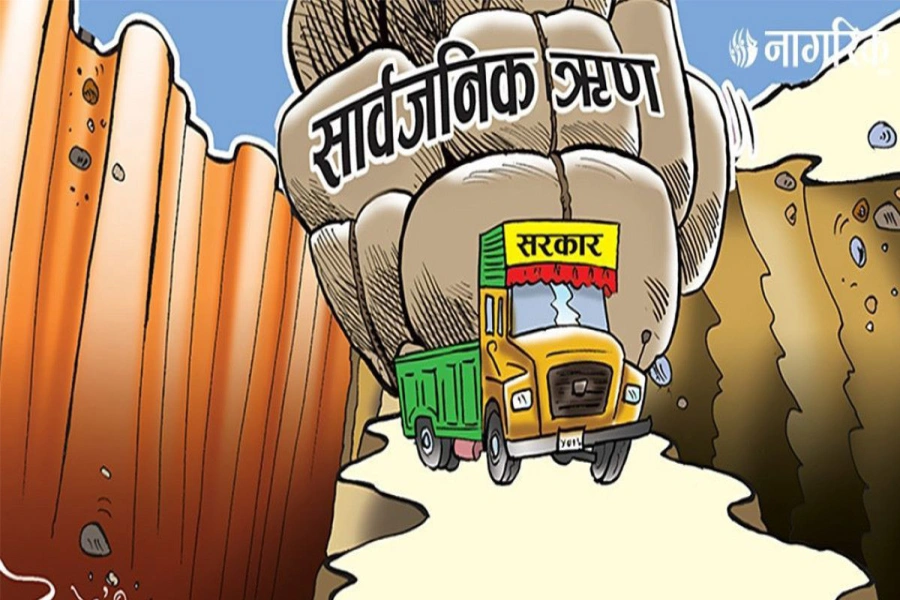
Public debt hits Rs 2.8 trillion mark
During my intervention in the session ‘Artificial Trust: Living, Loving, and Lying in the Age of AI,’ I observed an anxiety that transcends borders: the "Accountability Gap." In both the Bangladeshi and Nepali youth movements, social media acted as both a tool for liberation and a factory for deception. We are living in a paradox where we trust algorithms to manage our finances and social connections, yet we are increasingly alienated from the humans who design them. As I discussed with fellow panelists like Pyrou Chung and Tanha Kate, the ‘human-in-the-loop’ is vanishing from our governance.
In Nepal, as we move toward rapid digital governance, the risk is that we import black-box biases we cannot yet audit. Trust is the currency of the social contract; when AI is weaponized to scale deepfakes and disinformation, the “Lying” part of our session’s title does not just spread rumors; it bankrupts a government’s credibility. This digital gap is statistically stark: according to the 2024 UN E-Government Development Index (EGDI), while Bangladesh has climbed to a rank of 100th, Nepal continues to trail at 119th. This ‘readiness deficit’ means our technology adoption is outpacing our institutional ability to ensure digital accountability. For Gen Z activists in Kathmandu and Dhaka, the fight isn't just against bad policy, but against an ‘Architecture of Deception’ that makes truth a luxury.
2. The Financial Rupture: Debt as the New Diplomacy
The discourse on ‘Debt as Diplomacy’ was perhaps the most sobering. Panelists argued that sovereign debt has transitioned from a financial liability into a primary instrument of statecraft—a non-kinetic weapon. In a multipolar world, lending has become the new warfare; creditors no longer need to occupy territory if they can occupy a nation's budget through opaque, high-interest loans. For landlocked nations like Nepal, the Bay of Bengal is our gateway to the world, but if that gateway is built on hidden debt, our strategic autonomy is at risk.
The panel explored how ‘opaque bilateralism’ creates a Sovereignty Trap. We concluded that default is no longer just an economic failure; it is a calculated diplomatic lever used to realign a nation's foreign policy or secure strategic assets. The Gen Z protesters in our countries are inherently aware of this—they know they are inheriting a ledger of debt they did not sign. To put this in perspective, as of early 2026, Nepal’s debt-to-GDP ratio has reached approximately 46%, with the government projected to spend nearly 50% of its financial management budget solely on servicing principal and interest. This fiscal pressure directly crowds out vital social sector investment, a trend mirrored across the region, where Sri Lanka’s debt-to-GDP remains a cautionary tale at over 100%, while Bangladesh maintains a more resilient but pressured 39%.
3. The Human Rupture: Borders That Move
I had the honor of moderating the panel "Borders That Move: Migration, Morality, and the Politics of Compassion." This session represented the human heart of the conference. The map no longer tells the full story. Rivers shift, coastlines vanish, and people cross borders that politics refuses to redraw. Climate change, war, and hunger are creating a slow, relentless migration that no wall can stop and no bureaucracy can fully comprehend. Yet compassion remains trapped behind paperwork and fear.
Nations debate sovereignty while families search for safety. The panel—featuring Mustafa Osman Turan, James Angelus, Karori Singh, and Zuraida Binti Kamaruddin—concluded that the question is no longer who belongs where, but how we choose to define belonging itself. The scale of this challenge is immense: the World Bank’s Groundswell Report projects that by 2050, South Asia could see as many as 40.5 million internal climate migrants. For Nepal, this underscores that migration is no longer a simple economic choice but a survival imperative. In the age of moving borders, humanity, not geography, must decide who we are.
From Rupture to Realignment
The theme—Rivals, Ruptures, and Realignments—is the defining story of our decade. My observation is that while the ruptures are inevitable, the realignments are within our control. The youth movements in Bangladesh and Nepal have shown that the status quo is no longer acceptable. However, as the experts at BOBC warned, passion without policy is a recipe for further rupture.
We need strategic autonomy. We must balance our debt, audit our algorithms, and humanize our borders. I leave Dhaka with deep gratitude to the Centre for Governance Studies. By turning rupture into a conversation, they have given us the tools to build a more resilient reality. In an era of great power rivalry, our moral courage remains our greatest form of power.





-1200x560-1783083574.webp)




