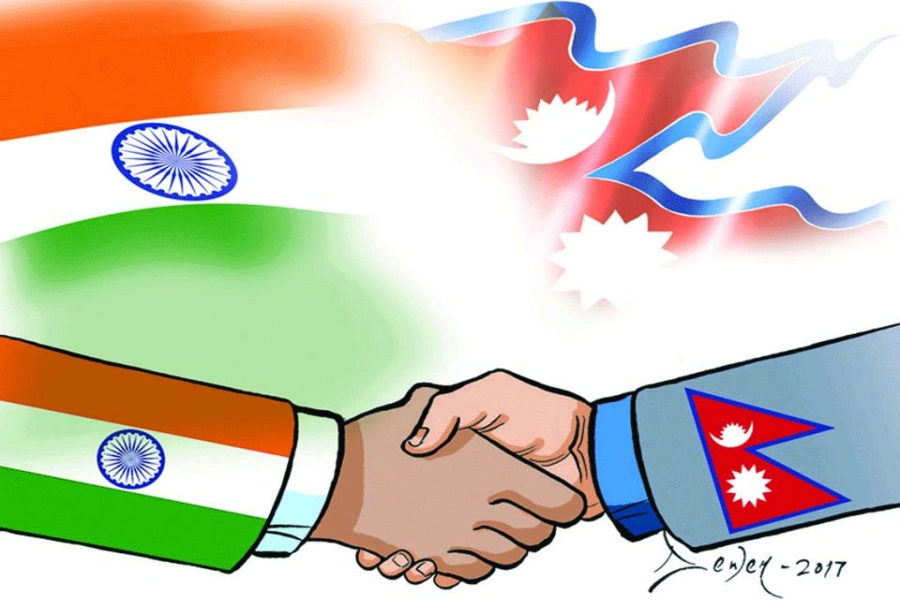
The latest diplomatic exchange between India and Nepal over the Lipulekh Pass and the Kailash Mansarovar Yatra route is a reminder of an enduring truth in South Asia: geography may divide, but history binds. The immediate trigger, Kathmandu’s objection to the use of Lipulekh for the pilgrimage and New Delhi’s firm rejection, has once again brought an old boundary dispute into contemporary focus.
Yet, to view this moment in isolation is to misunderstand the deeper nature of India Nepal relations. For all the periodic tensions over maps, treaties, and territorial interpretations, the relationship between the two countries is not defined by disputes. It is defined by civilisational continuity.
At the heart of the current disagreement lies the Lipulekh Pass, a strategically located Himalayan corridor that sits near the tri junction of India, Nepal, and China. Both sides have long standing claims rooted in differing interpretations of the 1816 Sugauli Treaty and the origin of the Kali River, which determines the boundary. The dispute itself is not new. What is new is the political attention it periodically attracts, often shaped by domestic pressures and evolving regional dynamics.
The immediate context, the Kailash Mansarovar Yatra, adds a layer of sensitivity. This pilgrimage is not merely a logistical or territorial issue. It is a sacred journey for millions across faiths. For decades, the Lipulekh route has served as one of the primary pathways for this spiritual odyssey, underscoring its long standing operational and cultural significance.
But here lies the critical point: neither India nor Nepal benefits from allowing such issues to escalate beyond diplomatic management. Both countries have repeatedly demonstrated that even their disagreements are framed within the language of dialogue. India, even while rejecting Nepal’s claims, has explicitly reiterated its openness to constructive interaction and resolution through diplomacy. This is not the rhetoric of confrontation. It is the grammar of coexistence.
Will Idris Elba be first black James Bond?

To understand why this matters, one must step back and consider the unique nature of India Nepal ties. Unlike most international relationships, this is not merely a state to state engagement. It is a people to people continuum. The open border between the two nations allows for the free movement of citizens. Families straddle both sides. Cultural practices overlap seamlessly. Religious circuits, from Janakpur to Varanasi, from Lumbini to Bodh Gaya, are shared spiritual geographies, not contested ones.
Indeed, few bilateral relationships in the world are as deeply embedded in everyday life. Millions of Nepali citizens live and work in India without visas. Gurkha soldiers serve in the Indian Army. Indian pilgrims travel through Nepal for sacred journeys. Trade, remittances, education, and healthcare flows are constant and deeply interlinked.
This is why periodic tensions, such as the Lipulekh dispute, rarely define the relationship in the long term. They are interruptions, not transformations.
History offers ample precedent. The 2020 map controversy, when Nepal released a new political map incorporating disputed territories, led to a sharp diplomatic exchange. Yet, within months, both sides resumed dialogue, restored engagement, and continued cooperation across sectors. Similarly, earlier disagreements over trade routes, infrastructure, and border management have been managed through negotiation rather than escalation.
The reason is simple: both India and Nepal recognise the asymmetry between the scale of their relationship and the scale of their disputes. The former is vast, multidimensional, and rooted in centuries of shared history. The latter, while important, is limited and resolvable.
Moreover, there is a growing strategic awareness in both capitals that cooperation is not optional. It is essential. Nepal’s economic development is closely linked to connectivity with India, while India’s regional stability depends on a stable and friendly Nepal. In an increasingly competitive geopolitical environment, neither country can afford prolonged friction.
There is also a deeper philosophical layer to this relationship, one that transcends policy and politics. India and Nepal are part of the same civilisational ecosystem shaped by shared epics, languages, traditions, and spiritual philosophies. The Himalayas, often seen as a boundary, are equally a bridge, a sacred landscape that connects rather than divides.
This is particularly relevant in the context of the Kailash Mansarovar Yatra. The journey itself symbolises transcendence, of physical hardship, of national borders, and of worldly divisions. It is, in many ways, a reminder that the subcontinent’s cultural unity predates and outlasts modern political boundaries.
None of this is to suggest that disputes like Lipulekh are trivial. They are not. Sovereignty, territorial integrity, and national sentiment are serious matters for both nations. But seriousness does not necessitate escalation. It necessitates patience, clarity, and sustained dialogue.
What is encouraging is that both India and Nepal have consistently chosen this path. Even in moments of disagreement, diplomatic channels remain open, engagement continues, and the larger relationship is preserved.
The road ahead, therefore, is not one of confrontation but of calibration. Boundary issues will need structured negotiations, historical clarity, and mutual sensitivity. But they will be resolved, not because they are easy, but because the relationship demands it.
Lipulekh is a reminder, not of division, but of the resilience of India Nepal ties. Borders may be debated, but bonds are not.
And in South Asia, where history often complicates politics, India and Nepal offer a rare counterpoint: a relationship where civilisation still has the final word.
The author is Editor at The Daily Milap, India