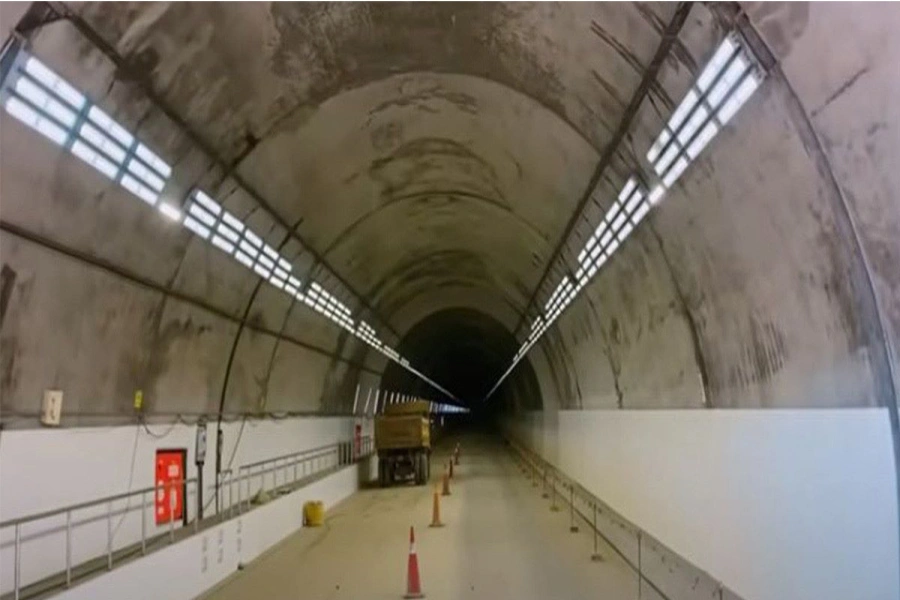
KATHMANDU, March 9: Among several international companies that submitted proposals to operate the Nagdhunga Tunnel, six Indian firms and one Chinese company have been shortlisted in the technical evaluation stage.
The Department of Roads (DoR) is preparing to bring the tunnel into commercial operation by mid-June, after selecting a service provider to manage and operate the project. Although construction is almost complete, the tunnel has yet to open due to various administrative and technical reasons.
According to Sanjay Panthi, deputy secretary at the Nagdhunga Tunnel Project, the final selection of the international company responsible for operation and management will be made on March 15. “We have already completed the technical evaluation,” Panthi said. “Seven companies have been shortlisted, and we plan to finalize the selection on March 15.”
Under Nepal’s legal provisions, the selected foreign company will be required to partner with a Nepali company before beginning operations. Panthi said that earlier six Chinese companies, three Indian companies, and one Turkish firm had submitted applications within the deadline to operate the tunnel, but the Turkish company was eliminated during the technical screening stage.
According to an engineer at the Ministry of Physical Infrastructure and Transport, once 90 percent of construction work on any physical structure is completed, it is generally considered finished. In the case of the Nagdhunga Tunnel, more than seven months have passed since 90 percent of the work was completed, yet it has still not come into operation. Construction of the tunnel began six years ago with the goal of reducing traffic congestion at Nagdhunga and making travel faster.
The government had earlier announced that the tunnel would be opened on a trial basis during the last Dashain. The ministry even promoted the plan publicly, but the tunnel could not be launched during the festival. Later, the government announced that the tunnel would start commercial operation on January 1 to coincide with the English New Year, but that plan also failed.
Another plan was to begin operation from the Nepali New Year 2083, but that timeline also appears unlikely. According to Panthi, even after the final company is selected on March 15, it will take at least one month to complete the formal process of assigning operational responsibilities. “Therefore, we are preparing to operate the tunnel commercially from mid-June,” he said.
Nagdhunga-Naubise tunnel route to undergo breakthrough tomorrow...

The process of selecting an international company to operate the tunnel has itself taken considerable time. The Department of Roads repeatedly extended the tender deadline, which alone took about four to five months. The final deadline was set for mid-January 2026, after earlier deadlines of December 17 and 31.
According to departmental sources, the Japan International Cooperation Agency (JICA)—which provided loan assistance for the project—had set conditions that Chinese companies should not be selected to operate the tunnel.
Despite that condition, six Chinese firms still appeared in the technical shortlist.
A senior official at the DoR said that the condition from JICA had initially created confusion regarding the selection of the service provider. The official also said JICA had advised the department not to select companies that had been blacklisted internationally.
“We are proceeding according to Nepal’s legal provisions,” the official said. “Ultimately, we must follow our own laws.”
To mobilize a service provider for the operation, management, and maintenance of the tunnel, the government approved a Tunnel Operation and Management Procedure last September.
A senior official at the infrastructure ministry said the delay also occurred because operating a road tunnel is a new experience for Nepal. “Now we have gained some experience. Future tunnel projects will not face such delays,” the official said.
Initially, officials at the Department of Roads believed the Kathmandu Road Division could manage the tunnel. However, they later realized that operating the tunnel would require at least 120 permanent staff, which is not possible with the current manpower of the department. Creating additional government positions would be complicated, making it more practical to assign operations to a private service provider.
Because the DoR has not yet been able to appoint an operating company, the Nagdhunga Tunnel has remained unopened even though more than 98 percent of construction work has been completed. Panthi said the project reached this stage about one and a half months ago, meaning construction itself is essentially finished.
Once operational, the tunnel will eliminate long traffic jams at Thankot–Nagdhunga, where vehicles currently wait for hours when entering or leaving Kathmandu. Vehicles using the tunnel will be able to cover the route in about 30 minutes.
The tunnel will also shorten the travel distance by around 2.5 kilometers. Currently, the distance between Balambu and Sisnekhola is about 7.5 km, but after the tunnel opens it will be reduced to five kilometers.
According to guidelines approved by the Council of Ministers, vehicles using the Nagdhunga–Sisneri tunnel will be charged tolls ranging from Rs 50 to Rs 500.
Officials say four-wheeler vehicles and larger trucks with up to 12–14 wheels will have to pay toll fees before entering the tunnel.
However, motorcycles and vehicles carrying flammable materials such as petrol or diesel will not be allowed to use the tunnel.
Under the proposed system, small vehicles will pay around Rs 50, buses Rs 200, and large trucks up to Rs 500. Separate charges may apply for vehicles that enter the tunnel and return through the same route.
The guidelines also outline detailed provisions regarding traffic flow inside the tunnel. The company responsible for collecting tolls will also have to manage facilities such as oxygen supply systems, fire control, security, and communication infrastructure inside the tunnel.
The service provider will also be responsible for electricity supply within the tunnel.
A ministry official said that because this is Nepal’s first road tunnel, drafting the legal and operational framework took time. “We are learning from this experience,” the official said. “Future projects will be easier to implement.”