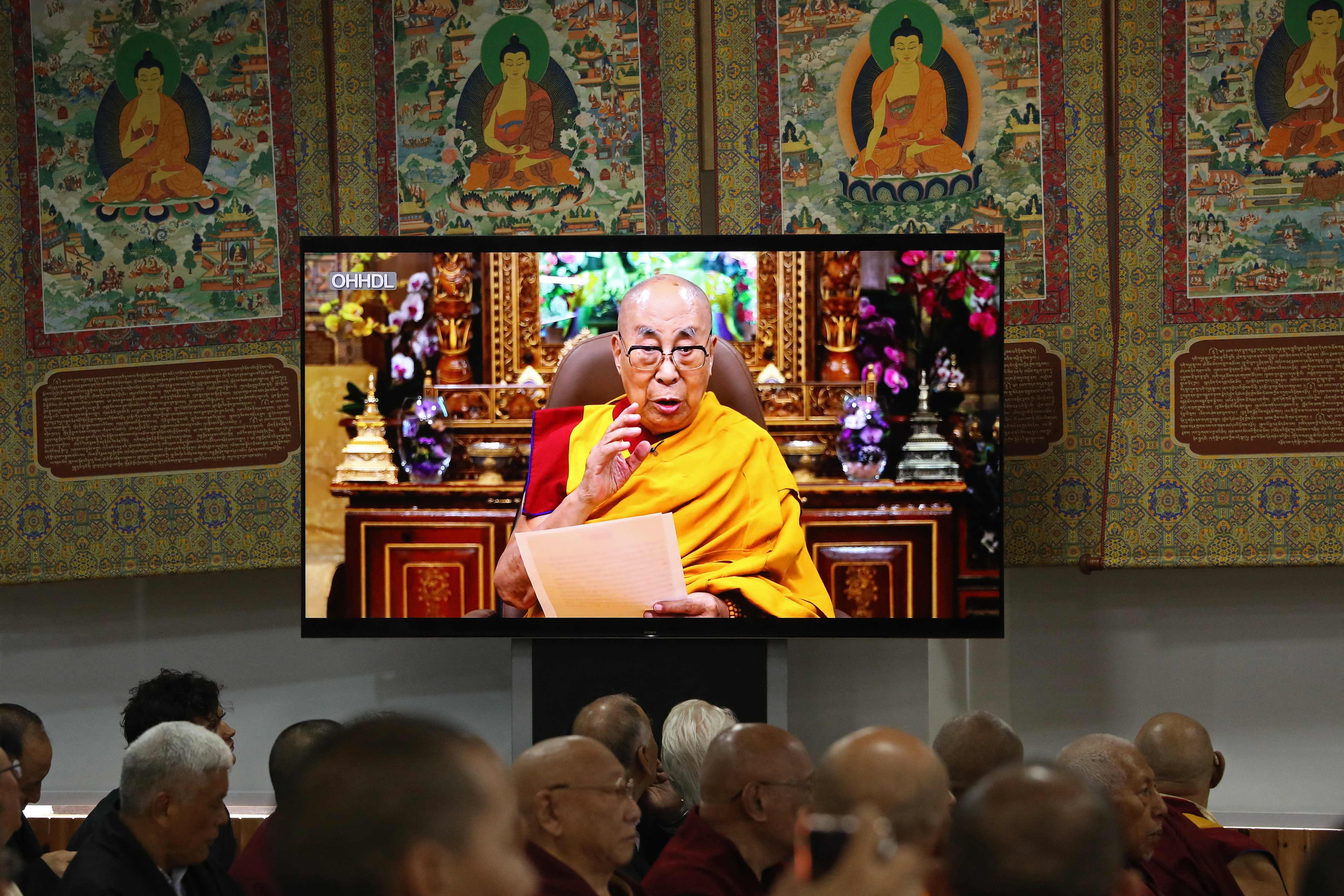
KATHMANDU, July 10: What began as a religious celebration has rapidly snowballed into one of Nepal's most contentious diplomatic controversies in recent years, with the 91st birthday celebration of the 14th Dalai Lama igniting a fierce political debate and raising questions about the country's commitment to its long-standing One China policy.
The event, organized by Tibetan refugees and Buddhist followers at Namgyal School in Nagarjun Municipality-2 on July 6, has become the center of an escalating political storm after ambassadors and senior diplomats from several Western countries attended the celebration.
Their presence has sparked intense criticism from former diplomats, opposition leaders and left-wing politicians, who argue that the event risks straining Nepal's delicate relationship with China and undermining its carefully balanced non-aligned foreign policy.
Former Prime Minister and senior Nepali Communist Party (NCP) leader Jhala Nath Khanal strongly condemned the government's decision to allow the celebration, calling it an "anti-national" act that could seriously damage Nepal-China relations.
In a statement, Khanal specifically objected to the participation of ambassadors from the United States, France, Australia and the European Union, describing their attendance as a matter of grave diplomatic concern.
The controversy also dominated Thursday's meeting of the House of Representatives.
NCP lawmaker Pramesh Kumar Hamal demanded an official clarification from the government regarding both the event at Namgyal School and the involvement of foreign diplomats.
MoFA expresses concern over foreign diplomats' attendance at Da...

Addressing Parliament, he questioned whether the government had considered the possible consequences for Nepal-China relations, whether Nepal had deviated from its One China policy and non-aligned foreign policy, and whether the incident had any connection with the TOB.
Adding to the criticism, CPN-UML Chief Whip Ain Bahadur Mahar launched a scathing attack in Parliament, arguing that permitting the birthday celebration of the Dalai Lama—who has lived in exile from Tibet since 1959—was unprecedented in Nepal's history and reflected diplomatic immaturity.
He said the decision ran contrary to Nepal's national interests and could jeopardize ties with its northern neighbour. Mahar further alleged that the presence of ambassadors from the United States, France, Australia and the European Union reflected an attempt by Western powers to turn Nepal into an anti-China platform, warning lawmakers that "neighbors are not toys" and the issue must be treated with utmost seriousness.
Former Foreign Minister and NCP leader Narayan Kaji Shrestha also voiced concern through social media, saying suspicions were growing that the present government was gradually aligning itself with the strategic interests of global powers.
He noted that speculation was already circulating that the next successor to the Dalai Lama could be announced from Nepal. According to Shrestha, a congratulatory message reportedly sent by the Dalai Lama's office to the rumored Sushila Karki-led interim government and the current Balendra Shah government, together with the government's formal approval for the birthday celebration, could not be dismissed as routine events.
He warned that any practical departure from Nepal's established foreign policy would place the country's sovereignty at risk and invite strong resistance from patriotic citizens.
Adding diplomatic weight to the criticism, seven former Nepali ambassadors to China—Rajeshwar Acharya, Mahendra Pandey, Tanka Karki, Mahesh Maskey, Leelamani Paudyal, Bishnu Pukar Shrestha and Krishna Prasad Oli—issued a joint statement expressing serious concern over the incident.
They said the event contradicted Nepal's longstanding commitment not to allow its territory to be used for activities directed against friendly neighbouring countries, particularly China.
The former ambassadors questioned how a commitment that had been reaffirmed only recently during Foreign Minister Shishir Khanal's official visit to China could apparently be undermined so soon. They warned that such developments could weaken Nepal's geopolitical balance, diplomatic credibility and long-held independent foreign policy.
The controversy comes against the backdrop of Beijing's longstanding position that the Dalai Lama is not merely a religious figure but a political separatist seeking Tibetan independence. China has consistently regarded anti-China or "Free Tibet" activities in Nepal as a diplomatic red line.
Diplomatic observers say that although the Chinese Embassy has yet to issue an official public response, Nepal's Ministry of Foreign Affairs will likely face increasing pressure to clarify the government's position.
The sensitivities surrounding the issue are rooted in decades of history.
The 14th Dalai Lama fled Lhasa on March 17, 1959, following a failed uprising against Chinese rule and crossed the Himalayas into India on March 31 that year. Earlier, in 1956, as Nepal and China formalized diplomatic relations, Nepal officially recognized Tibet as an integral part of China, laying the foundation for its commitment not to allow its territory to be used against its neighbours.
Despite that commitment, Tibetan Khampa rebels, backed financially and militarily by the US Central Intelligence Agency (CIA), launched armed resistance against China from Nepal's Mustang region during the 1960s.
In 1974, acting under the direction of the late King Birendra, the Nepali Army carried out a major operation in Mustang, disarmed the Khampa rebels and forced their surrender—effectively ending organized armed Tibetan resistance from Nepali territory.
In the years that followed, Nepal gradually tightened restrictions on Tibetan political activities. The government stopped issuing refugee identity cards to newly arriving Tibetans in 1989. In 2005, under Chinese pressure, authorities shut down the Dalai Lama's official contact office—the Tibet Office—in Kathmandu.
Following widespread Free Tibet protests and self-immolation attempts by Tibetan refugees ahead of the 2008 Beijing Olympics, Nepal imposed sweeping restrictions on anti-China political activities, banning rallies, demonstrations and other forms of political activism linked to Tibet.
Although Nepal's policy of restricting anti-China activities dates back to agreements reached in the 1950s and military action in 1974, the country's most stringent administrative and security measures against Tibetan political activities have remained in force since 2008.