LAHAN, Feb 28: Madhesh Province, long regarded as a politically vibrant and strategically significant electoral battleground, is witnessing a fascinating shift in voter mood. While political enthusiasm is still visible on social media and in campaign rallies, established political forces are now working harder to translate online support and early excitement into real votes on the ground.
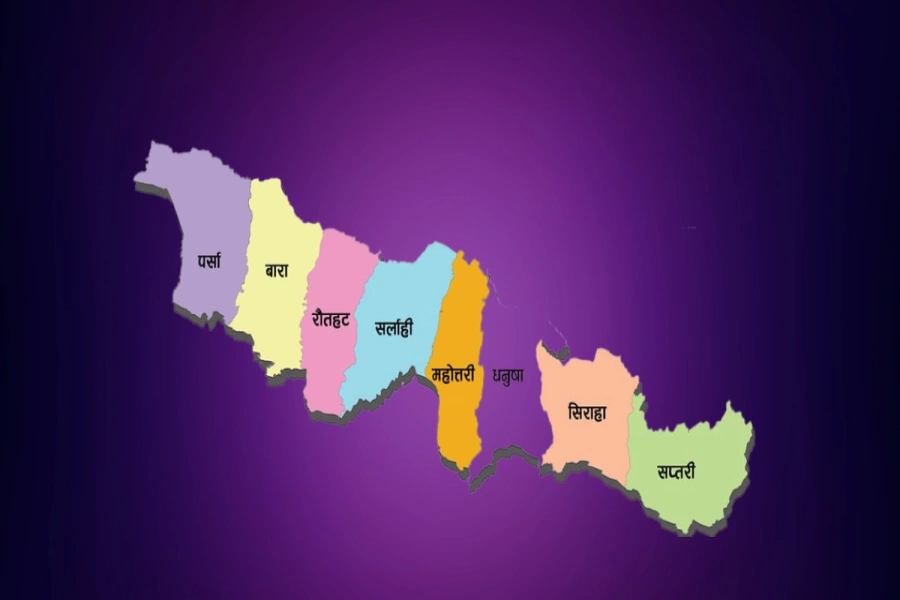
Madhesh Province has 32 parliamentary constituencies across its eight districts, with 1,054 candidates competing for the 32 seats. Dhanusha district leads with the highest number of candidates at 154, while another constituency has the lowest number of 104 candidates.
Since the Madhesh movement of 2007, the province has largely been considered a stronghold of Madhes-based political parties. However, in the upcoming House of Representatives (HoR) election scheduled for March 5, major national parties — including the Nepali Congress (NC), CPN-UML, Nepali Communist Party (NCP), and Rastriya Swatantra Party (RSP) — have intensified their campaigns to reduce the dominance of regional parties and expand their political reach. As a result, this election in Madhesh is being closely watched at the national level.
To strengthen its political presence in Madhesh, NC President Gagan Kumar Thapa has left Kathmandu Constituency–4 and is contesting from Sarlahi–4, where his party has projected him as a future prime ministerial candidate. Similarly, NCP leader Narayan Kaji Shrestha, who previously contested from hill districts, is now running from Sarlahi–3, signaling a strategic shift toward Madhesh politics.
Key contenders and political drama
Janata Samajbadi Party (JSP) Nepal chair Upendra Yadav is contesting from Saptari–3 this time. Yadav had lost from Saptari–2 in the 2022 election but later entered parliament through a by-election victory from Bara–2.
Interestingly, CK Raut, chair of the Janamat Party, who defeated Yadav in the previous election from Saptari–2, is again competing from the same constituency. Adding to the political drama, Satish Singh — who was once installed as Madhesh Province’s chief minister with Raut’s strong political backing — has now left the Janamat Party and is contesting from Saptari–2 under the Swabhiman Party banner. Singh, who was elected as a provincial assembly member from Saptari–2 (1) in the previous election, resigned from his parliamentary position to directly challenge Raut.
Meanwhile, JSP Nepal Vice-Chair and former minister Raj Kishor Yadav has returned to his former constituency Siraha–4 after previously winning from Siraha–2.
Bablu Gupta, who rose to prominence after the Gen-Z protests and later became Youth and Sports Minister, resigned from his ministerial post to contest from Siraha–1 under the Rastriya Swatantra Party (RSP).
11 licensed firearms submitted in Chitwan
From the CPN-UML, senior leader and Deputy General Secretary Raghubir Mahaseth is contesting from Dhanusha–4, while his wife Juli Kumari Mahato is contesting from Dhanusha–3. In Dhanusha–3, veteran NC leader Bimlendra Nidhi and RSP spokesperson Manish Jha are also in the race, making the contest highly competitive.
CPN leader Matrika Prasad Yadav is contesting from Dhanusha–1, the same constituency where he previously lost to JSP Nepal leader Deepak Karki in the 2022 elections.
Former Minister Saratsingh Bhandari is contesting from Mahottari–2, while former minister Girirajmani Pokharel is contesting from Mahottari–1.
Rastriya Mukti Party Nepal Chair Rajendra Mahato and CPN leader Mahendra Raya Yadav are contesting from Sarlahi–2, while senior CPN leader Narayan Kaji Shrestha is again in the race from Sarlahi–3.
Another high-profile constituency is Sarlahi–4, where NC has fielded its president and projected future prime ministerial candidate Gagan Kumar Thapa. In the same constituency, former NC leader Amresh Kumar Singh is contesting from RSP after winning the previous election as an independent candidate.
Rautahat–1 is also attracting attention, where CPN co-chair and former Prime Minister Madhav Kumar Nepal is contesting. In Rautahat–3, Prabhu Sah is running from the Aam Janata Party, while journalist-turned-politician Rishi Dhamala is contesting from Rautahat–4 along with NC candidate Dev Prasad Timsina, a two-time elected representative.
NC Joint General Secretary Farmullah Mansoor is contesting from Bara–3. JSP Nepal leader Pradeep Yadav, previously a stronghold winner from Parsa–1, has switched parties and is now contesting from CPN-UML. In Parsa–2, NC has fielded former minister Ajay Chaurasiya again.
Election psychology and changing voting trends
Political competition in Madhesh is becoming more dynamic due to the presence of established leaders, celebrity candidates, and emerging political forces. Campaign activities across districts have intensified, with candidates conducting door-to-door visits, public meetings, and strategic networking to win voter confidence. From roadside tea shops to social media platforms, election discussions are dominating daily conversations.
Like other parts of the country, voters in Madhesh are debating the strengths and weaknesses of both new and traditional political parties. New parties initially gained popularity by accusing traditional parties of corruption, poor governance, and factional politics. However, the early enthusiasm for new political forces appears to be gradually fading.
As traditional parties strengthen their grassroots organizational structures and intensify local campaigning, it has become more difficult for new parties to convert online popularity into real votes. Political analysts believe that while social media trends may influence urban voters, their impact is gradually weakening in rural areas.
Political analyst Chandra Kishore said that the excitement surrounding new political forces is gradually cooling down. He explained that voting behavior is ultimately shaped by party organization, candidate reputation, personal relationships, and local issues rather than social media popularity. “The campaign atmosphere changes as election day approaches. The picture seen during early campaigning is often not the same when voters finally cast their ballots,” he said.
Social, economic and cultural voting patterns
Elections are not only about choosing representatives but also reflect broader social inequalities. Voting patterns often reveal disparities between rich and poor, urban and rural populations, and educated and less-educated communities. Candidates with stronger financial resources often gain advantages through extensive campaign networks and media outreach.
In Madhesh, elections are strongly influenced by caste, identity, and financial power. In many cases, voters prefer candidates who represent their own community or identity group rather than focusing on policy agendas. In recent years, identity-based politics and financial influence have often overshadowed policy-based political debates.
Voting behavior is also closely tied to local culture, social norms, and traditional authority structures. In some communities, opinions of elders, religious leaders, and community figures strongly influence voting decisions. In Madheshi society, collective identity often takes precedence over individual political preferences.
Swing voters usually feel more secure choosing candidates who represent their social groups. Class background and economic status also shape political ideology. Family political traditions and peer influence also play a role in shaping voter psychology.
Money, access to power, and muscle strength are also reported to influence elections in Madhesh. Swing votes are often influenced by cash, goods, or promises of personal assistance.
Digital politics and algorithmic influence
This election is also witnessing a major shift from physical campaigning to digital influence. Popular sentiment and voter emotions are increasingly being targeted through social media platforms, which have become powerful tools for shaping political narratives.
Digital manipulation and image management have emerged as major political strategies. Traditional politics based on ideology, sacrifice, and party loyalty is increasingly being replaced by social media-driven branding and viral culture.
Earlier elections were dominated by ideological debates, political history, and philosophical campaigning. This time, however, social media algorithms are presenting candidates more like products and political brands.
Candidates’ symbolic images are being shaped by Facebook Live sessions, visual storytelling, and viral content. Social media trends are increasingly influencing campaign agendas. Short videos, TikTok-style clips, and reels are gradually overshadowing policy debates, development plans, and governance issues.
Political analyst Khushilal Mandal argues that voters should avoid being misled by algorithm-driven narratives. He stressed that only politics based on candidate character, clear policy agendas, and social awareness can truly strengthen democratic progress.