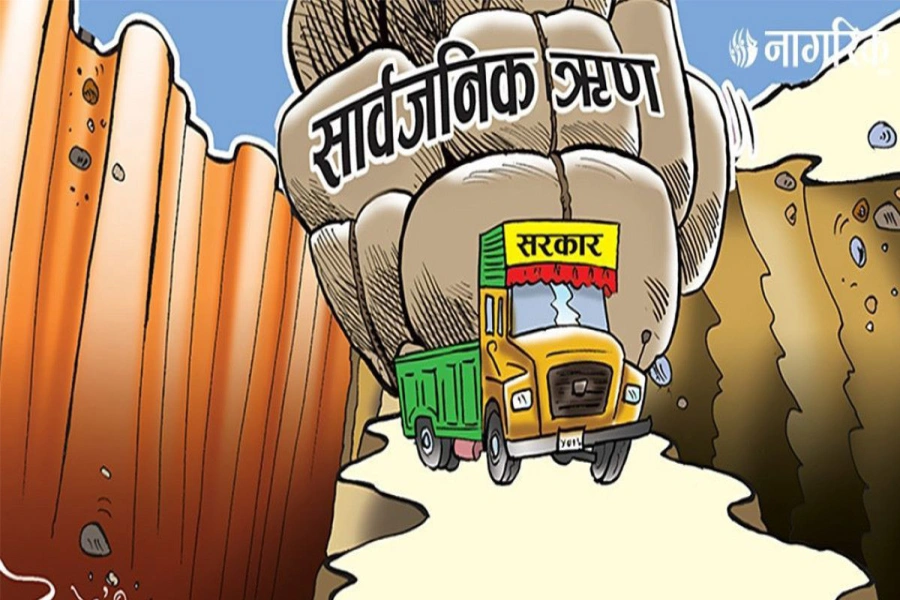
Every government in Nepal is heavily reliant on public debt to construct mega projects such as airports, water supply systems, electric grids, dams, subways, bridges, sewerage systems, and railroads, as these are seen as the sole responsibility of the government. The private sector and multinational companies remain less involved in these areas, citing the lack of a supportive environment for investment in such infrastructure projects.
Under these circumstances, the government is compelled to mobilize huge resources to build these infrastructures. However, its revenue collection capacity is insufficient even to meet recurrent expenditures, forcing dependence on public debt not only for infrastructure construction but also for repayment of existing debt, interest, and other expenditures not covered by domestic revenue.
Nepal’s public debt has surged to Rs 2.961 trillion in the first 11 months of fiscal year 2025–26, equivalent to 44.87 percent of the country’s gross domestic product (GDP), according to the Public Debt Management Office (PDMO). Of the total, foreign debt accounts for 53.49 percent, while domestic debt makes up 46.51 percent. Most countries follow the principle of debt-to-GDP ratio, with many trying to keep debt below GDP, while some have surpassed it. Developed countries usually have higher public debt ratios than their GDP, with the USA and Japan being examples.
Some economists believe that setting a maximum debt-to-GDP ratio helps keep the economy safe, while others argue there is no hard and fast rule. They contend that the benefits of public debt depend on its productive use, increased output, higher government revenue, and timely repayment capacity. Otherwise, debt can be risky for a nation regardless of fixed ratios.
Take prudent measures to curb public debt

As Nepal’s debt management capacity remains weak, it must carefully balance opportunities, costs, and risks of borrowing. Nepal’s debt-to-GDP ratio cannot be considered low compared to the economic returns from debt. The reality is that Nepal rarely conducts serious analysis of whether programs and projects financed through debt—both external and internal—deliver acceptable results, or whether debt is simply piling up without meaningful transformation or repayment capacity.
Given the heavy reliance on public debt, Nepal urgently needs to attract foreign direct investment (FDI) and private investment for major infrastructure projects instead of depending solely on debt. Otherwise, excessive reliance on debt for mega projects could derail the economy in unexpected ways in the future.
The Government of Nepal has established an Investment Board to improve the investment process, with specialized technical committees tasked with preparing concrete proposals and strategies to attract investment. Projects have been prepared in areas such as roads and tunnels, international airports, bus rapid transit, expressways, cable cars, metro rail, hydropower, international convention centers, and integrated agriculture infrastructure. The Investment Board organized three investment summits in 2017, 2019, and 2024, showcasing finalized projects and securing billions of rupees in commitments. However, none of these projects have been implemented to date.
The reluctance of donors to invest highlights Nepal’s lack of an investment-friendly environment. According to investors, Nepal still suffers from political and economic instability despite considerable potential. They argue Nepal is suitable only for those willing to accept the inherent risks and unpredictability of doing business, with resilience and a long-term mindset. Corruption, restrictive laws on foreign banks, challenges in profit repatriation, and controlled currency exchange remain major obstacles. Nepal’s ease of doing business ranking is still low, and severe bureaucratic red tape along with the absence of a one-door system discourage investment in large projects.
To make planned investments successful, Nepal must improve its business climate by enacting laws that support risk-taking in investment. The private sector should also be strengthened to support multinational companies. Additionally, reforms in human capital development, education quality, labor markets, and investment laws are urgently needed.
Multinational enterprises (MNEs) employ strategic investment models to build and finance mega projects, managing the high operational and financial risks inherent in infrastructure, energy, and advanced manufacturing. Nepal’s advantages include a young population, cheap labor, and satisfactory sovereign credit ratings. The government must seriously invite large multinationals to invest in infrastructure, while seeking policy advice and technical assistance from experts and multilateral agencies to support and regulate them effectively.
The government should also clarify investment and financing modalities for investors. Several models are available. One is the BOOT (Build, Own, Operate, Transfer) model, in which a private company or multinational finances, builds, owns, and operates a project for a set period before transferring it back to the government. Another is the Public-Private Partnership (PPP) model, which involves collaboration between multinational enterprises (MNEs) and host governments. In this arrangement, the MNE finances, builds, and often operates the facility, while the government provides land, regulatory backing, and sometimes revenue guarantees. A further option is the Joint Ventures (JVs) and Consortia model, where MNEs partner with host-country firms or other multinationals to pool capital, share risks, and gain localized market expertise.
FDI increases capital flow, reducing the government’s debt burden. It creates jobs, mobilizes private capital, and helps reduce poverty. It also enables access to new markets, technology transfer, and expansion of local businesses. Overall, FDI supports economic development, trade balance, and payment balance, making the nation more prosperous and developed.
Finally, under its hundred-day governance reform action plan, the Government of Nepal has outlined measures to make infrastructure development more efficient, manageable, and investment-friendly. Investment modalities for all projects under the National Highways Project and the Investment Board will be mandatory. A National Structured Project Pipeline (NSPP) document will be prepared, outlining operational frameworks, risk-sharing, implementation, and timelines for projects under government funding, PPPs, private investment, or ministerial investment. A One-Door Approval System will be established to provide unified services to domestic and foreign investors within a specified timeframe. Additionally, the “Private Sector Protection and Promotion Scheme (PSPP)” will be implemented immediately after approval.