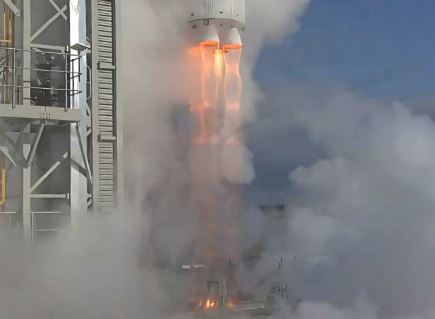
KOUROU, Sept 15: The European Space Agency has successfully put into orbit two satellites designed to better detect extreme weather events linked to climate change, officials said.
The European Vega-C rocket successfully launched the Sentinel-3C and Flex satellites after lifting off from the Kourou space center in French Guiana at 10:21 pm Monday (0121 GMT Tuesday), according to an AFP journalist on the scene.
India launches more than 100 satellites into orbit

The two satellites were placed into a sun-synchronous orbit nearly two hours after liftoff.
The first satellite, Flex (Fluorescence Explorer), will provide data on the impact of heatwaves on plant matter.
It will monitor fluorescence, the red light emitted by plants when they carry out photosynthesis, aiming to establish the link between "plant stress and fluorescence" and to "quantify it", head of the Flex program Thierry Huiban told AFP at Thales Alenia Space in April.
The second satellite, the Sentinel-3C from the European Union's Copernicus Earth observation program, will measure the marine environment -- including temperature, wave height and ocean currents -- as well as land use and land cover, aiming to optimise yields to prevent food crises.
Such missions are "essential" in helping with the "climate change we are experiencing", said Simonetta Cheli, Director of Earth Observation Programmes at the European Space Agency (ESA), speaking from Kourou.