KATHMANDU, April 25: Nepal Republic Media (NRM), the publisher of Nagarik Daily and Republica, has conferred the ‘Nagarik Nayak–2083 BS’ award on former prime minister and former chief justice Sushila Karki on the occasion of its 17th anniversary.
Born in August 1947 in Shankharapur, Morang, Karki is Nepal’s first female chief justice. She holds a Master’s degree in Law from Tribhuvan University and also studied Political Science in India. Beginning her legal career as an advocate in 1991, she rose to become Chief Justice in April 2016.
Widely known for her integrity and assertiveness, Karki built a reputation as a strong anti-corruption voice. Her public life later took an extraordinary turn when, in the aftermath of the 2025 Gen Z uprising, she was appointed prime minister to lead the country through a period of deep political crisis.
Her tenure followed a violent wave of protests that resulted in dozens of deaths and widespread destruction of state and private property. Amid a leadership vacuum and growing instability, Karki emerged as a consensus figure, backed by political leaders, state institutions and sections of the public.
Nagarik journo Neupane gets ICT media award

She assumed office on September 12, 2025, at a time when key state institutions had been attacked and public trust had eroded. Her leadership was widely seen as a stabilising force, culminating in the successful conduct of general elections on March 5, 2026, which proceeded peacefully.
Karki’s journey—from the judiciary to crisis-era political leadership—marks a rare trajectory in Nepal’s public life. Reflecting on her experience, she has said that a sense of responsibility, particularly toward women who looked up to her, compelled her to remain in office despite immense pressure.
Her tenure, though brief, is regarded as a defining chapter in Nepal’s recent democratic history.
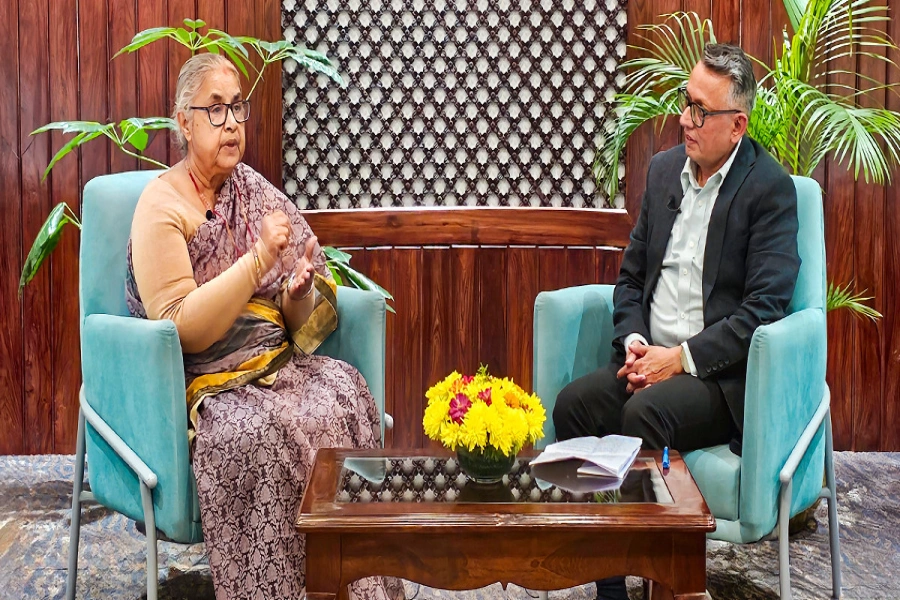
In an interaction with NRM’s Sambridhi Gyawali during the felicitation event, Karki said her government delivered tangible results, particularly in ensuring the successful conduct of elections despite threats and challenges.
She stressed that corruption in Nepal can be significantly reduced if those in leadership positions refrain from engaging in it. “People no longer trust that appointments can be made without money changing hands,” she said, noting that corruption exists across sectors. “But what is the point of amassing wealth through bribes? It does not ensure a good future. It must be stopped.”
Karki also said it was too early to comment on the performance of the current government led by Balendra Shah.
Also addressing the event, NRM Chairperson Shova Gyawali highlighted the broader role of media, stating that it is not merely a tool for information dissemination but a force that shapes society, builds trust, and amplifies the voice of the people.
NRM also marked the occasion with a special anniversary supplement, focusing on Nepal’s journey toward peace following successive political transformations. Editor-in-Chief of Nagarik Daily, Guna Raj Luitel, said the publication aimed to reflect on how the country achieved stability after years of upheaval beginning from the movement to abolish Rana oligarchy to the recent Gen Z protest that ousted the two-third majority government led by CPN-UML Chairman K P Sharma Oli.