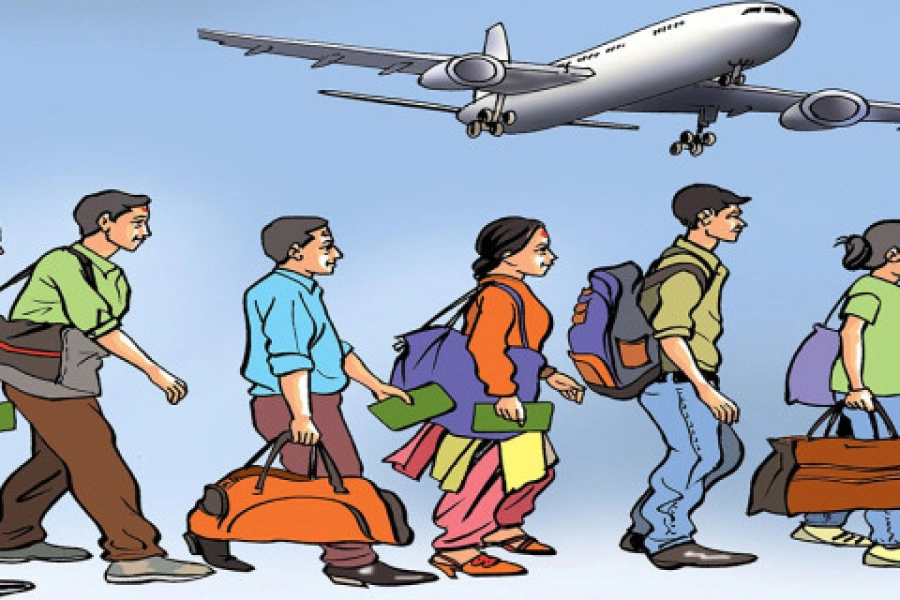
KATHMANDU, May 1: Governments may change, but the destination of Nepali youths remains the same—abroad. With fading hope for opportunities at home, the outflow of young workers shows little sign of slowing.
According to the Department of Foreign Employment (DoFE), as many as 62,265 Nepalis left for overseas jobs between March 25 and April 26. Of them, 55,272 were men and 6,993 were women, all departing with labor approval. On average, 60,000 to 65,000 Nepalis continue to leave the country each month in search of work.
Even a temporary halt on labor approvals for 12 Gulf and West Asian countries—from March 1 to April 20—amid regional tensions failed to significantly dent the numbers. The trend points to a deeper, structural problem rather than a short-term disruption.
Youths call for changes in education policy and curriculum to s...

DoFE data show that in the first nine months (mid-July to mid-April) of the current fiscal year 2025/26, a total of 587,340 Nepalis obtained labor permits for foreign employment. Among them, 517,936 were men and 69,404 were women—further underlining the enduring pull of overseas jobs.
The monthly trend also tells a familiar story. November recorded the highest number of labor approvals at 73,094, while February saw the lowest at 52,944. The post-festival rush in November typically drives a spike, as many head abroad soon after major holidays.
Despite the formation of a new government, the daily outflow remains steady. On average, around 2,075 Nepalis leave the country each day for foreign employment—close to last fiscal year’s daily average of 2,299—highlighting Nepal’s continued dependence on external labor markets.
Pitambar Ghimire, spokesperson for the Ministry of Labour, Employment and Social Security, says the trend is largely driven by limited prospects at home. “Industries are largely inactive, and many who want to start businesses lack the capital,” he said. He also pointed to global factors, noting that tensions such as those between Iran and the United States have affected labor demand.
“Conflicts in West Asia disrupted the global labor market, and some destination countries temporarily halted recruitment,” Ghimire said. “Now that hiring has resumed in most countries, the number of outgoing workers is expected to rise again.”
The Ministry of Finance has repeatedly stressed the need to create sufficient domestic employment to curb forced migration. Yet, progress remains slow.
Labor and migration expert Rameshwar Nepal says the new government has yet to outline a concrete strategy to reduce reliance on foreign employment. “Despite the change in government, there has been no clear plan to bring down the number of youths leaving for foreign jobs,” he said, adding that the persistent outflow reflects weakening public trust in the state.
While the government continues to promise reform and good governance, tangible steps to generate jobs at home remain elusive. Until the domestic job market expands meaningfully, Nepali youths are likely to keep looking beyond the country’s borders for their future.