

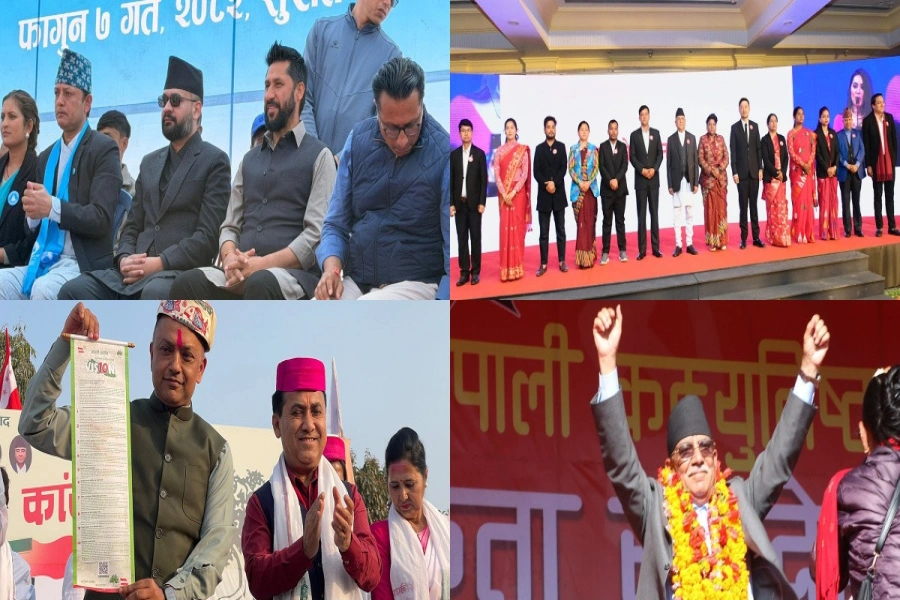
KATHMANDU, Feb 20: In the manifestos of political parties publicly released ahead of the March 5 House of Representatives (HoR) snap polls, health insurance and prosperous health services have emerged as common issues. Mainly, major political parties, including Nepali Communist Party (NCP), CPN-UML, Nepali Congress (NC), Rastriya Swatantra Party (RSP), have promised to enhance the quality of health services in their manifestos.
The UML, while releasing its manifesto on Thursday, announced that it will address financial and administrative issues in health insurance to provide accessible services to citizens, complete the construction of basic hospitals, further strengthen them, and provide international-level health services.
It plans to implement evidence-based prioritization of basic health services and offer free health services through local authorities, remove financial burdens caused by overlapping systems in the health sector, integrate social security programs with health insurance, ensure universal health coverage, expand health insurance coverage to make the system sustainable, and clarify the definition, package, responsibilities, and financial management of primary health services in law.
Additionally, the party has promised to ensure that every primary health center has at least one nurse and one MDGP doctor, with pharmacy and nursing services available. Specialized services will be developed based on referral systems, and district hospitals will be upgraded. It also includes regulating private hospital fees, implementing preventive programs to reduce disease burden, improving yoga, meditation, and Ayurvedic medical systems, and reviewing and removing ineffective programs.
Insurance authority issues directives on monetary loss insuranc...

The UML manifesto also includes some immediately actionable programs. These include providing five lakh worth of free insurance for pregnant women, Rs 20,000 maternity nutrition allowance, doubling the postnatal home visit allowance, and integrating citizens into contribution-based social security systems.
The NC has also released its pledge, announcing future health programs and envisioning a system where the state takes full responsibility for a developed-country-level health insurance system. The pledge covers citizens from pregnancy to old age, ensuring state responsibility and sensitivity toward health. It also addresses concerns about treatment and hospital fees, aiming to relieve citizens from fear regarding medical care.
The NCP has emphasized health services as a fundamental citizen right, promising that the state will provide medicines and hospital care to every citizen. It plans to make health insurance mandatory and progressive, increasing the current coverage of approximately 305 limited health insurance programs to 100% by 2088 BS. Premiums for disabled, chronically ill, and senior citizens will be covered by the state transparently and effectively.
Each ward will deploy mid-level health teams, provide free health check-ups for youths going abroad, seniors, the disabled, pregnant women, newborns, and underprivileged populations, and offer lifestyle counseling and preventive services. Priority will be given through a green channel.
Mental health services will be integrated with basic health services, expanded to village levels, and a psychosocial counseling helpline will be established. Specialized and referral hospitals will be set up in all seven provinces to prevent patients from having to travel to the capital unnecessarily.
Preventive measures such as physical exercise, yoga, meditation, and nutritious food promotion will be prioritized. Centralized frameworks and government procurement systems will be applied to eliminate irregularities in medicine purchases. The capacities of Nepal Pharmaceuticals Limited and Singha Durbar Hospital will be enhanced.
The RSP announced health programs in its manifesto. It plans to develop basic health services uniformly nationwide, strengthen health services in remote areas, integrate mental health programs in schools, communities, and health institutions, provide free treatment for patients with specific injuries, and establish specialist hospitals for burn victims.
It will also set up a Mental Health Directorate, provide quality integrated services for persons with disabilities, reduce the individual and family burden caused by disabilities, offer modern equipment for early identification of autism and hearing impairment in children, focus on vector control and housing to prevent insect-borne diseases, expand mental health access, and prioritize preventive over curative programs for diseases like cancer.











