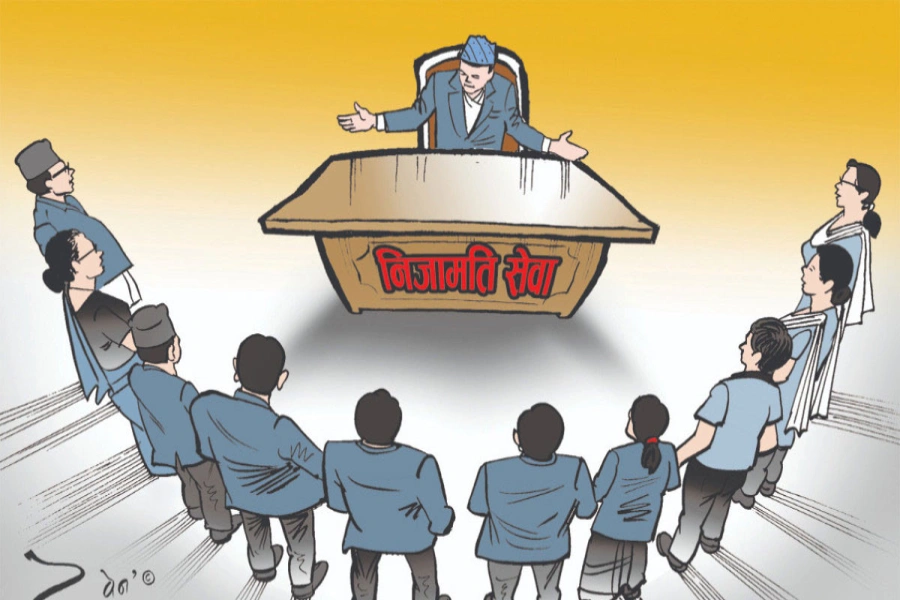
KATHMANDU, April 30: The government has released a draft of the Federal Civil Service Act, introducing sweeping reforms in the civil service system, including stricter rules on trade union activities among government employees.
The draft bill has been opened for public suggestions until Friday. According to the Ministry of Federal Affairs and General Administration Information Officer Bibek Ghimire, more than 6,000 suggestions have already been received, with a large number focusing on the retirement age of civil servants.
The proposed legislation introduces several major changes. One of the key provisions makes service in remote areas and local governments mandatory for promotion. Under the draft, employees who do not serve in such postings will not be eligible for promotion.
The bill also revises entry age limits for civil service. The proposed ceiling is 35 years for women, 32 years for men, and 39 years for persons with disabilities. Under the existing law, the entry age limit is 35 years for men and 40 years for women.
The draft retains the cooling-off period, preventing retired civil servants from taking new government appointments for two years after retirement.
It also proposes the formation of a Civil Service Board under the chairmanship of the Chief Secretary, which will handle employee grievances and related decisions.
Bill bars local units from recruiting civil servants

Voluntary retirement at 55
The draft allows civil servants aged 55 years and above to opt for voluntary retirement. It further provides that such employees may receive up to five additional years of service (not exceeding 60 years) for pension eligibility purposes.
Employees in redundant or no-longer-required positions may also be offered voluntary retirement under special conditions to be published in the Nepal Gazette.
The mandatory retirement age has been increased from 58 to 60 years, which will be implemented in two phases—first to 59 years and then to 60 years.
New 14-level structure
The draft introduces a 14-level hierarchy in the civil service. The Chief Secretary will be placed at Level 14, the highest position, while the Secretary will be at Level 13. Joint Secretaries (Gazetted First Class) will fall under Levels 11 and 12.
Similarly, non-gazetted employees will be placed in the lower levels. Office assistants and drivers will fall under Levels 1 to 3. Section Officers (Gazetted Third Class) will be placed in Levels 6, 7, and 8, while Under Secretaries (Gazetted Second Class) will fall under Levels 9 and 10.
Shorter tenure for top officials
The draft proposes reducing the tenure of top bureaucratic positions. The Chief Secretary will serve a fixed term of two years, while Secretaries will serve for three years. However, the government may extend a Secretary’s tenure by one additional year.
Under the existing law, the Chief Secretary serves a three-year term, while Secretaries serve for five years.
Ban on trade union formation
One of the most significant changes in the draft is the prohibition on civil servants forming trade unions—a completely new provision in the proposed law.
While earlier versions of the bill allowed employee organisations linked to political parties, the new draft removes that provision entirely.
Currently, civil servants are allowed to form multiple trade unions aligned with political parties, a provision introduced through an amendment in 2064 BS. However, following the Gen-Z movement and the dissolution of the House of Representatives, the federal civil service law effectively became inactive, prompting the government to prepare a new draft.