

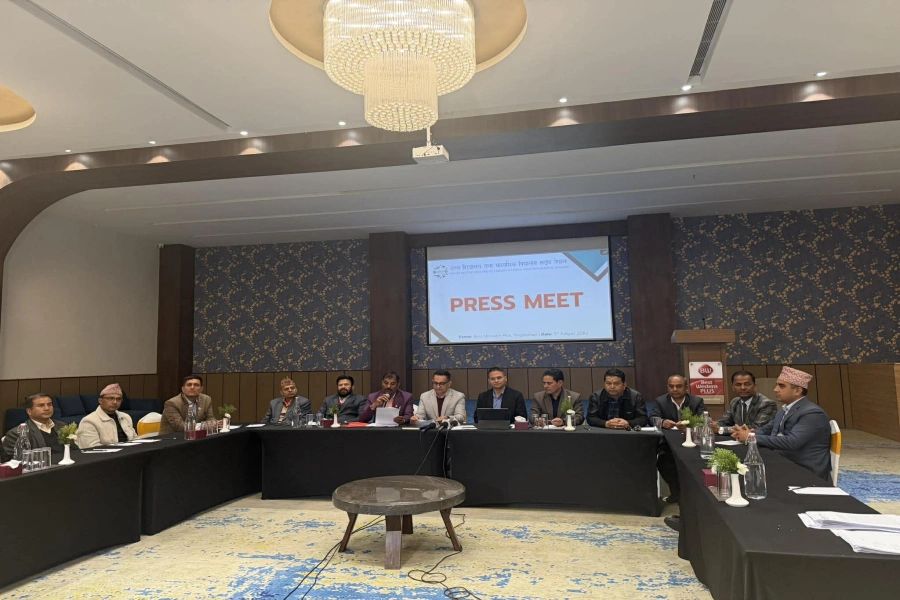
KATHMANDU, Feb 18: As political parties intensify their campaign efforts ahead of the March 5 House of Representatives (HoR) election, education has once again emerged as a key agenda in election manifestos.
With 68 political parties contesting across 165 constituencies, candidates are busy drafting promises—but private education leaders are urging them to move beyond rhetoric and commit to concrete reforms.
At a time when parties are pledging to prioritize education, the newly elected executive committee of the Higher Institutions and Secondary Schools’ Association Nepal (HISSAN) has called for sweeping systemic reforms—from school to university level—and unveiled an ambitious plan to equip teachers with artificial intelligence (AI) skills.
Speaking at a press conference on Tuesday, HISSAN President Yubaraj Sharma said Nepal’s education system must adapt to the era of information technology and AI. “This is the age of AI. If our teachers are not prepared, our students will fall behind,” he said.
There are currently around 10,000 schools operating up to SEE and Grade 12. HISSAN plans to train five teachers from each school—amounting to 50,000 teachers nationwide—in AI-related skills. “We will collaborate with the government to include public school teachers as well,” Sharma said, adding that HISSAN is preparing to submit written suggestions to political parties to ensure the proposal is clearly incorporated into their election manifestos.
According to Sharma, Grades 9 to 12 represent a critical stage in school education. HISSAN also plans to provide targeted training to teachers of mathematics, science, and accounting at this level.
Private school teachers place an ultimatum to withdraw decision...

Sharma criticised political parties for failing to fulfill past commitments. During the previous HoR election, parties had pledged to introduce the Education Act as a priority, but it has yet to be enacted. “A manifesto is the main basis for voters to evaluate a party,” Sharma said. “Parties must clearly articulate their positions on school, higher, and technical education.”
Private educational institutions, which account for one-third of school, higher, and technical education, remain concerned about investment security and policy uncertainty. “Parties must clearly specify what they will accomplish in the education sector within five years,” Sharma said. “They must also set a clear timeline for introducing the School Education Act, Higher Education Act, and Technical Education Act.”
He further stressed that manifestos should define accountability mechanisms if commitments are not implemented within the stipulated timeframe.
According to Sharma, political wrangling has stalled key education laws, leaving the sector in prolonged uncertainty. He urged parties to incorporate comprehensive, system-wide reforms in their manifestos, covering everything from budget allocation to institutional management.
“Education must be the top priority,” he said. “Out of 27,000 public schools, more than 15,000 have fewer than 100 students. This reality demands policy clarity on school consolidation and the expansion of residential schools.”
Sharma also called for guarantees to protect private investment while ensuring institutions fulfill their social responsibility through scholarship provisions.
Pointing to growing politicization in higher education as a key driver of student outmigration, Sharma emphasized the need for structural reform and skill-based technical education. “The current uncertainty is weakening both public and private education,” he said. “Just as students complete Grade 12 in Nepal, they should also be able to complete their bachelor’s degrees here.”
Central to HISSAN’s proposal is granting greater autonomy to higher education institutions. Sharma said private institutions should be allowed to design curricula, conduct examinations, publish results, and issue academic certificates. However, the final bachelor’s degree certificate should remain under the authority of the university. Colleges affiliated with private universities, he added, should receive recognition equivalent to constituent campuses.
He also argued that technical education would remain ineffective without structural reform, proposing a provincial university model as the future framework for technical education.
“HISSAN represents private institutions from higher secondary to university level,” Sharma said. “We are preparing detailed, point-wise reform plans to submit to political parties.”
HISSAN General Secretary Ram Hari Silwal said private institutions possess strong infrastructure and qualified human resources, but require policy stability and legal protection from the government.
“With an investment exceeding Rs 10 billion and a 33 percent share of the education sector, private education must be guaranteed a safe and uninterrupted operating environment,” Silwal said. “We want to contribute within the legal framework.”
The new executive committee has also initiated internal reforms, forming specialized departments to strengthen organizational structure, introduce technology-driven financial management, and promote academic development through examinations, conferences, seminars, educational tours, publications, and training programs.
To steer the reform agenda, HISSAN has formed three councils: a six-member Steering Council coordinated by Umesh Shrestha, an eight-member Advisory Council led by Ramesh Silwal, and a ten-member Academic and Research Council headed by Dr Madhav Baral.





-1782782519.webp)


