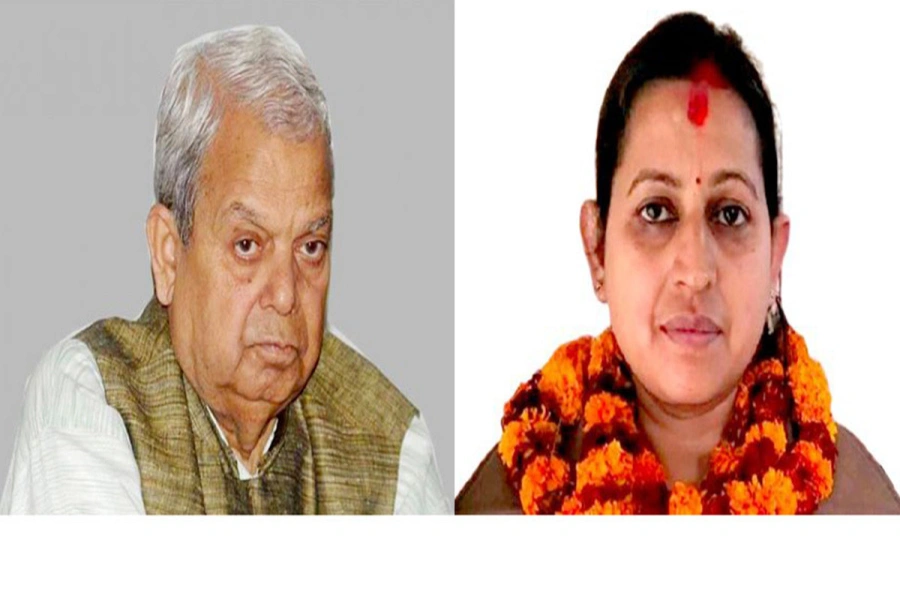
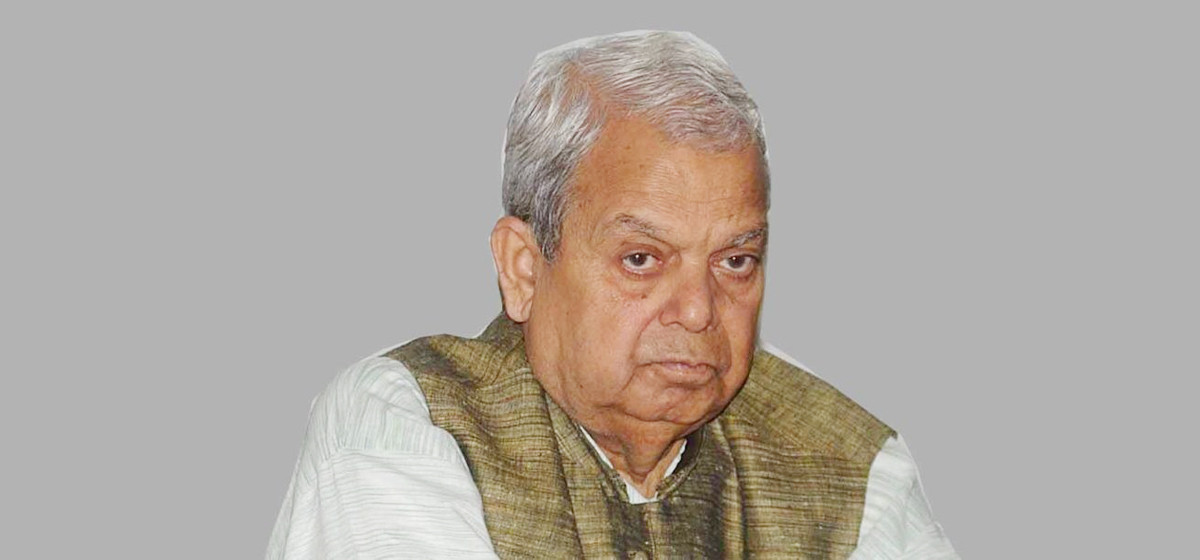
KATHMANDU, Feb 23: Janata Samajbadi Party (JSP) Nepal patron Mahantha Thakur has largely remained politically centered in Mahaottari Constituency-3, with critics saying his political influence is now increasingly tied to family politics.
Thakur, who left the Nepali Congress (NC) and formed the Tarai–Madhesh Loktantrik Party (TMLP) on Jan 19, 2008, while serving as treasurer, rose to prominence as a key Madhesh leader through the Madhesh movement. He led the TMLP and the Second Madhesh movement, earning a reputation as a soft-spoken but politically revolutionary and assertive leader.
However, in recent years, Thakur has faced criticism for focusing on promoting his daughter, Minakshi Thakur, as his political successor. After fielding her as a candidate from Mahottari-3, Thakur has struggled to expand his political influence beyond the constituency.
Thakur, who is now approaching retirement from active frontline politics, still commands significant respect in Madhesh Province but faces growing criticism for prioritizing family political legacy.
In the Constituent Assembly election held in March 2008, after the second Madhesh Movement, Thakur contested from Sarlahi-4 but was defeated by Madhesi Janadhikar Forum candidate Shivapujan Yadav, despite winning elections there repeatedly since 1991.
Later, in the 2013 Constituent Assembly election, he was defeated by NC candidate Amresh Kumar Singh, after which he shifted his political base from Sarlahi to Mahottari. Thakur later won from Mahottari-3 in 2017 and again 2022, with Congress support playing an important role in both victories.
'Ministry’s missing vehicle used by leader Mahantha'
Thakur’s decision to promote his daughter has triggered internal party rebellion. JSP leader Harinarayan Yadav broke away and filed an independent candidacy, weakening Minakshi Thakur’s electoral prospects.
Local party leaders had recommended the names of Harinarayan Yadav, Ram Kumar Sharma, and Krishna Shankar Sah for the party ticket, but Minakshi’s name was not recommended. Despite this, Thakur decided to field his daughter from his traditional stronghold, angering several party leaders.
At over 80 years of age, Thakur is attempting to establish a political successor within his family. Critics say he has previously also given political opportunities to relatives and in-laws, contributing to dissatisfaction within JSP ranks. Due to health reasons, Thakur has largely remained in one place during campaigning and is currently staying in a hotel in Jaleshwar, meeting relatives, supporters, and party workers to mobilize support for his daughter.
Although Thakur is widely regarded as one of the most influential leaders of the Madhesh movement and a broadly accepted political figure in Madhesh Province, this election has brought renewed criticism over his attempt to establish a family political successor.
Following Minakshi’s nomination, Harinarayan Yadav, who has been active in party politics since the formation of the Madhesi Janadhikar Forum, rebelled and contested as an independent candidate. He said, “We respected Mahantha Thakur as our leader, but he only saw his daughter. I decided to contest independently because his daughter has no political contributions. My victory is certain.”
JSP General Secretary Ram Kumar Sharma has remained silent on the dispute. Meanwhile, Thakur has argued that during the democratic movement, when he lost everything, his daughter stood by him. Minakshi Thakur is a medical doctor by profession.
The Mahottari-3 constituency includes Mithaijani Municipality, Jaleshwar Municipality, wards 8–10 of Manara Shisawa Municipality, wards 1–5 and 7 of Pipara Rural Municipality, and wards 1–5 of Ekdara Rural Municipality. Thakur has been focusing all his political resources in this constituency, which he has won twice.
After Minakshi’s candidacy, the internal party rebellion has weakened her political position. Following Yadav’s exit, JSP leader Surendra Jha has been supporting her campaign.
41 candidates are contesting in Mahottari-3. The main competition is expected among NC candidate Bajrang Nepali, UML candidate Manoj Singh, JSP candidate Minakshi Thakur, Rastriya Swatantra Party (RSP) candidate Ujjwal Jha, and independent candidate Ramadhar Kapar.
Ujjwal Jha, a resident of Ekdara — the same village as former Kathmandu Metropolitan City Mayor Balendra Shah’s hometown — is believed to have gained local voter support. He was previously a JSP worker.
Local voters say the growing influence of RSP in Madhesh makes Jha’s performance difficult to predict. Meanwhile, Ramadhar Kapar, who contested as an independent after failing to secure a UML ticket, may split UML votes, while Yadav may cut JSP votes.
Congress candidate Bajrang Nepali is also seen as a strong challenger, especially after Congress President Gagan Kumar Thapa contested elections from Sarlahi, creating favourable political momentum for Congress in Madhesh.
There are 110,436 registered voters in Mahottari-3, and analysts say the election result could be decided by a margin of around 20,000 to 25,000 votes.
Thakur’s political career includes serving in multiple ministries. He had previously helped appoint his relative Umakant Jha to ministerial positions. Jha is Thakur’s son-in-law. Earlier, Jha’s wife, Indra Jha, was also made a proportional representative MP from TMLP. Umakant Jha was later appointed Governor of Lumbini Province on Jan 17, 2018.
Thakur was active in student politics during his youth and served as president of a Congress-affiliated student union. He was arrested during protests against King Mahendra’s coup on Dec 16, 1960, and completed his postgraduate studies while in jail. He also holds a Bachelor of Laws degree.
He was elected to parliament in the 1991 general election from Sarlahi-5 as an NC candidate and served as deputy speaker until 1994. He later became agriculture minister and law minister, holding several key portfolios including agriculture, law, science, and technology.
The 82-year-old leader has now entered the National Assembly while attempting to promote his daughter to the House of Representatives, triggering growing dissatisfaction within party ranks.