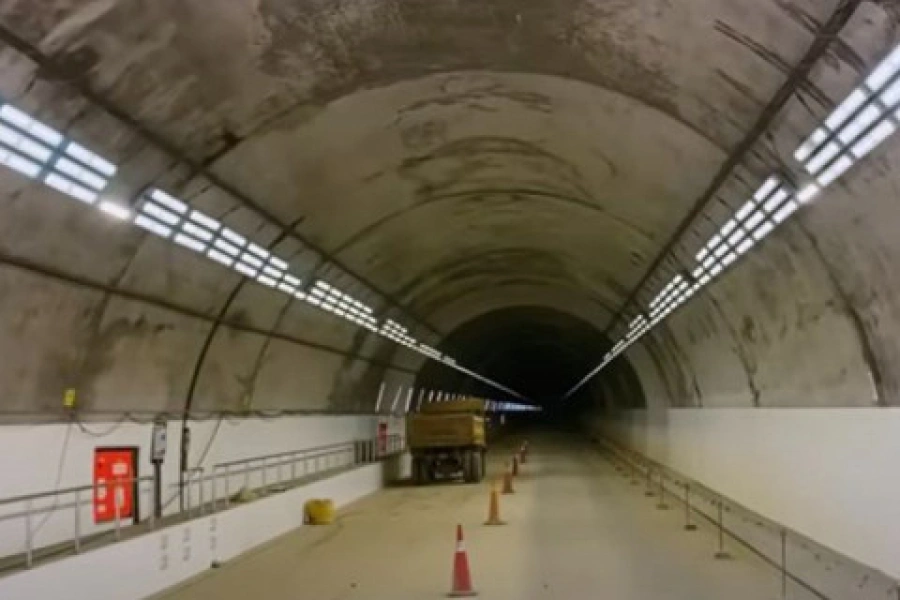
KATHMANDU, June 14: The Nagdhunga–Sisnekhola Tunnel Road, Nepal’s first commercial highway tunnel, is expected to come into operation during the start of the new fiscal year in mid-July, with final preparations currently underway.
According to Saujanya Nepal, chief of the Nagdhunga–Sisnekhola Tunnel Project, authorities are working to complete all remaining operational and technical arrangements so that the long-awaited tunnel can be opened to traffic in less than two months.
The project has already signed an agreement with the company responsible for toll collection and tunnel operations, and technical preparations, including staff training, are in progress. Officials are also conducting tests and final checks on emergency response systems, lighting, ventilation, and other operational infrastructure required for safety and round-the-clock service.
“We are carrying out all necessary preparations for the tunnel’s operation and are making every effort to bring the project into service within mid-July,” Nepal said.
To ensure 24-hour operation, around 150 employees have been recruited and will work in shifts. Training is being provided on emergency procedures, rescue operations and tunnel management.
Three new tunnel roads to be built next FY

Speaking at a meeting of the National Assembly’s Public Policy and Delegated Legislation Committee on Monday, project officials reported that construction has reached 99.5 percent, while financial progress stands at 96 percent.
The government has already signed an agreement with service provider Yusin–ART JV, which will be responsible for operating and maintaining the tunnel for the next five years. The company will oversee routine maintenance of civil, mechanical and electrical systems, along with tunnel safety infrastructure.
Once operational, the tunnel is expected to ease travel on the busy Kathmandu–Naubise corridor by reducing congestion and eliminating the need for a longer route currently used by passenger and freight vehicles.
According to project data, the main tunnel stretches 2,688 meters, while the emergency tunnel runs 2,557 meters. Authorities estimate that approximately 8,000 vehicles will use the tunnel daily.
Based on that traffic volume, annual toll revenue is projected to reach around Rs 350 million. Of that amount, approximately Rs 220 million per year will be paid to the service provider under the operation and maintenance agreement, totaling about Rs 1.1 billion over five years.
A dedicated electronic toll collection system has already been installed. Revenue generated from toll fees will be deposited into the account of the Road Board Nepal, while payments to the operating company will be made by the government.
During Monday’s committee meeting, lawmakers including Gopal Basnet, Madankumari Shah (Garima), Ranjit Karna, Chandrabahadur KC, Padam Pariyar, Yubaraj Sharma, Meena Singh Rakhal, Rukmini Koirala, Sunil Thapa, Gomadevi Timilsina, Somnath Portel and Narbahadur Bista expressed concerns over delays in bringing the completed project into operation.
The lawmakers urged the government to expedite the opening process, stating that the tunnel should not remain idle now that construction has effectively been completed. They also called for the skills and experience gained during the project’s construction to be utilized in future infrastructure projects and stressed the importance of recognizing and employing trained and semi-skilled workers.
Although construction of the tunnel faced delays due to the COVID-19 pandemic and other challenges, lawmakers emphasized that the project should now be opened as soon as possible to deliver its intended benefits to the public.