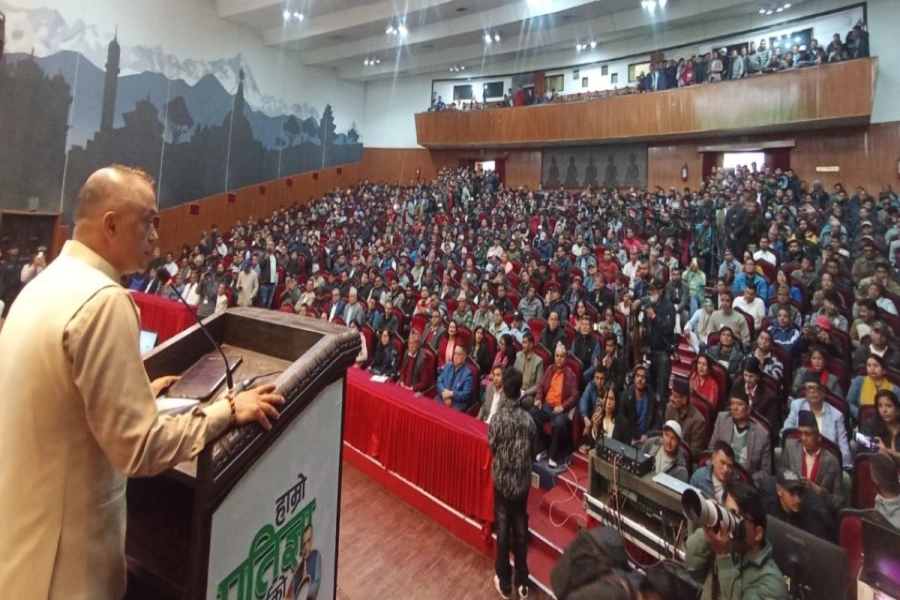
KATHMANDU, April 14: The government led by Prime Minister Balen Shah has unveiled an ambitious target to create 1.5 million jobs within the country over the next five years.
The government made the announcement while releasing a draft of an 18-point “national commitment,” outlining a roadmap for policy reforms.
The draft, prepared by synthesizing the election manifestos of six nationally recognized parties represented in Parliament, states that provisions will be made to allow people to work for foreign companies while staying in Nepal.
The government has committed to amending legal and policy frameworks to ensure people can work for foreign entities or employers, while promoting “remote work,” “digital employment,” and cross-border service exports.
To boost employment, policy reforms will be introduced in sectors such as information technology, construction, tourism, and commercial agriculture. The draft also mentions launching a large-scale “big push” campaign by completing projects related to physical infrastructure, solar and wind energy, and waste management, as well as green industries to generate jobs.
Sampang to RSP: Where are 1.2 million Jobs?

The government has announced that skills such as coding, data, artificial intelligence (AI), and cybersecurity will be included in school-level curricula.
Employment-oriented IT programs and an “earn while you learn” model will be developed in collaboration with universities, CTEVT, and the private sector.
The government also aims to retain skilled manpower within the country, as many technical workers have been going abroad due to a lack of opportunities at home. Professionals such as doctors, nurses, engineers, and experts in agriculture, forestry, and IT will be encouraged to work and do business within Nepal. The draft also highlights the use of skills, knowledge, and experience of Nepalis abroad as part of a “brain gain” strategy.
The education system will be reformed to make STEM education—from school to university level—more practical, research-oriented, and linked to employment. A “National Skills Development Campaign” will also be launched, making skills mandatory for work. Traditional skills will be modernized and branded, linking them with modern technology and large industries.
Local governments will assess and document labor demand and supply, while enhancing workforce skills. Employment will be treated as a long-term foundation rather than a temporary relief measure, and job fairs will be organized to encourage private sector job creation.
To make the labor market free from exploitation, a comprehensive reform program will be implemented to end wage arrears and labor abuse. The government has also adopted a policy of “mandatory labor” to connect everyone with a culture of work.
The government aims to make foreign employment voluntary rather than compulsory. Prior to going abroad, workers will be provided with information, skill-based training, and capacity development, along with guarantees of rights and security for migrant workers.
The draft also clarifies that foreign employment companies will be made transparent and fully accountable, with action taken against fraud, excessive fee collection, and false contracts.
Additionally, programs will be introduced to utilize the skills and capital of returning migrant workers in national development. The government plans to provide engineering consultation and technical support to channel remittances into secure investments.
The draft, introduced as part of a 100-point governance reform agenda, has been opened for feedback from political parties and stakeholders until April 23.
Based on the suggestions received, the government plans to revise the draft and implement it through the upcoming fiscal year’s budget, policies, and programs, according to the Office of the Prime Minister and Council of Ministers.