

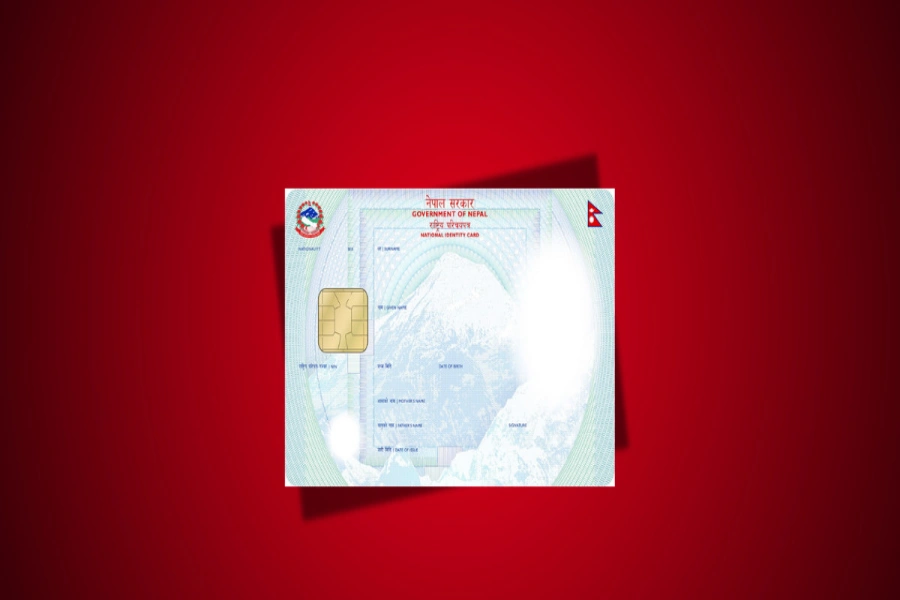
KATHMANDU, Jan 9: Nearly 20 million Nepali citizens have registered their personal details for the National Identity Card, but fewer than half have received the physical card, exposing a widening gap between registration and delivery.
According to the Department of National ID and Civil Registration (DoNIDCR), the data were collected between July 2018 and January 6, 2026.
Tulsi Prasad Dahal, Director of the DoNIDCR’s Card Management Division, said 19,568,837 people have registered for the National ID card so far. Of these, 7,495,711 cards have been printed, while only 3,778,875 citizens have actually received their cards.
The National Identity Card initiative is rooted in Article 11 of Part 2 of the Constitution of Nepal 2072 BS, which defines Nepali citizenship. Based on existing citizenship certificates, the government is gradually rolling out the card, which is expected to eventually replace the citizenship certificate.
Ballot papers printed for 36 districts

Once fully implemented, the National Identity Card will be mandatory for accessing services provided by government bodies, institutions, and even the private sector. Even without the physical card, citizens will be able to obtain services if their identity can be verified through a unique identity number.
The government has designated the National Identity Card as the primary proof of identity and a key gateway to public services. Sub-clause 2 of Clause 10 of the National Identity Card and Civil Registration Act, 2076 BS formally recognizes the card as the main basis for obtaining public services.
Similarly, Clause 7 of Part F of Article 51 of the Constitution envisions an integrated national identity management information system that consolidates citizens’ data and links it with state services and national development plans.
At present, the National Identity Card has been made mandatory across 12 service-linked agencies. According to the DoNIDCR, the card is required for services including passport issuance, social security allowances, birth registration, Bagmati Province’s transport system, banks and financial institutions, the Office of the Company Registrar, elections, pension management, foreign employment, Nagarik App services, PAN registration at the Inland Revenue Department, and the Social Security Fund.
Despite growing demand, card distribution has lagged. Dahal attributed the slowdown to the declining capacity and recurring technical issues of card-printing machines. He said the problem intensified during voter list preparations, when making the National ID card mandatory pushed daily applications to 25,000–26,000.
Currently, 10,000–12,000 applications are registered each day. While demand continues to rise, Dahal said Nepal lacks the skilled manpower required to upgrade or expand printing capacity, prompting preparations to seek technical support from abroad.
The impact is evident in production figures. While 20,000–22,000 cards were initially printed each day, output has now dropped sharply to just 3,000–4,000 cards daily.
Card distribution has also been affected as many applicants fail to collect their cards on time. Since individuals must visit designated locations to receive their cards, uncollected cards have further reduced distribution numbers, Dahal said.
The department noted that citizens without a National ID card must renew their social security allowance cards at their respective wards. In contrast, those holding the National ID card can renew their allowances from any ward, making access to services easier.
Dahal said the National Identity Card has helped cut costs and curb misuse of state resources. By preventing duplicate benefits, the system has contributed to significant savings in the state treasury. He stressed that access to public services is a constitutional right—and the National ID card plays a crucial role in safeguarding that right.
The DoNIDCR also reported that around 800,000 cards were damaged during the Gen Z protests on September 8 and 9, while 13 pieces of equipment across 120 enrollment stations were vandalized. Dahal said the exact extent of the damage is still being assessed, but affected citizens are being issued replacement cards upon request.











