

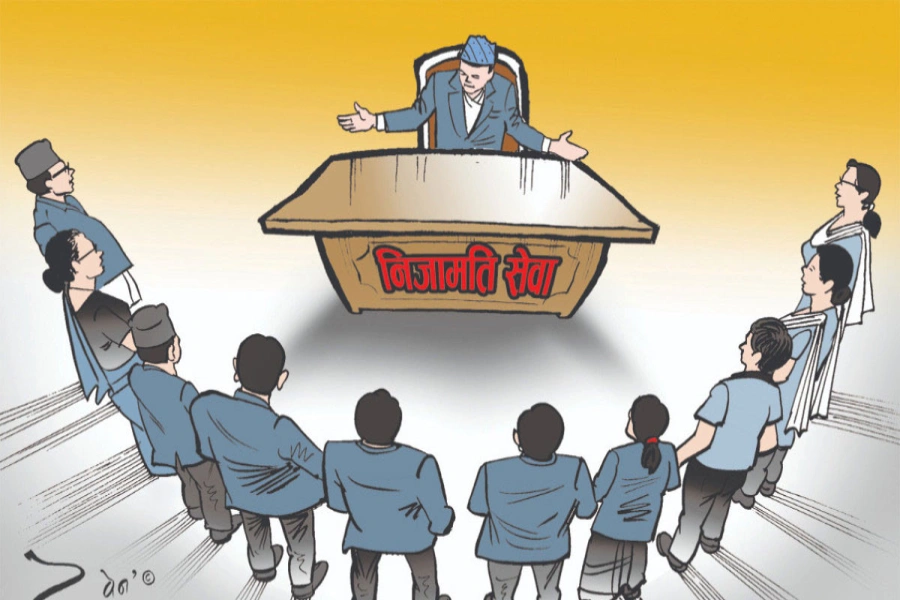
KATHMANDU, April 22: Nepal has become the first country in South Asia to introduce a system of paying government employees every 15 days.
The Ministry of Finance on Sunday decided to shift from a monthly salary system to a bi-monthly payment structure for civil servants. The ministry has already written to the Office of the Financial Comptroller General to implement the new system.
Former government secretary Govinda Kusum said Nepal is likely the first country in South Asia—and possibly even in Asia—to adopt a fortnightly salary system for government employees. He noted that such practices are common in countries like the United States, Canada, and Australia, while neighboring countries such as China and India continue to follow monthly payment systems.
Revised interest rate corridor system introduced
According to Kusum, the decision is expected to boost economic activity and have a positive overall impact. He also suggested that the system should gradually be expanded beyond civil servants to include teachers, security forces, and other public sector employees.
He added that the policy could particularly benefit lower-level employees who rely heavily on regular cash flow, calling it a positive reform.
Currently, Nepal’s Civil Service Act provides for monthly salary payments, meaning legal amendments will be required to implement the new system. The government is preparing to introduce a Federal Civil Service Act, where provisions for semi-monthly payments are expected to be included.
Experts say that similar legal amendments would be needed in laws governing the Nepal Army, Nepal Police, and teachers if the system is to be extended to them. A senior official at the Finance Ministry said the decision has already been made for civil servants and will gradually be implemented across other sectors.
At present, nearly 500,000 individuals receive monthly salaries and allowances from the state treasury, including civil servants, personnel of the Nepal Army, Nepal Police, Armed Police Force, and National Investigation Department.
The move is part of broader efforts by the government to reform the civil service. In recent weeks, the government has also introduced a two-day weekend (Saturday and Sunday).
Administrative reforms in Nepal date back to 1951 with the formation of the Buch Commission, which submitted its report in 1952. Following its recommendations, the government institutionalized monthly salary payments. The Civil Service Act introduced in 1956 further formalized provisions for monthly salary and allowances.



-1200x560-1781083488.webp)








