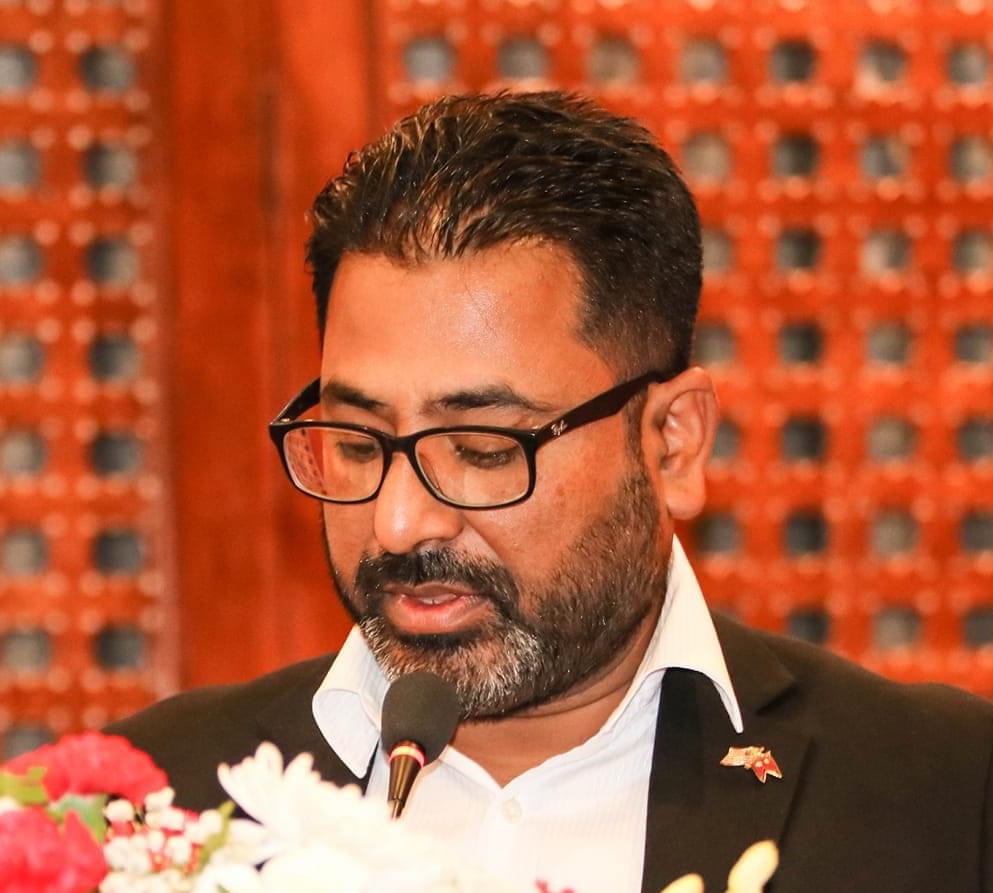
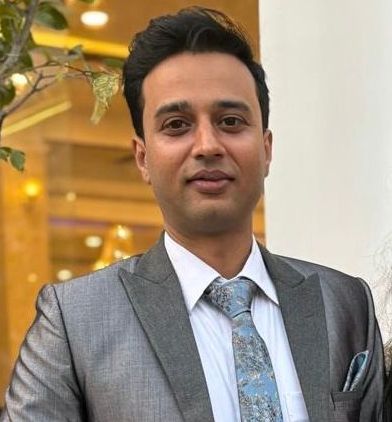
KATHMANDU, June 7: Foreign Minister Shishir Khanal has reaffirmed that Nepal is not seeking third-party mediation to resolve its longstanding boundary disputes with India, including Kalapani, Lipulekh and Limpiyadhura, and will instead pursue settlement through established bilateral diplomatic mechanisms.
Speaking to journalists at Tribhuvan International Airport on Sunday evening upon his arrival from a three-day official visit to India, FM Khanal said Nepal remains committed to addressing border-related issues “through dialogue and existing institutional mechanisms” between the two countries.
He dismissed speculation that Kathmandu was seeking mediation from the United Kingdom, clarifying that Nepal has only sought access to British archival materials for historical reference. “We have not sought third-party mediation. There are various historical documents related to the border, and if necessary we may require access to factual evidence from that period. The boundary was defined by the Sugauli Treaty. The Prime Minister has said dialogue should be initiated for this purpose,” he said.
His remarks come amid domestic political debate triggered by comments from Prime Minister Balendra Shah suggesting possible engagement with the United Kingdom in relation to the dispute. India’s Ministry of External Affairs has maintained that third-party involvement in bilateral issues between Nepal and India is not acceptable.
Khanal’s clarification also follows renewed public discussion over Nepal’s approach to the boundary issue. He reiterated Nepal’s historical claim over the disputed territories, stating that Kathmandu has already conveyed its position to both India and China through formal diplomatic notes.
The Kalapani dispute resurfaced after India included the areas in its political map in 2019 and expanded infrastructure and cross-border arrangements. Nepal responded in 2020 with its own revised administrative map asserting sovereignty over the territories.
NC stresses high-level diplomatic, political initiatives to ret...

The issue gained renewed attention again after India and China agreed earlier last year to reopen the Kailash Mansarovar pilgrimage route via Lipulekh, prompting Nepal to formally protest through diplomatic channels.
Khanal said existing bilateral frameworks, including technical boundary mechanisms, would be reinvigorated to address outstanding issues. Both sides have agreed to reactivate the Boundary Working Group (BWG) and Survey Officials’ Committee (SOC), which have remained largely inactive in recent years. However, disputed areas such as Kalapani and Susta remain outside the scope of technical settlement mechanisms.
Khanal was in New Delhi at the invitation of Indian External Affairs Minister S. Jaishankar, where the two sides held delegation-level talks covering development cooperation, connectivity, trade, energy and digital collaboration on Saturday.
“The discussions covered development cooperation, expansion of connectivity, trade and transit, energy, and enhancing people-to-people ties,” Khanal said, adding that regional and multilateral issues of mutual interest were also discussed.
Although official statements do not explicitly mention the boundary dispute, diplomatic sources said the issue was raised in closed-door discussions. Both sides reportedly agreed to strengthen existing mechanisms and ensure more regular engagement at technical and political levels.
Addressing the media in New Delhi before departing for Kathmandu on Sunday afternoon, Khanal said Nepal aims to reframe its ties with India from a geopolitical lens toward development-focused diplomacy, anchored in economic transformation, technology and connectivity.
He said the government, under a new political configuration in Kathmandu, is seeking to move beyond historical constraints and prioritise results-oriented diplomacy.
During the visit, discussions also covered trade, energy, infrastructure, water resources and people-to-people ties. Khanal said talks with Jaishankar focused on expanding cross-border connectivity, energy partnerships and broader economic cooperation.
On the Nepal–India Eminent Persons Group (EPG) report, Minister Khanal clarified that the document was prepared by a panel constituted with the consent of both prime ministers and is intended to be submitted directly to them.
He said the two sides reviewed progress in bilateral cooperation and explored new initiatives to strengthen collaboration in innovation, startups, digital and financial technology, and capacity-building. “Both sides agreed to intensify efforts to elevate the Nepal–India multifaceted partnership to new heights,” he stated.
Following the bilateral talks on Saturday, Dr. Jaishankar handed over 72 health institutions and 12 cultural heritage reconstruction projects completed under India’s post-2015 earthquake assistance to Minister Khanal.
The two ministers also jointly launched cross-border person-to-person digital payment connectivity between India’s Unified Payments Interface (UPI) and Nepal’s National Payments Interface (NPI). A memorandum of understanding was also signed between Kathmandu University and India’s Digital Bhashini initiative to co-develop a ‘voice-first’ language translation platform.
During the visit, Minister Khanal also met India’s National Security Advisor Ajit Doval and BJP Foreign Affairs Department Chief Dr. Vijay Chauthaiwale separately. He further addressed a programme organised by the India Foundation in New Delhi on Friday.
This marked the first official foreign minister-level visit between Nepal and India since the formation of Nepal’s new government. Observers say the visit has reinforced the tradition of regular high-level exchanges between the two close neighbours under India’s “Neighbourhood First” policy.