

KATHMANDU, July 24: The suspension of direct flights between Nepalgunj and Pokhara has left passengers facing significant travel difficulties, forcing many to rely on hazardous road routes, particularly during the monsoon season.
Private carrier Buddha Air had initially launched daily Nepalgunj–Pokhara flights in August 2021 before reducing the service to three flights a week. However, the airline suspended the route around a month ago after rising aviation fuel prices pushed up airfares, resulting in a decline in passenger demand.
The suspension has particularly affected travelers during the rainy season, when landslides frequently disrupt highways connecting western Nepal to Pokhara. Indian tourists entering Nepal through the Nepalgunj border crossing are also facing longer and more difficult journeys to Pokhara due to the lack of direct air connectivity.
Higher fuel costs pushed fares up
According to Buddha Air’s Nepalgunj station chief, Binit Shah, the minimum airfare on the Nepalgunj–Pokhara route was previously Rs 5,200. Following increases in aviation fuel prices, the fare rose to Rs 8,200, leading to a significant drop in passenger numbers.
Shah said there is currently little possibility of immediately resuming the service. Although the airline may reassess passenger demand by around October and consider restarting flights, no decision has been made so far.
“If passenger demand increases, the company may reconsider the route, but no decision has been taken at present,” Shah said.
GBIA records 115 flights, serves 6,500 passengers in February

Modern terminal operational, but flights declining
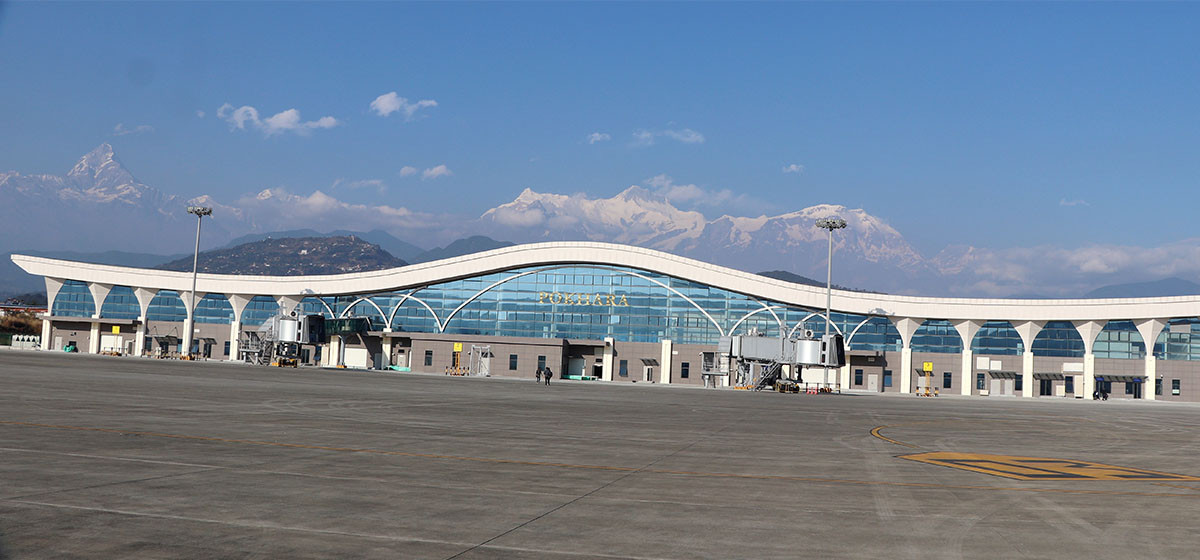
Nepalgunj Airport recently began operating from a newly constructed international-standard terminal building.
The three-storey terminal, which came into operation on April 28, covers 55,000 square feet, including an underground level. Built at a cost of Rs 2.72 billion excluding VAT, the project also includes aircraft parking bays, vehicle parking facilities, a guest house, drainage systems, gardens, footpaths and public toilets.
The new terminal can accommodate up to 698 passengers at a time.
Ironically, the direct Nepalgunj–Pokhara service was discontinued shortly after the new terminal became operational.
Airlines cutting flights amid rising costs
Nepalgunj Airport chief Santosh Kumar Pokharel said rising fuel prices, higher ticket costs and declining passenger demand have prompted several airlines to reduce their flight schedules.
“After fuel prices increased, airlines raised fares. As fares went up, passenger demand declined. Some airlines reduced flight frequency, while Buddha Air completely suspended the Nepalgunj–Pokhara route,” he said.
Tourism sector expresses concern
Former president of the Banke chapter of the Nepal Association of Tour and Travel Agents (NATTA), Shriram Sigdel, said the suspension has affected not only passengers but also the tourism industry.
He recalled that Buddha Air had launched regular services only after NATTA Banke successfully operated chartered flights on the route. Sigdel warned that unless the government develops Nepalgunj as a regional aviation hub, the airport could gradually lose its importance.
“Flight numbers have declined and passenger traffic has also fallen. There are no inter-provincial air services, and even existing flights are being reduced. Nepalgunj Airport no longer appears to be among the government’s priorities,” he said.
Calls to restore flights
Local political leaders, civil society representatives and elected officials have long demanded further expansion of Nepalgunj Airport and additional flight connections.
Rastriya Swatantra Party (RSP) Banke chairperson Bibek Kumar Shrestha said that since airport infrastructure has already been upgraded, efforts should now focus on expanding flight services to fully utilize the facilities.
“Inter-provincial flights from Nepalgunj should be expanded. The Nepalgunj–Pokhara service should not remain suspended permanently,” he said, pledging to advocate for the restoration of the route.
Demand for direct Delhi flights
Dr. Suresh Kumar Kanodia, a civic leader and operator of Nepalgunj Medical College, said Nepalgunj Airport serves as western Nepal’s principal aviation gateway and should be developed further for commercial operations.
He noted that many Indian pilgrims travelling to Mount Kailash and Mansarovar also use Nepalgunj as a transit point, making the airport strategically important.
“Nepalgunj should be connected not only through more inter-provincial flights but also via direct flights to Delhi. Previously, the Nepalgunj–Pokhara route connected two provinces and made a significant contribution to tourism promotion. Its suspension is ultimately a loss for the state itself,” Kanodia said.


-1200x560_20230115125633.jpg)








