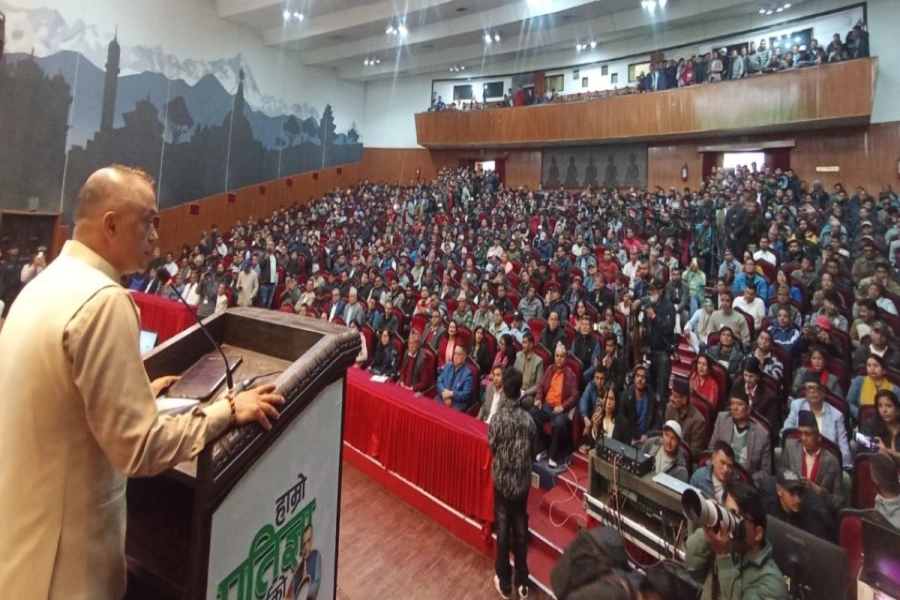
KATHMANDU, Feb 20: The Nepali Congress (NC) has unveiled a revamped economic roadmap, branding the next five years as a “Half-Decade of Economic Revival.” Party President Gagan Thapa presented the full manifesto, outlining a clear vision to reshape Nepal’s economy along three key pillars: pro-private, pro-growth, and pro-social justice.
The NC plans to ramp up private sector participation across all industries and has set an ambitious target of expanding the economy to Rs 11.5 trillion while boosting per capita income to 2,500 US dollars over the next five years. The party has promised to implement second-generation economic reforms to achieve these goals.
The manifesto notes that uninterrupted first-generation reforms, initiated after 2064 BS, could have already raised per capita income beyond 2,500 dollars. “Armed conflict and prolonged political instability cost the country significant economic opportunities. Now, it’s time to reclaim lost ground and move toward sustainable development,” the document states.
To meet these targets, the NC aims to mobilize Rs 13.75 trillion in investments, with around 80 percent coming from the private sector.
Tax and Business Incentives
The party proposes exempting individuals earning up to Rs 1 million annually from income tax, while capping the maximum rate at 25 percent, with surcharges only for incomes above Rs 10 million. Corporate taxes would gradually fall to 20 percent, with export and IT-related sectors receiving lower rates to stimulate production and exports.
All business processes, from registration to renewal, will become paperless, and a fast-track tribunal will handle investment-related disputes. The “no work, no pay” principle will also be strictly enforced.
Empowering Entrepreneurs and SMEs
Youth and women entrepreneurs could access collateral-free loans ranging from Rs 500,000 to Rs 5 million, while crowdfunding and venture capital will gain legal recognition. Small and medium enterprises, as well as agricultural loans, will benefit from fixed-interest policies for a specified period.
Targeting Inflation and Employment
Transparent policy-making makes people less cynical of their go...

Inflation will be kept below 5 percent, while domestic and foreign capital will be steered into productive sectors to generate jobs and transform young workers into partners in wealth creation and entrepreneurship. Special programs will help marginalized communities become producers and asset owners.
Financial and Agricultural Reforms
The NC plans to rehabilitate honest entrepreneurs affected by economic slowdowns through a “Silver Credit” program, alongside relief packages for microfinance and cooperative borrowers. Strengthening the Investor Protection Fund and modernizing surveillance will curb financial malpractice. Agriculture will receive priority lending, with a 90 percent subsidy on insurance premiums and crop damage assessments using drones and satellites.
Trade and IT Development
The export-import ratio will shift from 10:90 to 20:80 within five years, while information technology is positioned as the new backbone of the economy. Revenue administration will be streamlined, financial fraud curbed, and tax systems aligned with the federal structure.
By placing economic revival at the center of its agenda, the NC aims to build a balanced economy grounded in production, investment, employment, and social justice.
NC Commitments at a Glance:
Expand the economy to Rs 11.5 trillion in five years
Raise per capita income to 2,500 US dollars
Declare a “Half-Decade of Economic Revival”
Implement second-phase economic reforms
Mobilize Rs 13.75 trillion in investment (80% from the private sector)
Adopt “pro-private,” “pro-growth,” and “pro-social justice” policies
Ensure stable tax rates for at least 10 years
Exempt personal income up to Rs 1 million from tax
Establish a fast-track tribunal for investment disputes
Enforce “no work, no pay” policy
Provide collateral-free loans of Rs 500,000–5 million to youth and women entrepreneurs
Grant legal recognition to crowdfunding and venture capital
Strengthen the Investor Protection Fund
Focus lending on agriculture, energy, infrastructure, and IT
Launch “Silver Credit” for recession-hit entrepreneurs
Subsidize 90% of agricultural insurance premiums
Improve the export-import ratio to 20:80
Develop IT as the economic backbone
Gradually reduce corporate income tax to 20%