

In the strategic southern slopes of the central Himalayas between the world’s two most ancient civilizations and rising global powers, India and China, Nepal has been a challenging, interesting, and inspiring innovation in territorial unification, independent state formation, and nation-building. In its long history, until the democratic awakening of the 1950s, Nepalis endured wars with both their mighty neighbours, power struggles among the ruling dynasties, and a foreign policy of isolation from the outside world. But the 75 years since then have been marked by a never-ending Triumph and Trauma of internal political transitions and expansion in international relations amid geopolitical compulsions.
In this journey, Nepal is no stranger to not-so-easily explainable developments in its socio-political life and foreign affairs. But the “political storm” of September 2025 and the “electoral flood” of March 2026 have been among the most sudden and dramatic. First, the storm caused the collapse of the Nepali state almost overnight, and then the flood swept aside the political parties and leaders, leading all the previous political changes.
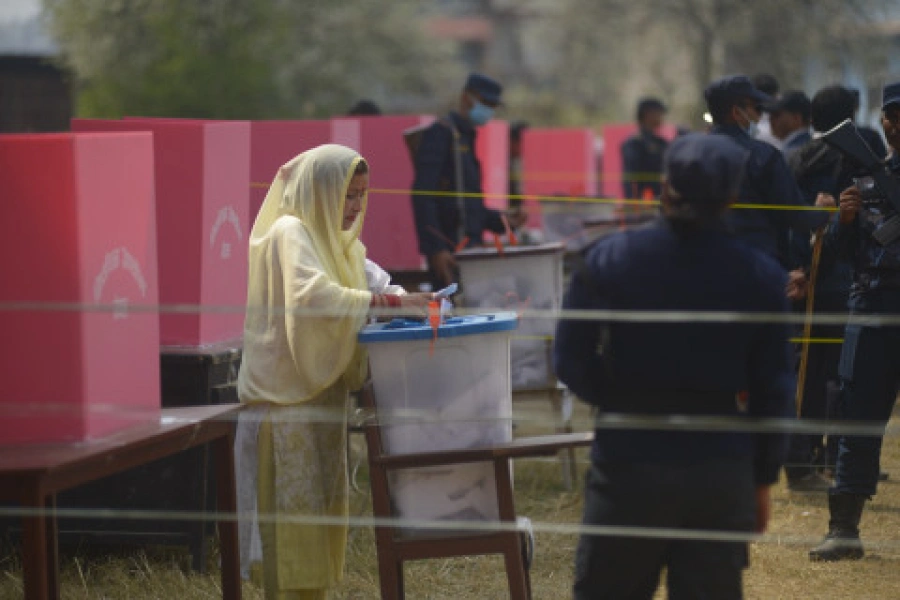
The electorate has now given an overwhelming majority to the new Rastriya Swatantra Party (RSP), headed by its charismatic President Rabi Lamichhane and Balendra Shah, who joined as Senior Leader and prime ministerial candidate just before the election. “Enigmatic” to some and “inspiring” to others, especially the youth, the 36-year-old Shah is now Nepal’s Prime Minister.
An engineer by profession and popular with his rebellious raps, Balen was elected Mayor of Kathmandu with a wide margin as an independent candidate in the party-dominated political landscape. With a record of zero corruption in a system known for rampant corruption, his short tenure created “Balen mania,” especially among the youth. This got him elected with a huge majority and also swept the RSP into national power. The Rabi/Balen duo now have a historic mandate to transform Nepal and its long-aspired journey toward a truly independent, democratic, peaceful, and prosperous Nepal for all Nepalis.
New Markers: These developments have captured the imagination of political thinkers and actors worldwide. Yet they are so sudden and unprecedented that it will take time to fully understand and explain them. Let alone outsiders, even for many Nepalis, the “pilots” behind this “policraft” are unfamiliar. So, some uncertainty is natural. From the initial accounts, six significant new markers are, however, noteworthy:
• Ideology and Identity Politics: Ideology (democracy, socialism, communism) and identity (ethnicity, culture, language, religion, or region) have been the most attractive platforms of politics in democracies. But the Gen Z protests and the subsequent RSP electoral sweep bypassed these traditional themes completely. In fact, the political parties and leaders long thriving on ideology and identity politics were swept aside. Instead, the RSP and Balen’s political campaign focused solely on popular dissatisfaction and promises of better livelihoods and governance.
CESIF hosts roundtable discussion on ‘Geopolitics and Informati...

• Legacy Politics: Most of the RSP leaders are not only young and educated professionals newly entering politics, but have also defeated almost all the stalwarts with a long history of political struggle and family legacy.
• Party Organization: The RSP, a new political force with no nationwide organization, is holding its first national convention only after the election. Yet many of its candidates defeated the hitherto mainstream political parties, the Nepali Congress, the UML, and the Maoists, with large memberships and strong organizations from the national level to the grassroots, thus challenging the notion that strong party organization and large membership are essential for voter mobilization.
• Money in Politics: The cost of elections and its role in political corruption have been among the biggest worries for democracies worldwide. Perhaps one of the most unique features of the RSP and Balen’s rise is the role of money in politics, especially in elections. According to the electoral expenses filed with the National Election Commission, both Balen and Rabi spent less than 1.5 million Nepali rupees (US$10,000) each, but both were elected with huge margins.
• Technology in Politics: From the use of the Discord app during the Gen Z protests to the role of social media in the election, technology, as a tool of popular mobilization and voter education/participation, is another new innovation.
• External Involvement: This is the first major political change in which external actors with close relations and strong clout, invariably believed to be involved in and blamed for all the political changes of the past, find themselves guessing this time around.
These markers challenge conventional assumptions seen as indispensable in political engagement, representing a far-reaching philosophical, generational, and structural rupture. They also signal the erosion of traditional bases of political legitimacy and the emergence of a new cohort defined by professional credentials, technocratic, and reformist appeal. But is it the result of a one-time outburst of popular dissatisfaction with old parties and leaders, or can it bring about a political paradigm shift?
Politics has never been a straightforward game. That is why, before rushing to conclusions, it is worth recalling what one of the modern world’s most influential philosophers writes: “Our newfound knowledge leads to faster economic, social and political changes; in an attempt to understand what is happening, we accelerate the accumulation of knowledge, which leads only to even faster and greater upheavals. Consequently, we are less and less able to make sense of the present or forecast the future.” Which means credible answers to some questions, and even more significantly, how the RSP government fulfils the promises made to the Nepali people, can make what happened in Nepal significant for the wider “liberal international” order.
Nepal’s new “Policraft,” the profile of its “Pilots,” and most strikingly the highly unconventional style of its “Chief Pilot” are attracting heightened curiosity. Naturally, Nepal’s neighbours, friends, and development partners are watching with interest, hope, relief, and concern. Born of political upheaval, the government enjoys opportunities and faces challenges on all fronts, including foreign policy.
Managing Geopolitics – a Key Challenge: Often, a small country between two great powers is characterized as “the Revenge of Geography.” With the unprecedented power of technology, what was once unthinkable for some can now be possible for others. So, turning “Revenge” into the “Reward of Geography,” as the RSP manifesto and the Prime Minister’s overtures hint, is possible. But that will require political leadership, aided by skilled diplomacy.
Inclined to “let actions rather than words speak” in internal affairs, PM Shah, by addressing the diplomatic community twice, has tried to reassure the world of his government’s balanced and pragmatic foreign policy, emphasizing deeper ties with immediate neighbours, friendly nations, and development partners based on mutual trust and respect. He has highlighted peace as a shared priority and the importance of resolving conflicts through dialogue, diplomacy, and respect for international law. His stress on the safety and well-being of Nepali workers and the diaspora abroad was a clear signal that people’s interests must be at the centre of diplomacy.
By signaling continuity in some foreign policy imperatives while rejecting “business as usual,” the PM has set a much-needed new tone in diplomacy. Of course, diplomatic protocol should facilitate dialogue and negotiations, the heart and soul of diplomacy, and not be an impediment. That means his “break from the past” will require a nuanced approach in foreign policy, keeping the supreme national interest in mind.
For the well-intentioned gestures of the Prime Minister not to be misperceived (especially in important capitals), surely the foreign ministry will elaborate on his signals and directives through clearer foreign policy guidelines for effective diplomacy. Otherwise, as a scholar wrote long ago, when perceptions become misperceptions, they carry the risk of creating havoc in foreign policy.
In conclusion, the people have given Rabi and Balen a huge majority for a stable, democratic, peaceful, and prosperous Nepal for all Nepalis, promised several times but unfulfilled so far, primarily because of past failures in managing change. Can Rabi and Balen do better in taking the ongoing internal political transitions to more meaningful conclusions? Here, Nepal’s history gives a sobering lesson: sustaining internal political innovations demands leadership of both courage and wisdom, capable also of managing the increasingly complex geopolitical compulsions of the present.
The author has been involved in the study, teaching, and practice of international relations in and out of Nepal.





