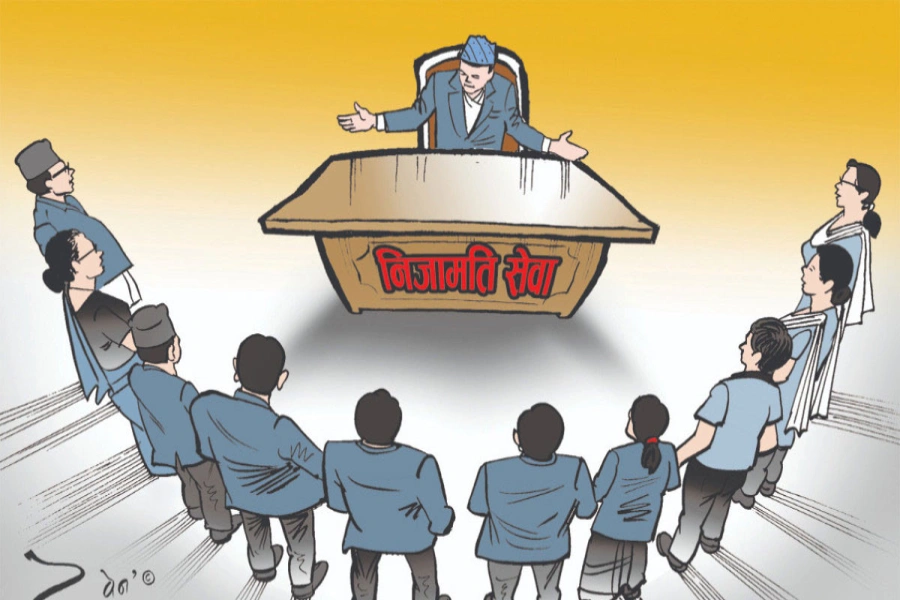
KATHMANDU, April 26: A new civil service blueprint prepared by the government signals one of the most far-reaching attempts in years to reshape Nepal’s bureaucracy—tightening political restrictions, restructuring administration under federalism, and redefining how civil servants are recruited, evaluated and retained.
At the heart of the draft Federal Civil Service Bill is a firm push for neutrality and performance-based governance. Civil servants who join political parties, affiliated organisations, or engage in political activities would not only face dismissal but also be permanently barred from future government service—an unusually stringent provision that marks a clear departure from past frameworks.
The bill also proposes raising the retirement age to 60 years while simultaneously lowering the upper age limit for civil service entry to 32 years for men and 35 years for women, reshaping both ends of bureaucratic careers.
In another major shift, the draft seeks to dismantle the long-standing trade union system within the civil service, arguing that it has blurred professional boundaries and encouraged politicisation of the administration.
Retirement age Increase threatens 2,500 new govt appointments

Instead, the bill envisions a merit-driven bureaucracy anchored in performance evaluation. Civil servants will be assessed based on institutional outcomes, service delivery indicators, citizen feedback and a newly introduced ethics-based profiling system.
Senior bureaucratic positions, including secretaries and chief secretaries, would be placed on fixed two-year tenures, extendable only on the basis of performance. The draft also opens the door for “lateral entry” into specialised or senior posts through competitive and competency-based mechanisms.
Structurally, the bill attempts to align the civil service with Nepal’s federal setup. Provincial services will extend up to the 12th level, while chief secretaries will be appointed from among 13th-level federal officials. For the next five years, the federal government will continue deploying chief administrative officers to local governments through provincial structures.
To regulate career progression and postings, a Civil Service Board is proposed, tasked with managing transfers and appointments up to the under-secretary level, alongside enforcing minimum service durations to curb frequent reshuffling of officials.
The draft further introduces strict conflict-of-interest provisions, barring civil servants from any role that could intersect with personal, family, or financial interests. It also imposes a two-year cooling-off period before retired or resigned senior officials can assume constitutional, diplomatic, or other government roles.
Despite its ambition, the bill enters a long-standing legislative vacuum. Successive attempts to enact civil service legislation since federalism was adopted have stalled due to political disagreements and parliamentary disruptions—making this latest draft both a policy milestone and another test of Nepal’s reform capacity.