


KATHMANDU, July 8: Nepal Rastra Bank (NRB) has estimated that the credit demand from the private sector will grow by 11 percent in the next Fiscal Year (FY). The projection stands in stark contrast to the past policies of the central bank, which failed to boost private sector lending of the banks and financial institutions (BFIs) in the last few years.
Unveiling the Monetary Policy for FY 2026/27 on Tuesday, the NRB has set an ambitious target once again amid poor confidence of the private sector. According to the NRB, private sector credit growth has remained modest at around 6 percent against the 12 percent projected in the monetary policy for this FY.
While the government’s projection of achieving a seven percent economic growth has invited questions, the central bank has blindly supported the government’s growth rate, mainly on the assumption that the BFIs’ private sector lending will regain momentum in the upcoming fiscal year. Credit demand is expected to regain momentum, benefiting from positive spillover effects of policy reforms that are envisaged to revitalize consumer demand, foster a resilient investment climate, and consolidate investment sentiment, the NRB claims.
The credit-extending capacity of BFIs is expected to improve as non-performing loans moderate following the resurgence of economic vibrancy and policy measures of the NRB for 2026/27.
Revised interest rate corridor system introduced
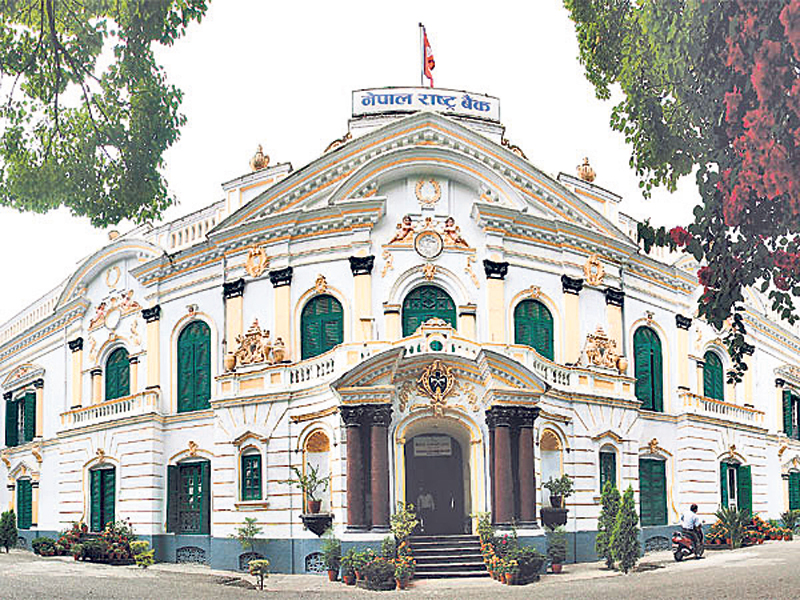
In addition, NRB has emphasized that the government’s effective execution of capital expenditure, timely policy reforms, restoration of private sector confidence, and improvement in the overall investment climate—alongside the central bank’s supportive measures—will be decisive in shaping the trajectory of credit demand.
Speaking at a program on Tuesday, NRB Governor Bishwo Nath Poudel informed that they have given continuity to the flexible monetary policy for the upcoming FY. According to him, the monetary policy for the upcoming fiscal year has made necessary arrangements to reduce the costs for the establishment and adjustment of branches of BFIs.
Governor Poudel said that the monetary policy for the upcoming fiscal year has given continuity to the current bank rate, policy rate, deposit collection rate, mandatory cash balance, and statutory liquidity ratio.
The monetary policy talks about implementing various flexible arrangements for facilitating credit. It states that special policy arrangements will be made to eliminate the situation where unlimited liability is created from personal guarantees as security for loans, and to reduce the situation where access to banking services is hindered by being blacklisted due to check dishonor.
Similarly, it aims to keep the inflation rate within 5.5 percent. “Inflation is projected to gain some momentum in the near term with moderation in the medium term,” the Monetary Policy states.
Inflationary pressure is projected to continue for a few months as the prices of petroleum products and food items have been increasing due to supply-side factors, but it is expected to decrease from the fourth quarter of the upcoming FY.
Likewise, special policy arrangements will be made to manage non-performing loans in sick industries, recovery of sub-standard loans, determine the share collateral loan limit based on the strength of the institution, and facilitate the loan-to-value ratio of large electric vehicles used as public transport.
The monetary policy states that the central bank will encourage commercial banks to invest in foreign government bonds to facilitate the management of liquidity flow through foreign currency purchases. Seeking to introduce new tools to manage excessive liquidity, the central bank also aims to introduce a policy of ‘sterilized intervention’ during the purchase of foreign currency.
Under the proposed policy, the central bank shall intervene when the value of the currency increases or decreases significantly. ‘Sterilized intervention’ is expected to keep the money supply stable and adjust the exchange rate, according to Governor Poudel.
In addition, the monetary policy has targeted to change the modality of classifications of the BFIs. “The policy has been adopted to reclassify BFIs and move forward with the concept of banking with specialized services according to the size and nature of the business," the NRB states.





