


KATHMANDU, June 29: As Nepal marked National Paddy Day on Monday, the government reiterated its ambition of making the country self-reliant in rice production. Yet, actual plantation progress remains sluggish, with only 11.3 percent of rice fields sown nationwide.
Nepal has 1.38 million hectares of land under rice cultivation, but just 156,583 hectares have been planted so far. Officials attribute the delay to inadequate rainfall despite the onset of the monsoon and limited irrigation facilities. Compared to 15.6 percent completion by the end of June last year, this year’s plantation has declined by 4.3 percent.
Regionally, Lumbini Province has recorded the highest progress, with 20.8 percent of its rice fields planted. Government records show plantation at seven percent in Gulmi district, four percent in Palpa, and only 0.4 percent in Banke district.
Plantation completed in 50% of paddy fields in 14 districts
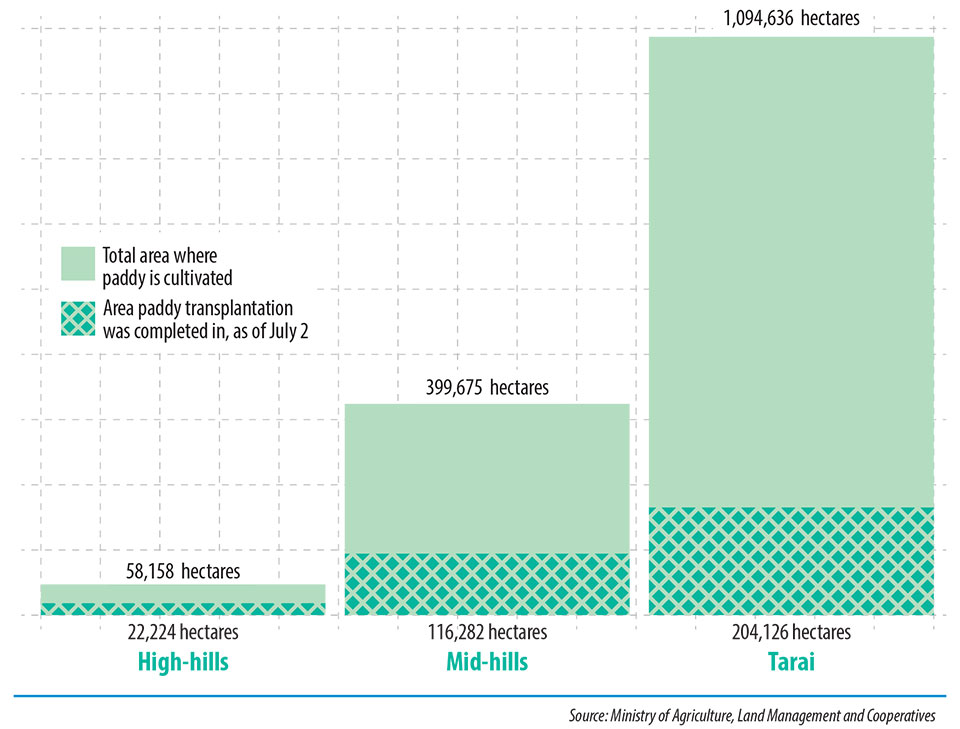
Meanwhile, the government celebrated the 23rd National Paddy Day under the slogan “Climate-Friendly Technology, Self-Reliance in Rice, and Prosperity.” In her message, Minister for Agriculture, Forests and Environment Gita Chaudhary called for expanding monsoon and spring paddy cultivation, developing improved rice varieties, transferring technology, expanding irrigation, ensuring access to production inputs, and guaranteeing fair prices to reduce imports. However, critics note the absence of a concrete plan to boost production.
During the zero hour of the National Assembly meeting on Monday, Lawmaker Mina Singh Rakhal urged the government to address shortages of water, fertilizer, and seeds to accelerate plantation and meet domestic demand.
Data from the Ministry of Agriculture and Livestock Development (MoALD) show Nepal produced a record 5.9 million tons of paddy in fiscal year 2024/25. Output fell by 4.2 percent this year to 5.7 million tons. With per capita rice consumption at 138 kilograms annually, the country requires 4.1–4.2 million tons to meet domestic demand. Despite this, Nepal continues to spend billions of rupees on rice imports each year.
MoALD Secretary Rajendra Prasad Mishra highlighted the challenge of shrinking paddy fields, citing land plotting, climate change, migration, and farmers shifting to cash crops as key factors. Nepal’s rice productivity currently stands at around four tons per hectare — less than half that of developed countries. Mishra said food security could be ensured if productivity doubled to eight tons per hectare. “In addition, there is a need to expand spring paddy production, enabling two harvests per year to achieve self-reliance in rice,” he added.








-1200x560-1774606010.webp)


