


KATHMANDU, April 17: Nepal’s public debt has continued its upward trajectory, rising steadily over the first nine months of the current fiscal year (2025/26). In this period alone, the debt stock has increased by around Rs 250 billion, reflecting growing fiscal pressure on the government amid weak revenue performance, exchange rate losses, and rising borrowing needs for development spending.
According to the Public Debt Management Office (PDMO), Nepal’s total public debt liability stood at around Rs 2.934 trillion as of mid-April 2026. At the beginning of the fiscal year, the figure was about Rs 2.675 trillion. The increase over the nine months stands at roughly Rs 260 billion, underscoring a consistent upward trend in government borrowing.
Government data shows that public debt has now reached 48.04 percent of the country’s Gross Domestic Product (GDP), signaling a gradually deepening debt burden on the economy. In terms of structure, external debt continues to dominate. As of mid-April, external borrowing accounts for 52.69 percent of total public debt, while domestic debt makes up 47.31 percent. Officials attribute the relatively higher share of external debt largely to fluctuations in foreign exchange rates, which have inflated the rupee value of foreign liabilities.
Economists and policymakers have long warned that rising debt carries long-term fiscal risks if borrowed funds are not channelled into productive sectors. They emphasize that debt sustainability depends not just on borrowing levels but on whether investments generate sufficient economic returns. Strengthening revenue mobilisation, controlling unproductive expenditure, and expanding economic activity remain key priorities for maintaining balance.
Public debt hits Rs 2.8 trillion mark
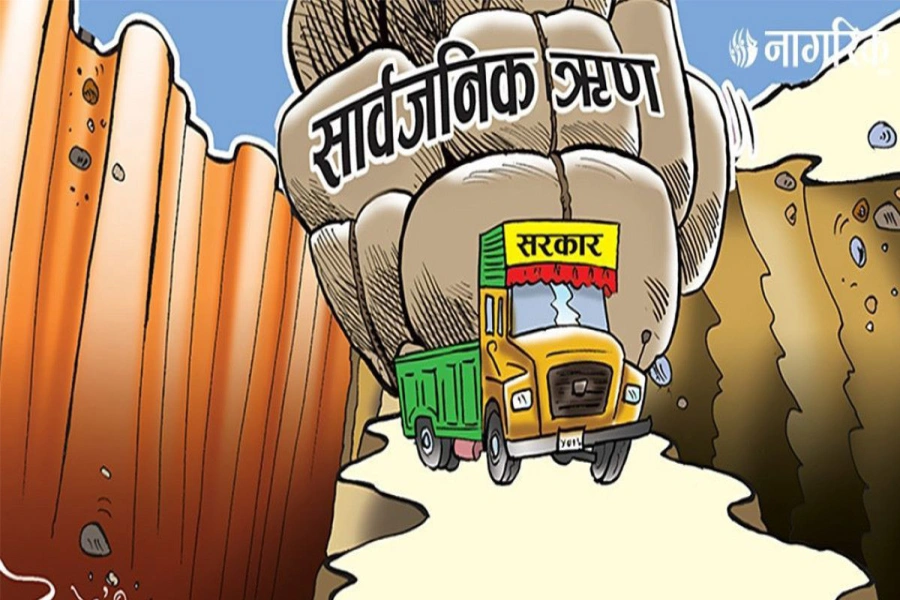
In recent years, Nepal’s public debt has been climbing steadily, driven by a combination of weak revenue collection, low capital expenditure absorption, rising recurrent spending, and increasing reliance on external financing. Large-scale infrastructure projects, social sector commitments, and broader development needs have further pushed borrowing requirements upward. With revenue growth failing to keep pace with expenditure demands, debt financing has increasingly become a fiscal necessity rather than a policy choice.
During the nine months, the government received Rs 34.82 billion in fresh loans and repaid Rs 20.41 billion, excluding interest payments. However, the debt burden was further amplified by a significant Rs 11.57 billion loss due to foreign exchange rate fluctuations, which increased the rupee value of external liabilities.
Breaking down the structure of public debt, domestic borrowing has reached Rs 1.388 trillion. At the start of the fiscal year in mid-July, domestic debt stood at Rs 1.268 trillion. Between mid-July 2025 and mid-April 2026, domestic debt rose by Rs 28.36 billion, while repayments worth Rs 16.37 billion were made. Domestic debt now stands at 22.73 percent of GDP.
Similarly, external debt has climbed to Rs 1.546 trillion. It was Rs 1.405 trillion at the beginning of the fiscal year. Over the nine months, Rs 6.44 billion was added, while Rs 4.39 billion was repaid. The rise in external debt has been significantly influenced by exchange rate volatility, which has increased the local currency valuation of foreign loans. External debt now accounts for 25.31 percent of GDP.
The rising debt stock comes at a time when expanding government structures, growing employee expenses, rising social security obligations, and increasing administrative costs are already putting pressure on the national budget. In this context, borrowing has become essential to bridge persistent resource gaps. As domestic resources remain insufficient to finance development priorities, the government continues to rely on both domestic and external borrowing.
According to the PDMO, all borrowings are being undertaken within approved budgetary limits. Officials also acknowledge that exchange rate fluctuations have added a layer of financial pressure on debt servicing.
For the current fiscal year, the government has set a target of mobilising Rs 596 billion in public debt. Of this, Rs 362 billion is expected from domestic sources, while Rs 233 billion will come from external borrowing. External financing is largely tied to reimbursement and budget support from development partners based on project expenditures, prompting greater emphasis on domestic debt management.
The Ministry of Finance states that the annual borrowing plan is prepared after analyzing monthly revenue inflows and expenditure requirements to estimate the budget deficit and ensure adequate financing. Past debt servicing obligations, including principal and interest payments, are also factored into the planning process to maintain fiscal balance.
Under the medium-term debt management strategy, the government is gradually reducing reliance on short-term instruments such as Treasury Bills while increasing issuance of medium- and long-term development bonds. Officials also note that the borrowing plan has been developed in consultation with Nepal Rastra Bank, aiming to improve coordination between fiscal and monetary policy management.











