

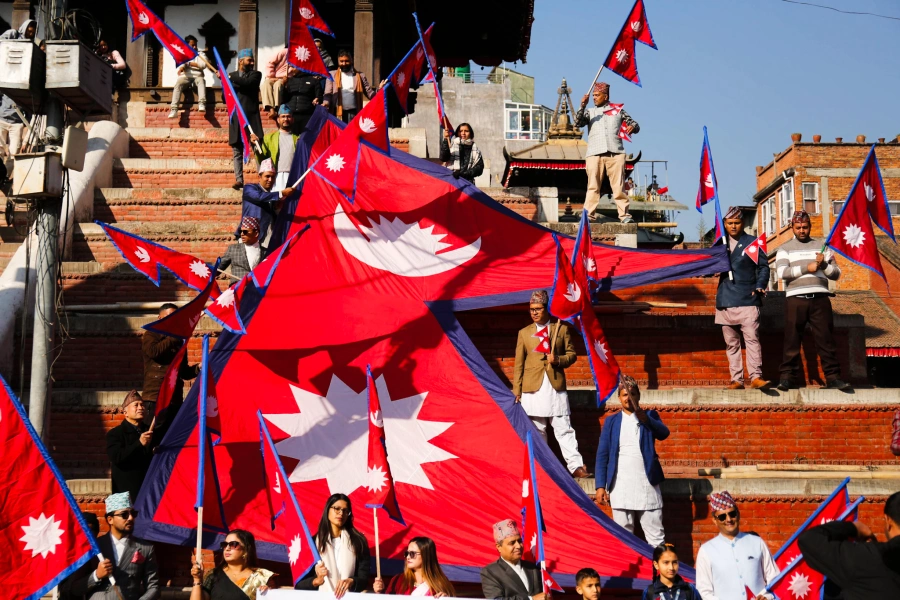
Standing in the mid-April heat of 2026, Nepal’s political atmosphere feels fundamentally different from the stagnant air we breathed for three decades. Only a month ago, the nation witnessed a general election on March 5, 2026, where the “Bell Party,” riding on the iconic appeal of rapper-turned-politician Balen Shah, secured a historic landslide of 182 seats—establishing the first single-party majority government since 1999. Today, as Prime Minister Balen Shah occupies office at Singha Durbar, it is essential to look back at the catalyst of this transformation: the singular upheaval of the “September Spring” in 2025.
Those two days of defiance on September 8 and 9 were not just protests; they were the final, decisive rupture with a past that had held the country in regression since the 1990s. For over three decades, Nepal was trapped in a weary game of musical chairs played by three gerontocratic vanguards who rotated power with cynical disregard for the public. This era was defined by a striking lack of stability, with over three dozen governments taking office, none completing a full five-year term.
Collapse of the Gerontocratic “Cash Cow” Politics
The political culture of those three decades was built on a gerontocracy that operated on what can only be described as a “cash cow” model. The state treasury was treated as a personal venture by demagogues who considered politics their permanent profession, to be milked until their final breath.
These old vanguards presided over an epidemic of corruption that seeped into every corner of the bureaucracy, while public disenchantment reached a breaking point. Their system thrived on the assumption that citizens would remain passive and that youth would remain a silent demographic to be manipulated during elections.
However, the catalysts for the eventual revolt were both systemic and sudden. The tipping point came when the government, in a desperate attempt to stifle dissent, moved to ban 26 social media platforms and curtail digital expression. By attempting to sever the digital nervous system of the youngest generation, the vanguards inadvertently signaled their own end.
They failed to recognize that Generation Z—digital natives who view connectivity as a fundamental right—would not tolerate the erosion of their future. Rising frustration, fueled by systemic corruption and institutional inertia, created a tinderbox that needed only a spark for a full-scale transformation.
September 8–9 and the Global Domino Effect
The revolt represented a systemic rejection of kleptocracy and a demand for a transparent, functional political order. On September 8 and 9, 2025, large-scale anti-corruption protests erupted across Nepal, predominantly led by Generation Z students.
Desperate search for missing girls as nearly 80 dead in Texas f...

The movement was driven by youth who were tired of seeing their future either exported abroad or consumed by domestic scandals. These two days of mobilization were marked by a “facelessness” that baffled traditional political structures. Organized digitally, the movement had no single leader or representative.
However, this vacuum also enabled “hijackers”—opportunistic figures from the old political establishment—who attempted to appropriate the movement for their own survival. Yet the student vanguard remained clear: they were not there to replace one demagogue with another, but to end the business model of politics itself.
The impact of the Gen Z movement extended beyond Nepal. A “domino effect” was observed in geographically and culturally distant regions—from Belgrade in Serbia to urban centers in Morocco, Togo, Kenya, and Madagascar—where youth movements began mirroring Kathmandu’s tactics. This transnational resonance demonstrated that the grievances of Nepal’s Gen Z were universal.
Across the world, young people were confronting the same intergenerational contradiction: aging elites consolidating power at the expense of the future. Nepal’s revolt thus became a global reference point, showing that digital mobilization had lowered the threshold for collective action beyond traditional suppression mechanisms.
Saving the Nation’s Potential Through a Fresh Mandate
Perhaps the greatest contribution of the September Spring was the preservation of national energy, time, and resources. The Gen Z movement ensured the untimely political end of leaders who had intended to remain in power indefinitely.
By forcing a crisis of legitimacy in 2025, the movement saved Nepal from another potential two decades of stagnation. Without it, the cycle of political rotation would likely have continued until the old guard exited naturally, wasting years of national progress and billions in resources.
Instead, the youth accelerated the pace of history, clearing the path for a fresh mandate and a renewed social contract.
This transition was formalized in the March 2026 election. The shift from the raw energy of protest to the governance of Balen Shah represents one of the most significant structural changes in Nepal’s modern political history. He has become the vessel of Gen Z aspirations, embodying a service-oriented and action-driven political ethos.
The symbolic convergence of Balen’s leadership and the institutional framework of the Rastriya Swatantra Party (RSP) provided the movement with a constitutional channel. The faceless energy of the September Spring crystallized around the “Bell” symbol, securing a commanding 182-seat majority and ending the era of hung parliaments.
A Sustainable Political Future
From the vantage point of April 2026, it is evident that the September Spring marked Nepal’s political maturation. The country moved from cycles of instability to a value-driven democratic mandate.
Those who attempted to hijack the movement have largely been sidelined by a public demanding authentic representation. This moment demonstrates that the “fresh mandate” is not only about new leadership but also about justice for the 76 lives lost during the September Spring.
Their sacrifice ensures that governance now focuses on institutionalizing transparency, accountability, and digital responsiveness—principles championed by the Gen Z movement.
Ultimately, the “cash cow” model of politics has been dismantled, and the old cycle of musical chairs has ended. Nepal is no longer a nation waiting for leaders to retire; it is a country actively shaping its own future.
The legacy of the September Spring is a sustainable political order where politics is no longer treated as a business venture, but as a sacred responsibility to serve every generation. The nation has reclaimed its energy and time—and for the first time in thirty years, the clock is moving forward.
The author is BA LLB student at Kathmandu School of Law

-1200x560-1781083488.webp)








