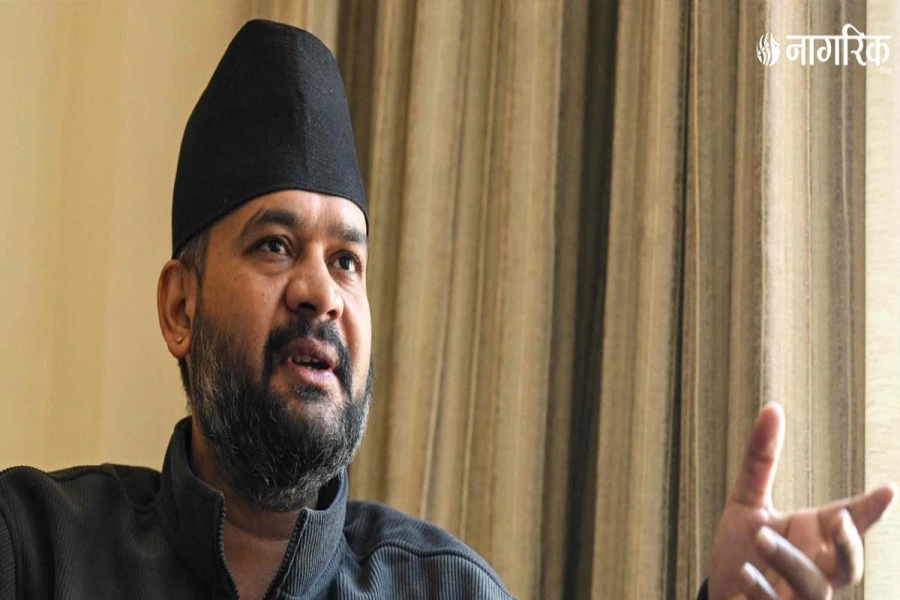
KATHMANDU, July 11: The death of 25-year-old Pathao rider Ganesh Nepali, who set himself on fire outside the Department of Passports in Tripureshwor on Thursday and succumbed to his injuries at Bir Hospital on Friday, has shaken Nepal. What reportedly began as a dispute involving traffic enforcement and Kathmandu Metropolitan City (KMC) police ended in an unimaginable tragedy, raising difficult questions about the conduct of public institutions, the mental well-being of young people, and the ways in which citizens express protest.
The exact sequence of events remains under investigation. Eyewitnesses claim the dispute erupted after KMC police wheel-locked Nepali's motorcycle. They allege that despite his repeated apologies, the lock was not removed, and that he was slapped by a police officer before dousing himself in petrol and setting himself ablaze. Police, however, have urged restraint, saying the facts will be established only after a thorough investigation. CCTV footage and other evidence will ultimately determine what happened. Until then, it would be inappropriate to declare anyone guilty or innocent.
One fact, however, is beyond dispute: a young man chose to set himself on fire in broad daylight, and that decision cost him his life. That reality alone demands serious reflection from society.
Ganesh Nepali was not a criminal. He was a young man struggling to earn a living as a Pathao rider from early morning until late evening. He was burdened by motorcycle loan repayments, preparing for the civil service examination, and considering foreign employment if he failed to secure a government job. He also carried the responsibility of supporting his wife, young daughter, elderly parents, and elder brother.
Why would someone in such circumstances make an irreversible decision within a matter of minutes? The answer cannot be sought only in individual temperament or impulse. It must also be understood through the lens of social, economic, and psychological pressures.
Desperate search for missing girls as nearly 80 dead in Texas f...
Nepal today is witnessing growing economic insecurity and uncertainty. Unemployment, debt, rising living costs, and anxiety about the future have placed many young people under relentless stress. Under such conditions, even an incident that may appear minor can be perceived as unbearable humiliation or the collapse of hope itself. Ganesh's death, therefore, cannot simply be dismissed as an act of momentary rage.
Yet another equally important question arises: Can self-immolation ever be a legitimate form of protest against injustice or humiliation?
The answer is no.
History records instances where self-immolation has galvanized political movements. But no democratic society accepts it as an appropriate means of protest. Such acts rarely end injustice; instead, they first destroy the future of an entire family.
Ganesh still had avenues through which he could have sought justice. Had he survived, he could have pursued legal action, approached the National Human Rights Commission (NHRC), sought media attention, or mobilized public support. By losing his life, however, the fight for justice shifted from his own hands to those of others.
More concerning, however, is the tendency of social media to romanticize such incidents, portraying them as acts of sacrifice or revolution. If self-immolation is emotionally glorified, it risks encouraging other distressed individuals to see it as a meaningful response to suffering. While Ganesh deserves compassion, his decision should never be celebrated as a model of protest.
The incident also raises uncomfortable questions about the conduct of state institutions. If eyewitness accounts prove accurate, why did what began as a routine administrative action escalate into a situation marked by humiliation and confrontation? Did the police officers involved exercise restraint, respect, and professionalism while dealing with a citizen? If excessive force or misconduct occurred, it must be investigated independently and those responsible held accountable.
Equally troubling are allegations that those present failed to extinguish the flames promptly after Nepali set himself on fire. Regardless of whether a person is accused of any wrongdoing, preserving human life must remain the foremost responsibility of both the state and society. These claims, too, deserve an impartial investigation.
Ultimately, this tragedy is not solely about police conduct or one man's emotional breakdown. It reflects deeper problems within Nepali society: rising intolerance, mounting psychological stress, and an erosion of dialogue. The fact that an ordinary dispute could spiral into such a catastrophic ending suggests a society struggling to manage anger and conflict. Social media outrage, financial pressures, and declining trust in institutions have only intensified these tendencies.
Ganesh Nepali will never return. His family has lost a husband, a father, a son, and their primary source of support. But Nepal can still learn from his death.
Public officials must treat citizens with dignity and humanity. Police officers and other frontline public officials should receive stronger training in communication, conflict de-escalation, and stress management. At the same time, the country needs better access to mental health services, crisis counseling, and effective, accessible mechanisms through which citizens can seek legal redress and file grievances.
Most importantly, no insult, injustice, or moment of anger is greater than a human life. Democratic societies provide lawful avenues for seeking justice—through the courts, the NHRC, the media, civil society, and peaceful public movements. At times, those institutions may appear slow or imperfect, but once a life is lost, those avenues lose their meaning for the person who needed them most.
Ganesh Nepali's death has rightly intensified demands for a fair and transparent investigation. Justice must be established through evidence, not speculation. But the tragedy also carries a broader warning: Nepal must never become a society where a slap, a perceived humiliation, or a wheel lock weighs more heavily than the value of human life.
If these questions go unanswered, Ganesh Nepali's death will fade into just another headline. But if it compels the state, society, and citizens alike to reflect and reform, his tragic death may yet serve as a warning that helps prevent another such loss in the future.



-1200x560-1774606010.webp)
-1200x560-1783685616.webp)