KATHMANDU, April 24: It has been 20 years since the country entered the democratic era. Democracy in Nepal was established through the People’s Movement of 2006 (2062/63 BS).
Seven political parties and the then armed insurgent CPN (Maoist) jointly led the movement against the autocratic rule of King Gyanendra Shah. The movement reached its peak on April 24, 2006 (Baisakh 11, 2063 BS), the day when all powers held by the king were restored to the people.
Baisakh 11 also marks the day the country moved decisively toward democracy, with the reinstatement of the House of Representatives dissolved by the king. Since then, the day has been observed annually as Democracy Day.
On October 4, 2002 (Ashoj 18, 2059 BS), King Gyanendra dismissed the elected prime minister and assumed executive authority, raising serious questions about the constitutional monarchy. After consolidating power, he imposed what amounted to an undeclared restriction on political parties. His actions were widely unpopular, drawing criticism even from parties that had supported constitutional monarchy.
The CPN (Maoist), which had launched an armed insurgency in 1996 (2052 BS) under the banner of a “people’s war,” was seeking a path toward peaceful politics. Meanwhile, pro-democracy parties were already protesting against the king’s actions. In this context, the Maoists also sought to join the peaceful movement led by the seven-party alliance. On November 22, 2005 (Mangsir 7, 2062 BS), the alliance and the Maoists signed a 12-point agreement in New Delhi, agreeing to jointly advance a movement aimed at ending the monarchy and establishing full democracy.
How strong is internal democracy within political parties?

The agreement injected new momentum into the movement. The decisive protest launched by the seven-party alliance on April 7, 2006 (Chaitra 24, 2062 BS) gained strength with Maoist support. As a result, King Gyanendra agreed to reinstate Parliament on April 24, 2006. The Maoists, who had taken up arms against the state since 1996, also entered the path of peace and multiparty democracy.
On May 18, 2006 (Jestha 4, 2063 BS), the reinstated Parliament suspended the monarchy and transferred even the powers of the head of state to the prime minister. From that point onward, Nepal’s politics began to move along a democratic course.
The Comprehensive Peace Accord signed on November 21, 2006 (Mangsir 5, 2063 BS) formally ended the decade-long armed conflict. The Maoists joined the peace process and mainstream politics. Constituent Assembly elections were held in 2008 (2064 BS), and on May 28, 2008 (Jestha 15, 2065 BS), its first meeting declared the end of the 237-year-old monarchy.
The Assembly also proclaimed Nepal a federal democratic republic.
From the People’s Movement to the declaration of the republic, the country avoided large-scale bloodshed. Although King Gyanendra was compelled to surrender to democratic forces, he did not resort to extreme repression that would cause widespread loss of life and property. As a result, he continues to live in the country as an ordinary citizen. This remains one of the more notable aspects of Nepal’s democratic transition.
Following the establishment of the federal democratic republic, Nepal adopted a new constitution in 2015 (2072 BS), which currently guides the governance system. Under this constitution, parliamentary elections held in 2017 (2074 BS) brought a near two-thirds majority government led by an alliance of CPN-UML and the Maoists. However, that alliance eventually collapsed due to internal power struggles. Political parties have since continued forming and breaking alliances in pursuit of power, often failing to respect public mandates. This has led to declining trust among younger generations toward traditional parties.
Democracy has enabled ordinary citizens to rise to the highest offices of the state, and the country has embraced federalism, inclusion, proportional representation, and secularism. These achievements were made possible through popular movements.
While political parties played a significant role in establishing democracy, they have struggled to internalize democratic practices over the past 20 years. Leadership transition and generational change have not taken place, with older leaders continuing to dominate both party structures and state power. Their reluctance to step aside contributed to unrest and destruction carried out in the name of the Gen Z movement.
Since that uprising, demands for generational change in Nepali politics have intensified. Younger generations have increasingly challenged traditional leadership through social media and public protests, calling for reform. Despite pressure to introduce new leadership and update policies, established parties largely resisted change. As a result, younger voters intervened through elections, leading to a shift in power from older to newer generations.
The Gen Z-led movement, which prioritized transparency, good governance, job creation, climate change, and gender equality, brought down the old guard and elevated a new generation into power. This shift has forced older leaders to reconsider their approaches and agendas.
The Nepali Congress has already brought younger leadership forward through a special general convention, and similar debates on leadership transition are gaining momentum in other parties. Political science professor Krishna Pokharel notes that the rise of a new generation has placed leaders over 70 in a position of crisis. “A 36-year-old is now prime minister, and even younger individuals are serving as ministers. The country is being run by the youth. The older generation has failed to justify its continued relevance and must now do so,” he says.
The Over-70 Generation Rejected
— Krishna Pokharel, Professor
In Nepal, many politicians have no professional identity beyond politics. Politics has become almost like an addiction. There is an entry point, but no clear exit. Although CPN-UML once introduced an exit mechanism, it was later removed for convenience. There is little planning for life after politics.
Some leaders from UML, including Bharat Mohan Adhikari, Keshav Badal, Yubaraj Gyawali, Siddhilal Singh, Ashta Laxmi Shakya, and Amrit Bohora, retired gracefully. By that measure, leadership transition should have taken place more broadly, but it has not.
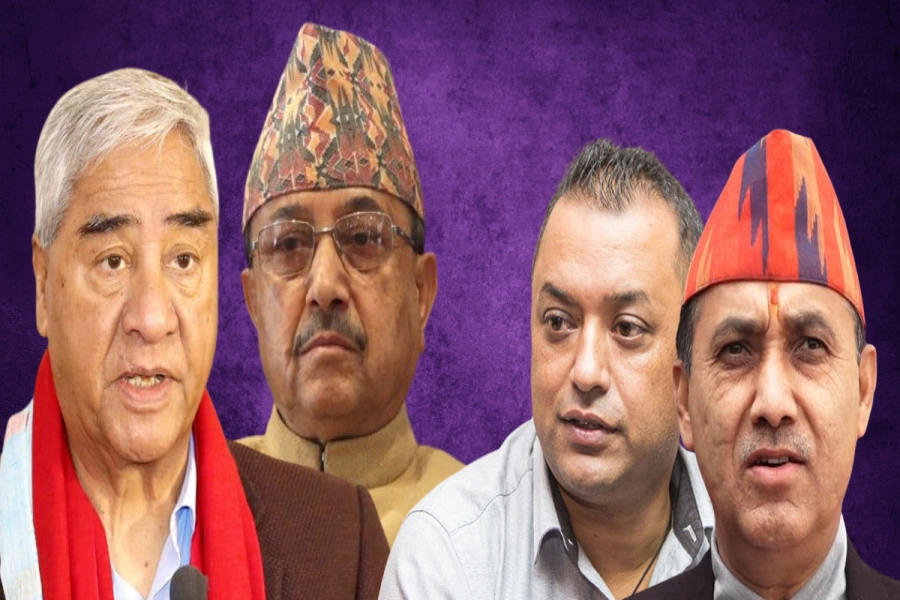
Former Nepali Congress president Sher Bahadur Deuba may still have ambitions for office. KP Sharma Oli and Pushpa Kamal Dahal (Prachanda) also show no signs of stepping down. With a 36-year-old prime minister now in office, leaders over 70 can no longer justify their continued dominance. Public opinion has already rejected them, and they can no longer ignore it. They should not continue to cling to leadership positions.