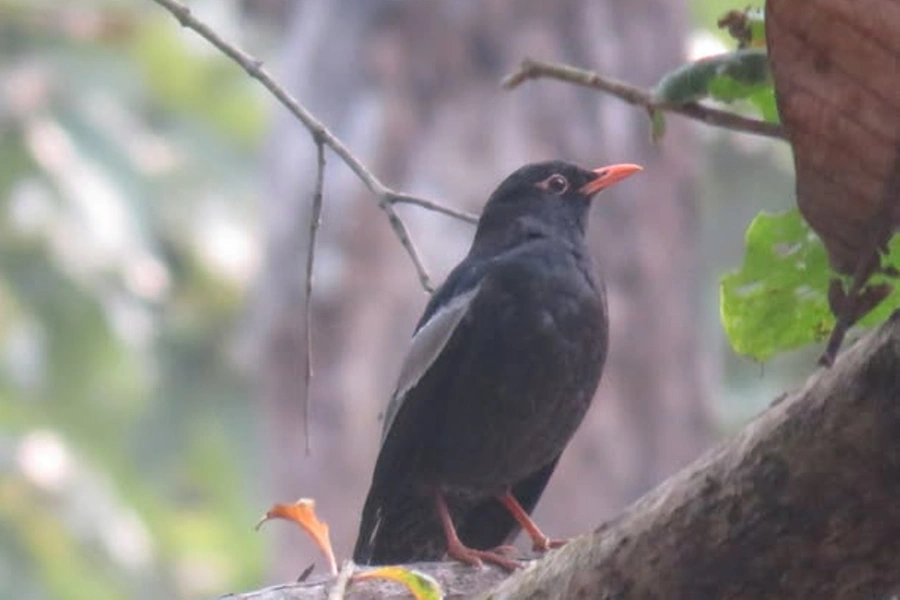
KANCHANPUR, Feb 27: The ‘Madana Chanchar’ bird has been spotted for the first time in Shuklaphanta National Park, a protected area known for its rich biodiversity.
The bird, which is usually found in mid-hill and Himalayan forest regions, has been recorded in the flat Tarai tropical belt, a development considered significant from a conservation perspective.
The Madana Chanchar was documented in the park by a team that included senior ornithologist Hirulal Dagaura, Dilip Chand Thakuri, Suman Chaudhary, Dr Bikalpa Pandey and others from the Bird Conservation Society Nepal (BCN) during a birdwatching survey.
Tiger census begins in Shuklaphanta through camera trapping

The scientific name of the Madana Chanchar is Turdus boulboul. It belongs to the thrush family. Although the International Union for Conservation of Nature (IUCN) has listed the species as being of ‘Least Concern’ globally, meaning it is relatively common, it is considered a completely new and locally rare species for Shuklaphanta, according to ornithologist Dagaura.
He said the bird primarily inhabits moist forests in the mid-hills and Himalayan regions. Generally found at altitudes ranging from 1,800 to 2,700 metres, the species may migrate to slightly lower elevations during winter. However, Dagaura noted that its presence in the flat plains of the Tarai is unusual.
“Although common globally, seeing it in Shuklaphanta is a locally rare event. It may indicate changes in environmental conditions or migration patterns,” he said. The Madana Chanchar measures about 28–29 centimetres in length.
He added that the appearance of this species—considered native to hilly regions stretching from Nepal to northern Vietnam—in the Tarai may indicate the impact of climate change or ongoing changes in the ecological system.
According to Dagaura, the presence of a bird typically found in hilly regions suggests that the biodiversity range in Shuklaphanta is expanding. With the arrival of this new species, the total number of bird species recorded in the park has increased further.
The documentation of this hill-region bird in Shuklaphanta will help establish the park as an even more important destination for birdwatching and scientific research.
RSS