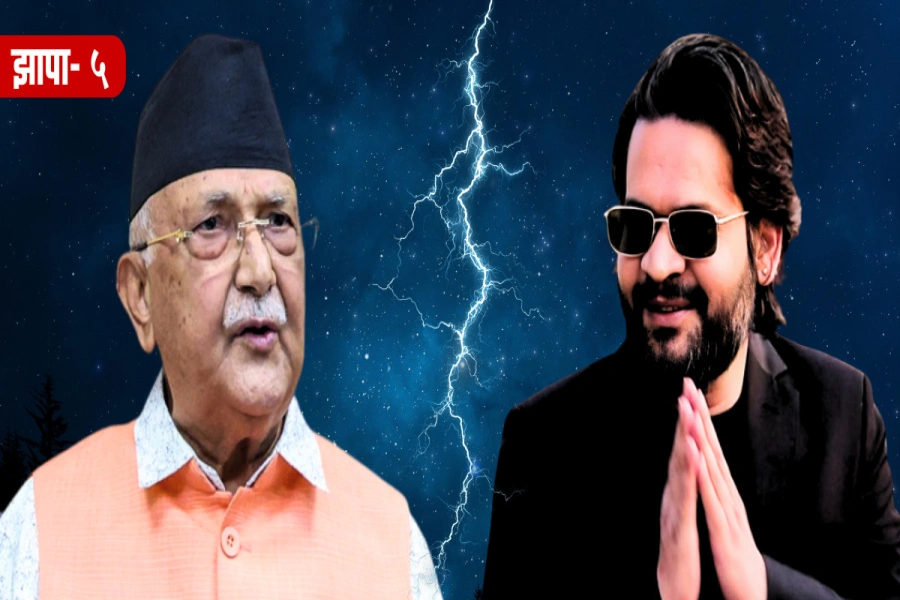
DAMAK, Feb 25: The electoral battle in Jhapa Constituency-5 has formally begun, with CPN-UML launching its first election assembly here on Monday. While the Rastriya Swatantra Party (RSP) has been staging election-focused gatherings across different parts of the country, UML chose Jhapa-5 — the stronghold of its chairman — to fire its opening salvo.
UML Chairman KP Sharma Oli himself is the candidate from this constituency. In previous elections, UML generated a nationwide wave through massive campaign rallies. This time, however, the party appears to be recalibrating its strategy, delaying large public assemblies and focusing instead on quieter, more calculated groundwork.
Rather than relying on grand stages and sweeping speeches alone, UML leaders and candidates have been holding internal meetings, engaging in discussions, and reaching voters at the grassroots level, seeking to consolidate support from within.
Despite UML’s strong organizational base in Jhapa-5, Oli is not without internal challenges. Some leaders and cadres have raised concerns, alleging that certain figures close to Oli failed to address public issues effectively and became distant or arrogant after assuming positions of power.
Yet, Oli’s stature remains formidable. His long record of victories from this region, his national and international visibility, and his firm stance on nationalism continue to anchor loyalty among supporters. For many, that legacy outweighs internal grievances.
In both the 2017 and 2022 elections, Oli’s campaign appearances across constituencies were widely credited with generating votes not only for himself but also for local candidates. His speeches were often seen as vote-multipliers for the party.
Now, Balendra Shah — popularly known as Balen — is attempting to disrupt that entrenched base, banking on his personal popularity and appeal to new voters. Even so, Oli does not appear significantly weakened. If anything, he has concentrated his full political machinery on Jhapa-5 this time. He is also maintaining strong media visibility, consistently projecting his narrative.
At Monday’s rally in Damak, Oli likened the country to “a vehicle without a driver” after he was removed from government. Yet notably, the very next day, he refrained from attending public events — a strategic pause or calculated silence, depending on how one reads it.
Addressing the rally, Oli argued that the country could only move forward if he returned to government. Taking a direct swipe at RSP senior leader Shah, he remarked: “I hear people saying he is a candidate for prime minister. If you ask children what they want to become, they might say prime minister or president. But that doesn’t mean they become one. They can declare themselves whatever they like.”
COVID-19: Second wave much deadlier than the first wave

While Oli was delivering this critique, Shah was campaigning in Itahari with a different message. He urged voters to consume vegetables grown in Nepal’s eastern hills rather than those imported from across the Indian border. By questioning cross-border vegetable consumption, Shah positioned himself as an informal guardian of economic nationalism.
“Have you eaten? Where were the vegetables you had this morning from? Across the border? You ate vegetables from across the border. You haven’t been able to eat vegetables produced in Ilam or Panchthar,” Shah told voters.
Even as Shah invoked nationalist sentiment through local produce, many voters were reminded of Oli’s own nationalist credentials — particularly his strong opposition to India’s blockade following the promulgation of Nepal’s Constitution in 2015.
Oli’s political journey has not been without setbacks. In 2008, amid the surge in popularity of the then CPN (Maoist Centre) after its transition from underground politics, he faced his first electoral defeat.
Otherwise, his career has largely been marked by victory. For Shah, contesting in Jhapa-5 is a calculated risk — driven by the belief that defeating Oli in his own stronghold would carry symbolic and national weight far beyond a simple electoral win elsewhere.
RSP is hopeful that, in addition to the 11,759 votes it secured in the previous election, it can draw support from UML, Nepali Congress (NC), RPP, and other parties this time. Meanwhile, the seasoned Oli is meticulously managing internal party dynamics to counter Balen’s challenge.
Shah is determined to defeat Oli on his home turf. Oli, however, confidently claims he will secure victory by a double margin in his traditional base. Shah counters that defeating Oli in Jhapa-5 would position him to lead the country.
In his election manifesto for Jhapa-5, Shah has pledged that if his party forms the government under his leadership, it will establish a commission within 100 days and resolve the long-standing issues of landless people, squatters, and unmanaged settlements within 1,000 days — a bold timeline aimed at attracting voters seeking structural reform.
Yet even within Shah’s camp, enthusiasm about this pledge appears measured. Many supporters believe the election hinges less on policy promises and more on one singular objective: defeating Oli.
“This attractive slogan about solving the squatter problem is not enough. The election can only be won by opposing Oli. There is no real substance in this slogan. The squatter issue cannot be solved in 1,000 days. Whether Balen promises it or not, the goal is to defeat Oli,” said a hotel entrepreneur in Damak market. “First defeat Oli; the rest can be dealt with later.”
UML, fully aware of this sentiment, has intensified internal mobilization. From Monday night through late Tuesday night, Oli held a series of meetings with dissatisfied party members, attempting to consolidate unity.
Party insiders expect these engagements to help manage internal tensions and address local grievances. “There is no problem within the party. I am discussing issues and demands raised by the public,” said DeBendra Dahal, UML’s election commander for Jhapa-5.
Local RSP leaders, too, are reading the ground carefully. While they admit their organizational structure in Jhapa is comparatively weak, they sense a growing wave in Shah’s favor — though they prefer not to declare it openly. Their focus remains on converting perceived momentum into actual ballots. Shambhu Dhakal, secretary of RSP Jhapa, has gone so far as to claim the party will win all five constituencies in the district.
The arithmetic of the past
This marks Oli’s eighth electoral contest in Jhapa — a district that has long shaped his political identity.
He was first elected to the House of Representatives (HoR) from Jhapa-6 in 1991. He retained the seat in the 1994 mid-term elections with 18,861 votes, defeating NC’s Keshav Bahadur Budhathoki, who received 14,202.
In 1999, Oli contested from both Jhapa-2 and Jhapa-6 — and won both. In Jhapa-2, he secured 18,909 votes, narrowly edging out NC candidate Giriraj Kumari Prasai by just 17 votes (18,892). In Jhapa-6, he won more comfortably with 23,749 votes against NC’s Kashi Lal Tajpuriya, who received 19,713.
However, in the first Constituent Assembly election in 2008, contesting from Jhapa-7, Oli was defeated by CPN (Maoist Centre) candidate Bishwadip Lingden, who secured 16,099 votes to Oli’s 14,959.
He returned stronger in the second Constituent Assembly election in 2013, winning Jhapa-7 with 19,287 votes against NC candidate Suresh Kumar Yongya’s 11,041.
By 2017, Oli had consolidated power within UML. After being elected party chairman at UML’s ninth general convention in 2014 and becoming prime minister following the promulgation of the
Constitution in 2015, he cultivated the image of a “nationalist leader” by confronting India’s unofficial blockade. He soon emerged as one of Nepal’s most powerful political figures.
In 2017, UML formed an alliance with CPN (Maoist Centre) with plans for party unification. Oli also forged a strategic understanding with the Rastriya Prajatantra Party (RPP), which held a notable voter base in Jhapa.
Backed by these alliances, Oli won Jhapa-5 in 2017 with 57,139 votes, while NC candidate Khagendra Adhikari secured 28,297.
In the 2022 election, Oli again triumphed in Jhapa-5 with 52,319 votes. His closest rival, again NC’s Adhikari — supported by CPN (Unified Socialist) and CPN (Maoist Centre), which had split from UML — received 23,743 votes. RSP candidate Suresh Kumar Pokharel secured 11,759 votes.
As Jhapa-5 heads into another high-stakes contest, history, personality, organization, and momentum are colliding once again — setting the stage for a battle that could resonate far beyond the borders of a single constituency.