More than a century-old sociocultural affinity exists between Nepal and Japan, which formally evolved into bilateral diplomatic ties in 1956. As the two countries mark seven decades of enduring partnership this year, both governments have resolved to commemorate the anniversary with buoyancy in their respective countries. This shared unflagging enthusiasm culminated in the visit of President Ramchandra Paudel to Japan, undertaken at the invitation of the Japanese government. The high-level visit, held from February 1–4, vividly underscored how Nepal and Japan adore their bilateral diplomatic engagements. It is worth mentioning here that, in the annals of their bilateral relationship, this visit marked the first time that a Nepali Head of State paid an official visit to Japan, specifically to commemorate the platinum jubilee of diplomatic bonds.
Socio-Cultural Underpinnings
Although geographically distant, Nepal and Japan have cultivated a profound cultural proximity since ancient times, with Buddhism serving as a principal bridge linking the two civilizations. As per historical accounts, Siddhartha, son of King Suddhodhan and Queen Mayadevi, was born around 623 BCE in Lumbini and attained enlightenment as the Buddha in Bodhgaya at the age of 35. With the speedy spread of Buddhism across North and East Asia, Japan too was touched by this fascinating cultural movement. In Japan, Buddhism as a religion is generally believed to have been introduced in 552 Common Era (CE), although some sources also claim 538 CE, primarily through the Korean Kingdom of Baekje. Prince Shōtoku (574–622) is largely credited with the promotion and institutionalization of Buddhism in Japan, as he supported the construction of monasteries and temples, including Hōryū-ji, and played a pivotal role in integrating Buddhist principles into the governance and cultural life of Japan. Initially confined only to members of the socio-economic and political higher echelon, Buddhism was gradually followed by the broader Japanese populace, ever since it was intertwined with the indigenous Shinto belief system.
Historical records also note that the initial civilizational linkage between the two countries was due to a Japanese monk, Reverend Ekai Kawaguchi, a Zen priest, who first traveled to Nepal on January 26, 1899, in search of the original Sanskrit Buddhist sutras. The quest for Buddhist sutras led him to visit Nepal many times—in 1903, 1905, 1912, and 1913. During these trips, Kawaguchi visited Lumbini quite frequently. At that time, Nepal's astute Prime Minister Chandra Shamsher JBR, who envisioned the significance of the Japanese Buddhist monk Ekai for Nepal, extended him warm hospitality. Deeply impressed with the humility of the Government of Nepal, Kawaguchi, upon his return to Japan, assiduously worked to highlight Lumbini and its profound socio-religious importance to the Japanese public. He also urged the Japanese government and relevant institutions to support Nepal, the birthplace of Lord Buddha, through the transfer of science, technology, and development experiences.
President Paudel returns home after Japan visit
Heartening High-Level Visits
Against the above backdrop, historical accounts record that, in order to enrich the diplomatic bond between the two nations, particularly since the formalization of relations in 1956, there has been a regular exchange of high-level visits between Nepal and Japan. This has been a priority for both countries. In this connection, it is contextual to mention the maiden visit made by Crown Prince Akihito and Princess Michiko on 6 December 1960. They travelled to Nepal via India’s Patna city, and coincidentally, their arrival was just a few days prior to King Mahendra staging a coup d’état against the democratic rule in the country. The Crown Prince and Princess left Nepal on 9 December 1960. King Mahendra, after consolidating power, paid official visits to Japan twice—in April 1960 and March 1970. Akihito and Michiko, now as Emperor and Empress, returned to Nepal in 1975 to attend the coronation of King Birendra. This was followed by King Birendra's state visit to Japan in 1978. Subsequent to the democratic change in 1990, GP Koirala paid an official visit to Japan in November 1998 as the first elected Prime Minister. It was reciprocated by Mr Yoshiro Mori in August 2000, marking the first official visit by a Japanese Prime Minister to Nepal. The former Prime Minister of Japan, Ryutaro Hashimoto, said to be remarkably fond of nature and its beauty, however, visited Nepal many times.
President Paudel's recent visit to Japan took place seven years after the visit of his predecessor in 2019. As the visit was undertaken in commemoration of the platinum anniversary of diplomatic ties between the two countries, the President's official visit accentuated the enduring bond existing between Nepal and Japan. The visit was also a source of particular pleasure for the host country to receive a distinguished personality who had been conferred with Japan's Imperial Decoration, the Grand Cordon of the Order of the Rising Sun, in 2020.
Dialogue at Leadership Level
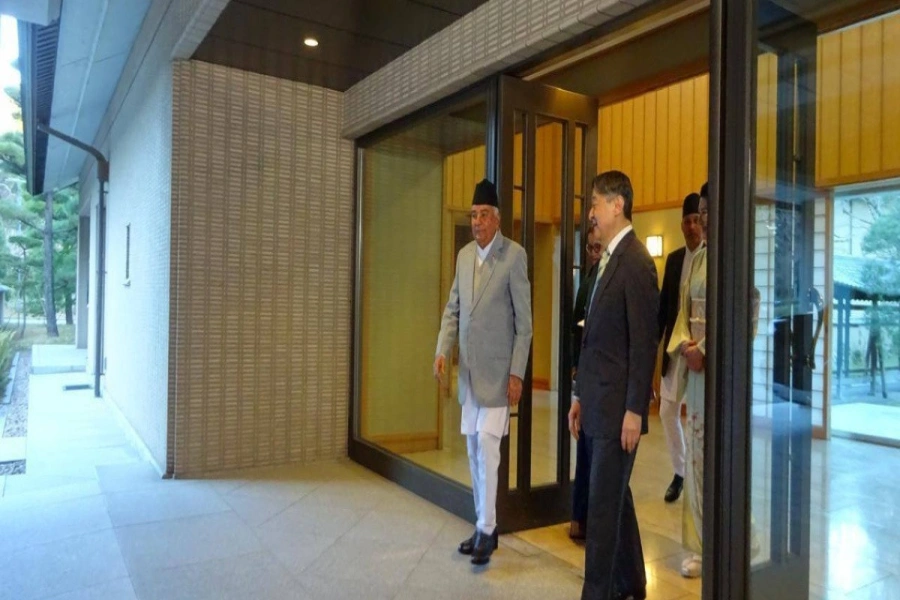
On 3 February, President Paudel and First Lady Mrs Sabita Paudel met with Emperor Naruhito and Empress Masako at the Imperial Palace. They were warmly received with affectionate smiles and handshakes by Their Majesties. In their brief conversation, His Majesty the Emperor fondly recalled his visit to Nepal in 1987, when he had the opportunity to visit places such as Kathmandu, Bhaktapur, Lumbini, and the hills of Pokhara, and shared some nostalgic moments with the Nepali President and his spouse. In the course of the meeting, the Emperor also shared some pictures of Nepali life that he had captured on his camera some 39 years ago. More importantly, one of the photographs depicted women fetching water from the river and carrying it to their houses located on the hillside. The hard life, as His Majesty disclosed to the President, in remote mountainous areas thoroughly moved him and heightened his interest in encouraging Japanese projects relating to safe drinking water in Nepal. Hence, it is pertinent to note that Emperor Naruhito was, in part, motivated to espouse such human-centred projects in Nepal also by the experiences of his parents. Their Majesties Emperor Akihito and Empress Michiko, during their visits in 1960 and 1975, had the opportunity to witness firsthand the challenges posed by Nepal's geographic isolation and developmental constraints.
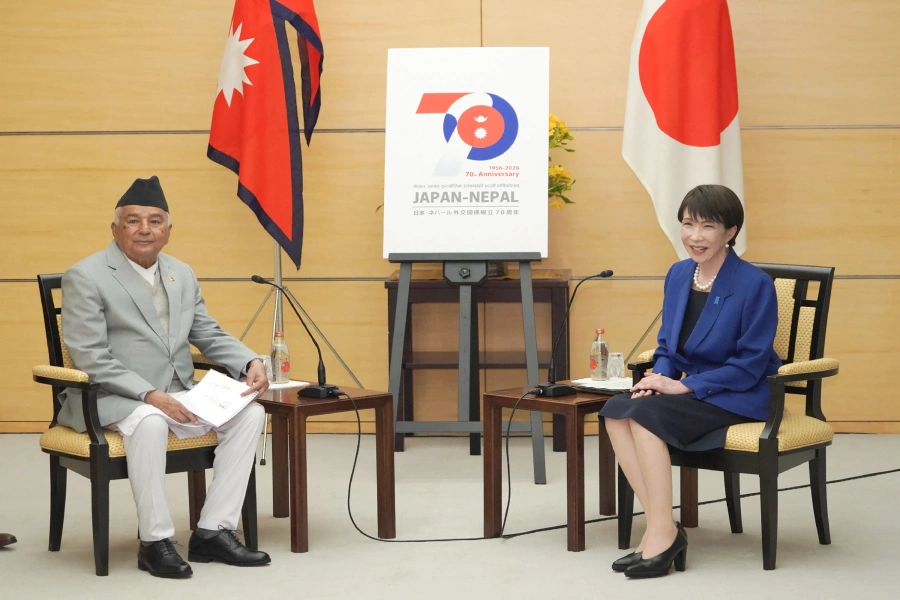
President Paudel also held a bilateral meeting with Prime Minister Sanae Takaichi. During his talks with the Japanese Prime Minister, which took place immediately after the guard of honour ceremony accorded to him, the President expressed gratitude, on behalf of the Government and the people of Nepal, for Japan's steadfast and longstanding cooperation in advancing Nepal's developmental endeavours. On the occasion, PM Takaichi described the diplomatic bond between Japan and Nepal as “a long-standing and close friendship.” In the context of fostering the existing relationship, she also underscored people-to-people ties, exchanges in the field of education, Japanese climbers visiting Nepal, and the vibrant Nepali diaspora in Japan as important factors. On development issues, she assured the President that Japan would continue to support Nepal in its development efforts. In that connection, she specifically mentioned the realms of information technology and democratic development. PM Sanae, who addressed President Paudel as Japan's “dear friend,” also expressed her best wishes for the success of the elections scheduled for 5 March 2026. She added that Nepal's political stability was imperative for the region's security. Further, PM Takaichi hinted that Japan would send a team of observers to Nepal to inspect the March elections. President Paudel observed that Nepal and Japan, both deeply influenced by the teachings of Lord Buddha, have long enjoyed an enduring and harmonious partnership. As Japan was also on the verge of holding elections to the House of Representatives, President Paudel reciprocated his best wishes to Prime Minister Takaichi for the successful conduct of the elections in Japan. At the core of the talks, both leaders underscored a shared commitment to further deepening the bilateral partnership through new avenues of cooperation. Subsequent to the conclusion of the bilateral meeting, Prime Minister Sanae Takaichi graciously presented President Paudel with a traditional Japanese jacket, Bakkhu. In a gesture of reciprocity, the President presented a Pashmina scarf to the Prime Minister, symbolizing mutual respect, goodwill, and enduring friendship between the two nations.
Nepali Diaspora as Strategic Asset
In the longer historical context of people-to-people ties between Nepal and Japan, special recognition is generally accorded to Prime Minister Chandra Shamsher, who initiated educational exchanges as early as 1902. He sent the first batch of eight Nepali students to Japan, accompanied by 17 attendants, which marked a formative chapter in people-to-people exchanges. The Nepali diaspora in Japan, over a span of nearly 124 years, has now grown to approximately 300,000. As noted by Deputy Foreign Minister Iwao Horii during his courtesy call on President Paudel on 2 February, of the 300,000, approximately 60,000 were Nepali students pursuing higher education in Japan. Of late, it is especially heartening to note that, for both countries, a significant number of Nepali diaspora members are actively engaged in entrepreneurial activities, contributing meaningfully to Japan's local economy and enthusiastically strengthening bilateral socioeconomic and cultural engagements at various levels. It has now become a strategic resource for both Nepal and Japan.
In essence, Nepal and Japan have been enjoying an enduring and cordial relationship grounded in cultural affinity, mutual respect, and expanding socioeconomic engagements. Since the establishment of diplomatic relations in 1956, bilateral ties have steadily deepened and diversified. Within Nepal's development landscape, Japan has emerged as one of its most reliable and generous development partners, extending support not only to infrastructure development and human resource capacity-building but also playing a pivotal role in strengthening Nepal's disaster risk management efforts.
During the President's rare and meaningful bilateral engagements with His Majesty the Emperor and Prime Minister Sanae Takaichi, both sides have acknowledged the urgency of expanding the existing relationship through forward-looking collaborations across mutually beneficial areas. This high-level understanding is poised to further strengthen the enduring ties between Nepal and Japan, particularly in areas such as trade, investment, technology transfer, and enhanced people-to-people exchanges. Against this encouraging backdrop, the official visit of President Paudel to Japan, which carried both symbolic and diplomatic significance, is indeed a boon, especially to the Government and people of Nepal.
(The author, an Alexander von Humboldt fellow, is Nepal's former ambassador to the US and the UK. The author currently serves as Foreign Affairs Adviser to President Ram Chandra Paudel.)