


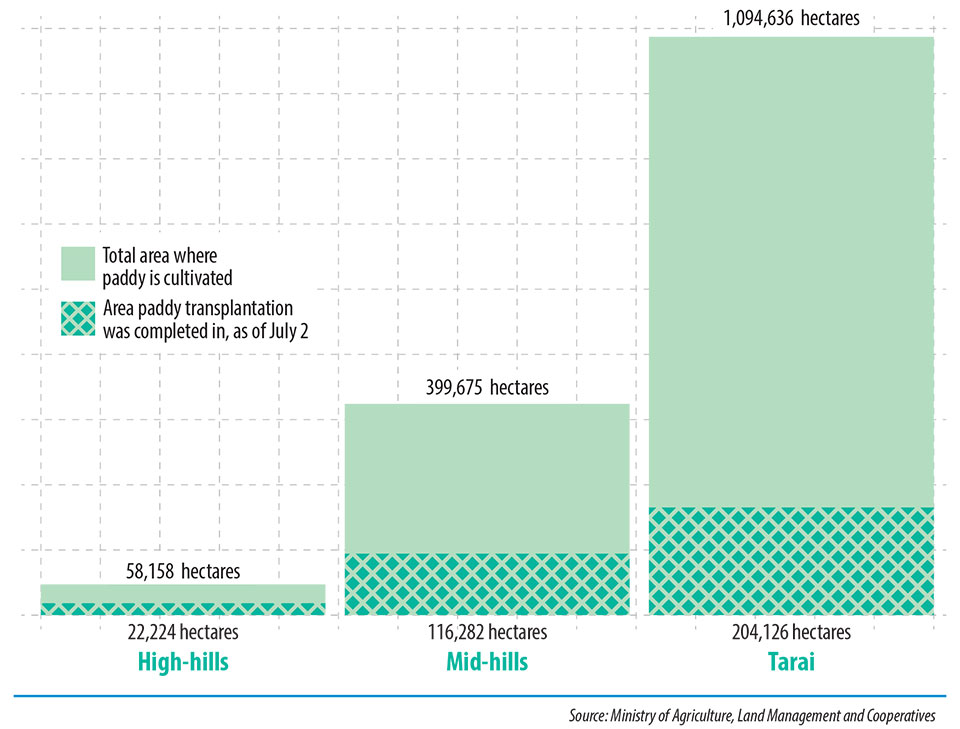
Nepal's paddy plantation season has entered a worrying phase. By the first week of July, farmers had planted rice on only 32.38 percent of the country's 1.37 million hectares of paddy fields. A year ago, plantation had already reached 45 percent. The gap is too large to dismiss as a temporary delay. Rice remains Nepal's most important staple crop, and any setback in plantation at the beginning of the season often affects harvest, food supply, rural income, and inflation later in the year.The provincial figures paint an equally mixed picture. Sudurpaschim leads with 57.9 percent plantation, followed by Gandaki and Karnali. Koshi has shown slight improvement over last year, but the country's biggest concern lies in Madhesh, Nepal's rice bowl. Only 15.6 percent of its paddy fields have been planted, far behind last year's pace. Lumbini and Bagmati have also recorded noticeable declines. Meanwhile, the government says more than 40,500 tons of chemical fertilizers have reached farmers in recent weeks, claiming that supplies are sufficient for the season. Despite all efforts, why are farmers still falling behind in plantation? The answer goes far beyond fertilizer. Agriculture today faces a combination of problems that have been building for years. Erratic rainfall and longer spells of drought due to the impacts of climate change have become increasingly common. Besides that, labor is turning out to be an even bigger problem. The working-age population in rural Nepal keeps moving to foreign employment and urban areas, leaving arable land barren.
Plantation completed in 50% of paddy fields in 14 districts
Besides that, farming is getting more and more unappealing financially. Input prices are increasing, but at the same time, farmers hardly get a decent price for their products. Quality seeds, fuel, irrigation, transportation, and machinery all cost more than before. At the same time, imported rice fills the market, often selling at competitive prices. Many farmers naturally question whether investing another season in paddy cultivation is worth the effort. This trend exposes a painful contradiction. Agriculture is still described as the backbone of Nepal's economy, yet the country imports billions of rupees' worth of rice and other food grains every year. A country known for its fertile lands and ample water resources is slowly increasing its dependency on imports of food grains. The government should not be treating agriculture as a seasonal concern. Providing farmers with dependable irrigation, guaranteeing timely access to good-quality seeds, and making sure that fertilizers reach villages before the planting season are necessary to boost farmers' paddy plantation capacity. Besides, farming with machines rather than by hand should be greatly encouraged through affordable access to machinery. Also, it would be of great help if crop insurance were made more realistic and easier to obtain.
On top of that, farmers need reliable markets and minimum support prices that shield them from sudden price crashes. It is not only the role of the government at the central level but also of provincial and local governments to determine the fate of farmers by identifying unused farmland, supporting cooperative farming where individual farming has become difficult, enhancing agricultural extension services, and encouraging the use of climate-resilient farming methods. Young people should see agriculture as a viable business, not as an occupation of last resort. This year's slow plantation should serve as an early warning, not another statistic that fades after the monsoon. Food security begins in the paddy field, not at the border where imported rice enters the country. Nepal cannot continue celebrating agriculture in speeches while allowing farming to lose its people, its productivity, and its future. The time to restore confidence in farming is now, before another season slips away.





