KATHMANDU, April 13: In Nepal’s political history, every year leaves its mark. The year 2082 BS (2025/2026) was no exception. In fact, it turned into a year of intense political upheaval.
The year began with a group led by Durga Prasai and others demanding a Hindu state with a monarchy, which once again emboldened voices against the federal democratic republic.
However, within just six months, the government formed by the first and second largest parties in the then House of Representatives decided to ban 26 social media platforms. Instead of regulating them, the state moved toward outright restriction. The decision deepened frustration among a generation that lives through social media freedom.
Under the banner of Gen Z, young people soon rose in protest—not only against the social media ban but also against misgovernance, corruption, and nepotism. Discontent within ruling parties added fuel to the movement. The CPN-UML-led government, already under pressure, struggled to maintain the internal and external balance of power. Yet UML Chair and Prime Minister KP Sharma Oli, backed strongly by the Nepali Congress and its President Sher Bahadur Deuba, dismissed growing concerns. The Gen Z movement was largely ignored.
Hawaii braces for long upheaval as erupting Kilauea boils

That movement in September became the defining political event of 2025. The rising distrust toward the state and the anger of the younger generation finally erupted.
On the evening of September 8, 2025, the KP Oli-led government lifted the social media ban. But the protests did not subside. On September 9, violence escalated, destroying major state institutions—including the executive, legislature, and judiciary—along with important cultural, political, and social structures. Attackers targeted party offices and leaders' residences, as well as business establishments, media houses, and journalists. The country slipped into a state of governance vacuum.
Nepal then entered a deep political transition. A government with a two-thirds majority collapsed within 24 hours of the protests. Unlike previous movements that replaced one system with another, the Gen Z uprising did not change the system itself—but it changed how power was exercised. The elected government fell, and an interim electoral government was formed.
Relying on the principle of necessity rather than strict constitutional provisions, the President, on September 12, appointed former Chief Justice Sushila Karki as head of an interim government. With a six-month mandate to hold elections, the House of Representatives was dissolved, and March 5, 2026, was set as the election date.
After the Gen Z movement, internal rifts within major parties deepened. UML held its general convention, retaining KP Sharma Oli as chair. Other parties, including the then CPN (Maoist Centre), moved toward crisis management through possible unification. The Nepali Congress, however, descended into severe internal conflict over its general convention, a dispute now under consideration in the Supreme Court.
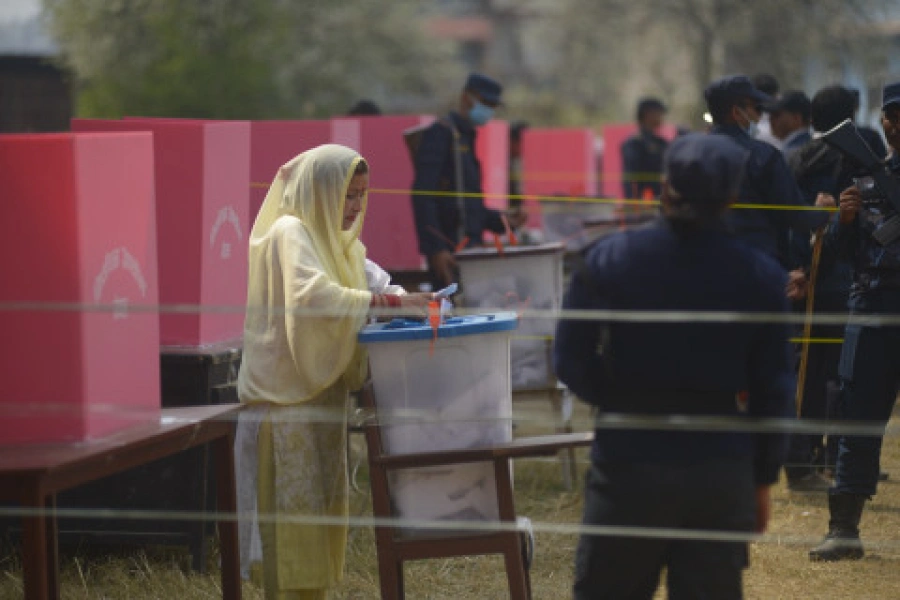
As uncertainty grew, political instability deepened further. Although reluctant at first, traditional parties eventually entered the electoral process. The House of Representatives election was held on March 5. Public anger against established parties was clearly reflected in the results, as voters turned toward new and alternative forces. Youth participation became decisive.
The election brought a major shift. The Rastriya Swatantra Party emerged strongly, while the Shram Sanskriti Party made its debut in Parliament. Representation of Madhes-based and regional parties dropped to zero.
Driven by the mandate of the digital generation, the Rastriya Swatantra Party secured 182 seats in the House of Representatives. By the end of the year, on March 27, 35-year-old Balendra Shah assumed the office of Prime Minister. Nepal once again returned to a parliamentary and constitutional path.
Despite natural disasters, the year also witnessed notable efforts in economic reform and development. The digital generation established a strong presence in both parliament and government. Many leaders of traditional parties were rendered politically irrelevant after the elections, with several facing investigations, including money laundering cases.
Overall, 2082 BS ends as a year of political upheaval—but also of new hope and renewed confidence.
May the year 2083 BS bring better fortune for all.