KATHMANDU, Oct 29: Nepal and India have signed Joint Venture and Shareholders’ Agreements (JV&SHA) to develop two major 400 kV cross-border transmission line projects in Inaruwa (Nepal) to New Purnea (India) and Lamki Dododhara (Nepal) to Bareilly (India) transmission systems.
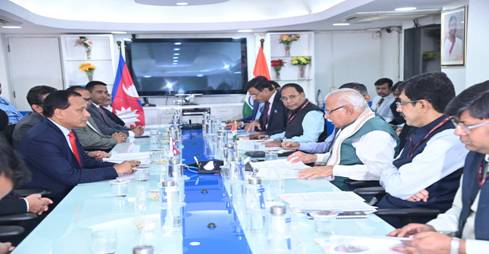
The agreements aimed at significantly strengthening electricity connectivity and trade between the two countries were signed in New Delhi on Wednesday in the presence of Nepal’s Minister for Energy, Water Resources and Irrigation Kulman Ghising and India’s Union Minister for Power and Housing & Urban Affairs Manohar Lal.
Ambassador of Nepal to India Shankar Prasad Sharma, Indian Power Secretary Pankaj Agrawal, Additional Secretary of India’s Ministry of External Affairs and Joint Secretary at Nepal’s Ministry of Energy Sagar Raj Gautam were among those present at the signing ceremony. The documents were signed and exchanged by Subhash Kumar Mishra, Deputy Executive Director of the Nepal Electricity Authority (NEA), and Sanjay Kumar Gupta, Chief Operating Officer (International Business) of Power Grid Corporation of India Limited (POWERGRID).
Construction of three int’l power transmission lines underway a...

With the signing of the agreements, the two sides have paved the way for the establishment of joint venture companies in both Nepal and India to construct and operate the Double Circuit (Quad Moose) transmission lines.
The company to be established in India will have a 51 percent shareholding by POWERGRID and 49 percent by NEA, while the company to be established in Nepal will have a 51 percent shareholding by NEA and 49 percent by POWERGRID. The construction of the two lines will be financed with 80 percent debt and 20 percent equity.
At the signing ceremony, Minister Ghising said that the construction of the two new cross-border transmission lines marks another important milestone in the ongoing Nepal–India electricity cooperation and regional power trade. He added that the projects will enable Nepal to export its surplus hydropower more efficiently and create a foundation for wider access to regional and international energy markets, while attracting both domestic and foreign investment in the hydropower sector.
Indian Power Minister Manohar Lal stated that the completion of the two high-capacity transmission corridors would further enhance cross-border electricity exchange, strengthen regional energy security, improve grid stability, and contribute to the economic growth of both nations.
According to the joint technical study carried out by Nepal and India in 2019, the Inaruwa–New Purnea transmission line will cover 26 kilometers in Nepal and 109 kilometers in India, with an estimated initial cost of Rs 2.65 billion in Nepal and INR 4.13 billion in India. Similarly, the Lamki (Dododhara)–Bareilly line will span 33 kilometers in Nepal and 185 kilometers in India, with estimated costs of Rs 2.57 billion and INR 6.14 billion respectively.
The NEA plans to invest around Rs 1 billion and Rs 2 billion in the joint companies to be set up in Nepal and India from its own resources.
The construction of both transmission lines is targeted for completion by 2030. These projects are part of the broader energy cooperation framework under the Agreement on Electricity Trade, Inter-Country Transmission Line Coordination and Operation Coordination between the two countries. The new lines will complement the existing Dhalkebar–Muzaffarpur 400 kV line, which is currently operational, and the Butwal–Gorakhpur line under construction. Nepal and India have also agreed to develop a 220 kV Chameliya–Joljibi line connecting Nepal’s far-western region with India’s Uttarakhand state.
Nepal is currently exporting around 1,000 megawatts of electricity daily to India and Bangladesh through the existing 400 kV and 132 kV transmission infrastructure. The signing of these agreements marks a new phase in bilateral power cooperation, with both sides reiterating their commitment to clean energy development, regional grid connectivity, and sustainable economic growth through enhanced electricity trade.