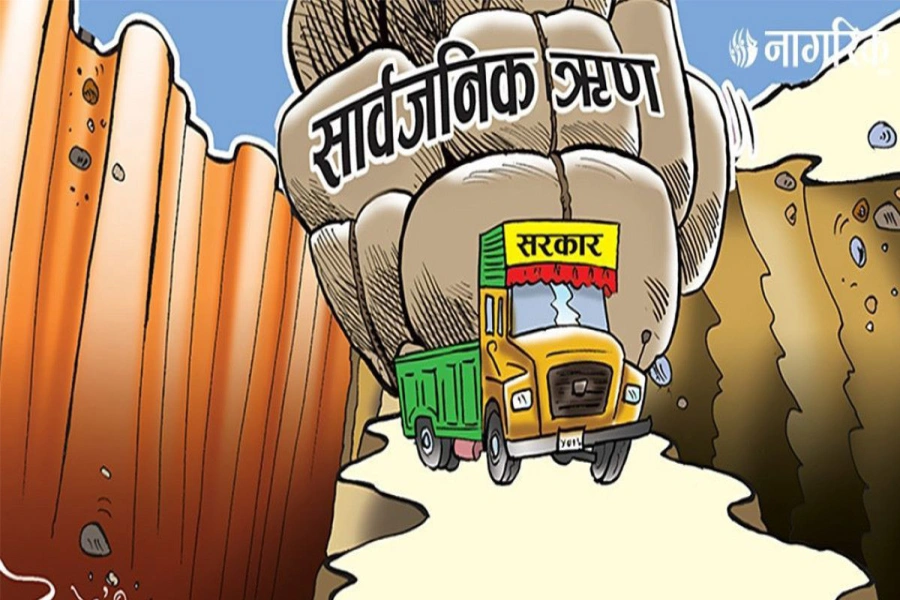
KATHMANDU, Feb 27: Nepal’s public debt has climbed to Rs 2.858 trillion, bringing the debt-to-GDP ratio to 46.81 percent as of mid-February 2026, according to the Public Debt Management Office (PDMO). The latest figures highlight growing fiscal pressure on the government amid weak revenue growth and a depreciating currency.
In the first seven months of Fiscal Year (FY) 2025/26, the country’s total debt increased by Rs 184.93 billion. Domestic borrowing now accounts for 22.09 percent of GDP, while external loans make up 24.72 percent.
Government data shows that during this period, authorities secured an additional Rs 255.48 billion in loans and spent Rs 163.52 billion on debt servicing. However, the depreciation of the Nepali currency significantly inflated the value of external debt, contributing Rs 92.96 billion in additional liabilities.
Public debt exceeds Rs 2.434 trillion, increasing by over Rs 30...

During the review period, the Nepali currency depreciated by about Rs 8 against the US dollar—from Rs 137.35 per dollar in mid-July 2025 to Rs 145.03 per dollar by mid-February, according to Nepal Rastra Bank. Since a substantial portion of Nepal’s external debt is denominated in US dollars or the International Monetary Fund’s Special Drawing Rights (SDRs), exchange rate fluctuations directly affect the total debt burden.
At the start of the fiscal year in mid-July 2025, public debt stood at Rs 2.674 trillion. The current figure reflects a steady upward trend, with Rs 52 billion added in the past month alone, up from Rs 2.806 trillion in mid-January.
External loans now total Rs 1.509 trillion, accounting for 52.81 percent of the public debt, while domestic borrowing stands at Rs 1.349 trillion, or 47.19 percent. Although most foreign loans are concessional—carrying interest rates of less than one percent annually—the growing scale of debt and associated currency risks remain pressing concerns.
The government typically uses public borrowing to boost economic activity, manage inflation, and fund infrastructure development. However, with revenue collections consistently falling short of covering recurrent expenditures in recent years, borrowing has increasingly become a structural necessity rather than a counter-cyclical measure.
A prolonged economic slowdown has further constrained revenue generation. Over the past two fiscal years alone, public debt has increased by more than Rs 150 billion, rising from Rs 2.434 trillion in FY 2023/24.
Through the annual budget, the government has set a target to raise Rs 595 billion in public debt in the current fiscal year. As of mid-February, 42.89 percent of that target has been met.
With debt approaching half of Nepal’s GDP, the trend raises serious questions about fiscal sustainability, vulnerability to exchange rate volatility, and the government’s ability to fund development without deepening long-term liabilities.