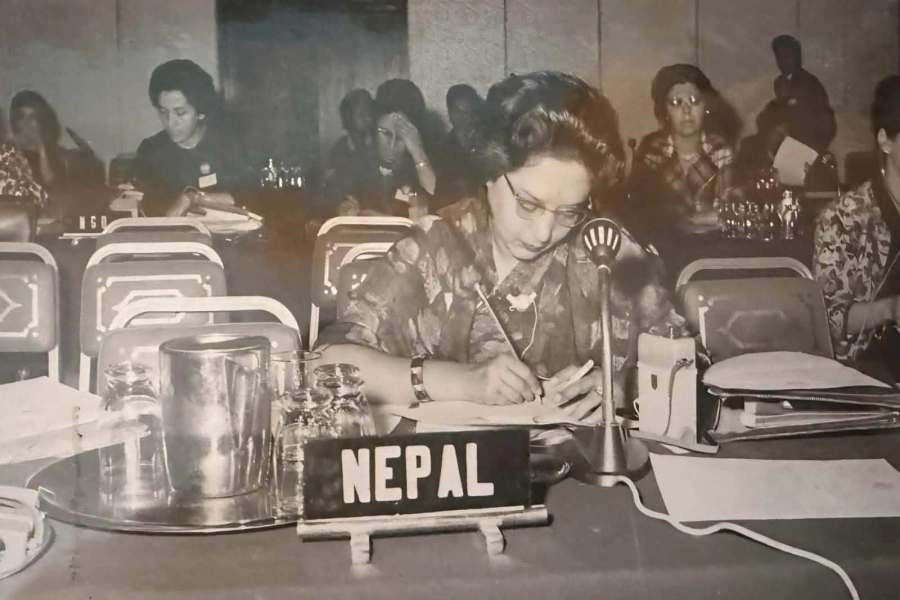
KATHMANDU, Feb 19: Nepal has lost one of its earliest and most steadfast champions of women's leadership and public service. Mrs. Kamal Rana, a stalwart of the women's movement, a pioneering parliamentarian and a lifelong social worker, passed away at 12:55 AM on Thursday. She was 98.
As per her wishes, her last rites will be performed at the Electric Crematorium in Pashupati at 12:00 noon.
 Born in 1928 in Tansen, Palpa, Kamal Rana was the daughter of Raja Tarak Bahadur Shah and Madan Dibyashori Shah. Raised in a family deeply intertwined with Nepal's political and social history, she grew up at a time when women's public roles were limited, yet her life would go on to redefine those boundaries.
She pursued higher education when few Nepali women did so, earning a Master's degree in Political Science from Tribhuvan University. Her academic grounding in governance and public administration became the intellectual foundation for a life dedicated to service, reform and representation.
Preeti Khatri: A trailblazer in adventure tourism

 In 1952, at a time when organised women's mobilisation was still in its infancy, she founded Women's Volunteer Services to encourage women's participation in community welfare and national life. That same year, she was appointed Vice-Chair of the National Assembly (then an advisory body), becoming one of the first women to hold a legislative leadership role in Nepal.
With the promulgation of the 1959 Constitution and the formation of Nepal's first bicameral parliament, she was appointed by King Mahendra to the Maha Sabha, the upper house. In July 1959, she was elected Chair of the Maha Sabha - the first woman in Nepal's history to lead a parliamentary house. At a formative moment in Nepal's democratic journey, she presided over legislative debates, set procedural precedents and quietly asserted that women belonged at the centre of national decision-making.
 Her public service extended beyond Nepal's borders. In 1962, she represented Nepal at the United Nations General Assembly. From 1963 to 1965, she served as a member of the UN Commission on the Status of Women, bringing Nepal's voice into global discussions on gender equality and women's rights at a time when such participation was rare.
Throughout the 1960s and 1970s, she remained deeply engaged in social and development work. She was a founder member of the Nepal Red Cross Society and later served as Chairperson of the Nepal Family Planning Association. Her work bridged health, welfare and policy, reflecting her conviction that governance must respond to lived realities.
During the Panchayat era, she served in the Rastriya Panchayat and continued to contribute to national deliberations. Following the 1980 referendum, King Birendra appointed her to the Constitution Reform Recommendation Commission, an eleven-member body tasked with reviewing constitutional provisions at a critical juncture in Nepal's political evolution.
 Among her legislative initiatives was the drafting of a Special Marriage Bill that sought to address issues of marriage age, polygamy and legal recognition. Although the bill did not reach public debate due to the dissolution of parliament, it reflected her enduring commitment to legal reform and women's dignity.
In her personal life, she was married to General Meen Shumsher J.B. Rana, son of Juddha Shumsher, and was the mother of Anoop Shumsher Rana, founder of NECON Air. She endured profound personal loss with the untimely death of her only son - a sorrow that marked her later years with quiet reflection.
To many, she was not only a public figure but a family elder, a mentor and a source of inspiration. To her nephew, she was "Fua" - the elder sister of his father - a presence woven into both family memory and national history.
In her later years, even as age made her frail, she remained a respected voice in conversations about women's leadership and Nepal's democratic journey. Her life spanned nearly a century - from a Nepal without parliamentary institutions to a republic still striving to perfect them.
 Kamal Rana's legacy is not merely that she held office, but that she opened doors. She stood at the threshold of change and stepped forward when few women were invited to do so. Her life was a testament to courage, conviction and quiet determination - a reminder that the architecture of democracy is strengthened by those who dare to lead when leadership itself is an act of defiance.
Nepal bids farewell to a pioneer whose service will remain etched in its political and social history.