

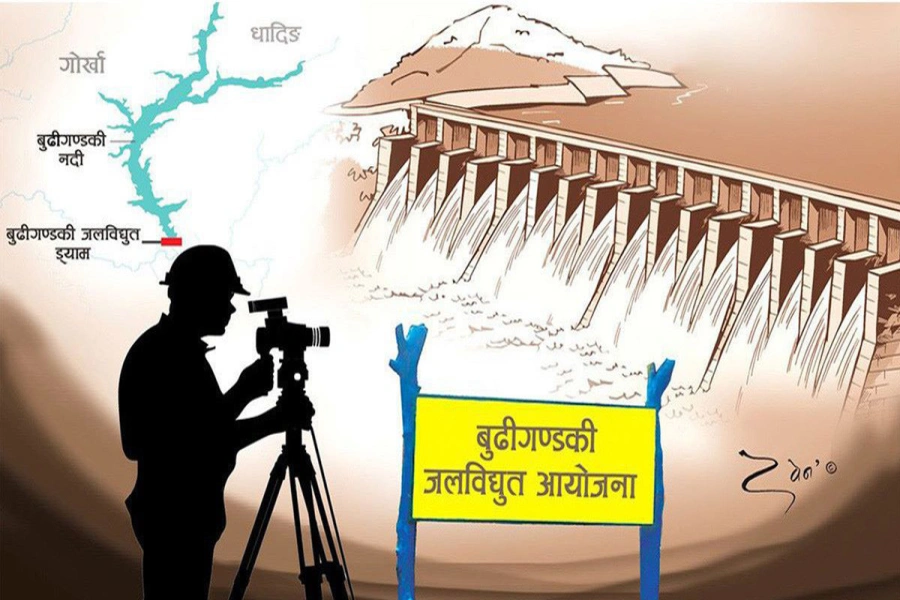
KATHMANDU, Jan 18: The long delayed 1,200-megawatt Budhigandaki reservoir-based hydropower project has finally secured approval for its investment model. The Ministry of Finance has endorsed a plan to move the project forward through a mix of government equity and loans. The project will enter the implementation phase after the Cabinet gives formal approval.
With the investment model approved, the project will now move ahead, said National Planning Commission Vice Chair Prakash Kumar Shrestha. “The Ministry of Finance has approved the investment modality,” he said.
The project is estimated to cost nearly Rs 400 billion. Its base cost stands at USD 2.77 billion, around Rs 374 billion. Under the approved plan, 70 percent of the funding will come from loans and 30 percent from equity. Of the equity portion, the government will hold an 80 percent stake, while the Nepal Electricity Authority will own the remaining 20 percent.
The government’s total investment will reach Rs 248 billion, including Rs 97.47 billion as equity and Rs 150 billion in concessional loans. The Rs 45 billion already spent by the government on the project will be converted into share investment.
Govt’ll build Budhigandaki on its own: Energy minister

The proposal also states that 50 percent of the infrastructure tax collected at customs points on petroleum imports will be earmarked for investment in the project. The government will need to ensure sources for its Rs 248 billion commitment. The Nepal Electricity Authority will invest Rs 24.37 billion as equity.
To lower financing costs and improve feasibility, the plan also proposes issuing energy bonds worth Rs 30 billion, counted under the mandatory liquidity ratio, with government facilitation. Banks, financial institutions, insurance and reinsurance companies, and public funds will be eligible to purchase these bonds.
Banks and financial institutions will provide loans totaling Rs 104 billion. Funds will also be mobilized through co financing involving the Employees Provident Fund, Citizen Investment Trust, Social Security Fund, insurance and reinsurance companies, HIDCL, Nepal Telecom, and commercial banks.
The project faced delays for years due to the lack of a clear investment model and financial arrangements. Although it was declared a national pride project around 13 years ago, its estimated cost has increased by nearly Rs 100 billion.
Despite a target to complete construction by fiscal year 2083 84, set under the Budhigandaki Hydropower Project Development Committee Formation Order 2069, the project has yet to enter the construction phase. Around 95 percent of the affected people have already received compensation, but construction stalled due to financing gaps.
Once operational, the project is expected to generate 1.41 billion units of electricity in the dry season and 1.97 billion units in the wet season, totaling 3.38 billion units annually. The proposed power purchase rates are Rs 12.40 per unit in the dry season and Rs 7.10 in the wet season. Annual revenue is estimated at Rs 31.48 billion, and the plant will produce electricity for 42 years after completion.
The project will affect 8,117 households in Gorkha and Dhading districts, with 3,560 households facing full displacement. Due to its proximity to major load centers such as Kathmandu, Chitwan, and Pokhara, the Budhigandaki project holds strategic importance for energy security.
The plan includes constructing a 263-meter high curved arch dam on the same river, which flows along the border of Gorkha and Dhading. The dam will affect 14 former VDCs in Dhading, now four rural municipalities and one municipality, and 13 former VDCs in Gorkha, now four rural municipalities.
After damming, the reservoir will spread over 63 square kilometers in the upstream area. The project is expected to create jobs and offers scope to develop tourism and fish farming. The maximum reservoir water level will reach 540 meters.








