KATHMANDU, Jan 14: Nepal has made significant strides in literacy rate over the past decade, with the national rate rising by 10.3 percent to reach 76.2 percent, according to the educational report under the National Census 2078 BS, released Tuesday by the National Statistics Office (NSO).
This figure applies to people aged five and above. In comparison, Census 2068 BS recorded the literacy rate at 65.9 percent.
The report highlights a persistent gender gap. Men now have a literacy rate of 83.6 percent, while women, who make up more than half the population, lag at 69.4 percent—a difference of nearly 14 percent. Over the decade, women’s literacy rose by 12 percent, compared to 8.5 percent for men. In Census 2068 BS, men’s literacy was 75.1 percent, and women’s 57.4 percent.
“While women’s literacy has improved faster than men’s over the last ten years, it still trails overall male literacy,” said Binod Sharan Acharya, Director of the NSO. “The gap remains, but the progress shows that efforts to boost women’s education are working. The government now needs to build on this with policies and programs to further strengthen women’s educational opportunities.”
Perhaps most encouraging is the literacy among children under 18, which has reached 99 percent, signaling remarkable intergenerational progress, said Acharya.
Rasuwa declared as 43rd literate district

However, disparities remain. Literacy rates in Madhesh Province lag behind, with only 66 percent, while Bagmati and Gandaki provinces have achieved 95 percent literacy. Among adolescents of all ethnic groups, literacy exceeds 98 percent, but for Madhesi Dalits, it stands at just 80 percent.
“Household-level analysis shows that 13.4 percent of households in Madhesh Province have no literate members, rising to 23 percent among Dalit communities,” Acharya noted.
Among people with disabilities, literacy is lowest for adults with intellectual disabilities and autism, though the gap with those having sensory disabilities is gradually narrowing.
770,000 children still out of school
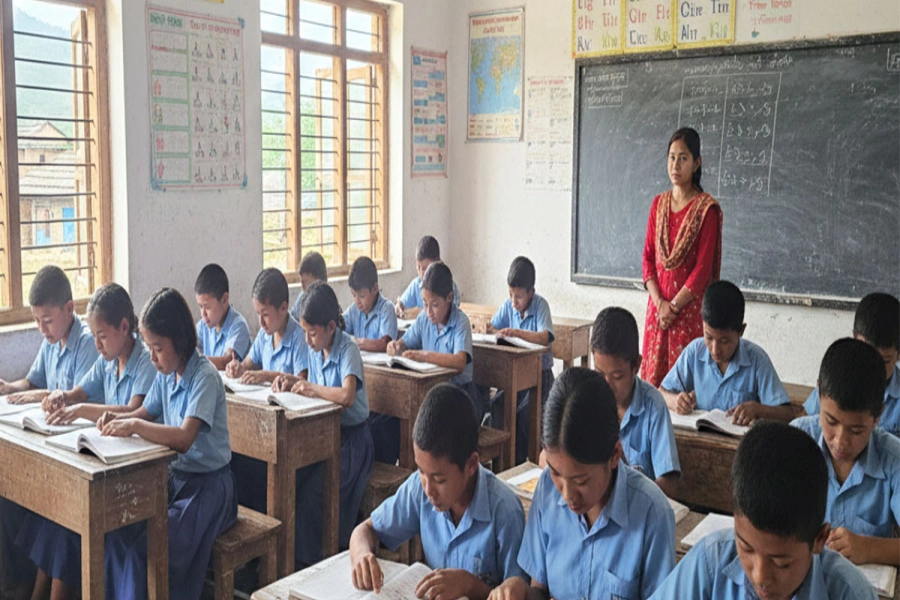
While school attendance is high after age five, the report shows sharp drop-offs after secondary school. One in four youth aged 15 to 19 is out of school, a problem especially pronounced among girls.
At the national level, roughly 10 percent of children aged 5 to 17—around 770,000—are out of school.
“Of these, 380,165 have never attended school, while 390,000 attended but later dropped out,” said Dr. Kamal Pokhrel, Chief Statistical Officer at NSO. “The issue is most severe in remote areas, low-income communities, and marginalized groups. The highest risk of dropping out occurs at school entry ages, 5 and 10–14, and particularly after grade 5.”
In Madhesh Province, more than 60 percent of children have never attended school. In Gandaki Province, that figure is under 5 percent. About three-quarters of children from Madhesi castes, Madhesi Dalits, and linguistic minorities have never been to school, while the number is far lower among hill castes and indigenous groups.
“Economic status is a major factor in school attendance,” said Acharya. “While 45 percent of children from disadvantaged families remain out of school, only 3 percent of children from affluent families are in the same situation. Even children from well-off families sometimes miss school for various reasons. At higher education levels, students are mostly in education, management, humanities, and science and technology, though these fields contribute limitedly to the economy.”
Caste, gender, region, and economic background also influence subject choice, raising concerns about future imbalances in the labor market, he added.
Since the Constitution of Nepal, 2072 BS, declared education a fundamental right, initiatives like free and compulsory education, the School Education Sector Plan (2079–2088 BS), snack programs, and targeted scholarships have boosted school attendance and learning outcomes. Yet, bringing the remaining 10 percent of secondary-level children into school continues to be a challenge, according to Ministry of Education, Science, and Technology (MoEST) spokesperson Shiva Kumar Sapkota.
“Efforts are focused on disadvantaged communities and children in Madhesh to bring them into classrooms,” said Sapkota. “The ministry aims for 100 percent school attendance. Except for eight districts in Madhesh, all districts have already been declared literate. Dolpa is next. Programs are underway in Madhesh Province to reach 86 percent literacy, and the province has committed to declaring literacy within six months of this fiscal year.”
Currently, 96,000 children aged 5 to 9 in primary grades remain out of school, and efforts are underway this fiscal year to enroll all of them.


-1200x560-1781083488.webp)