

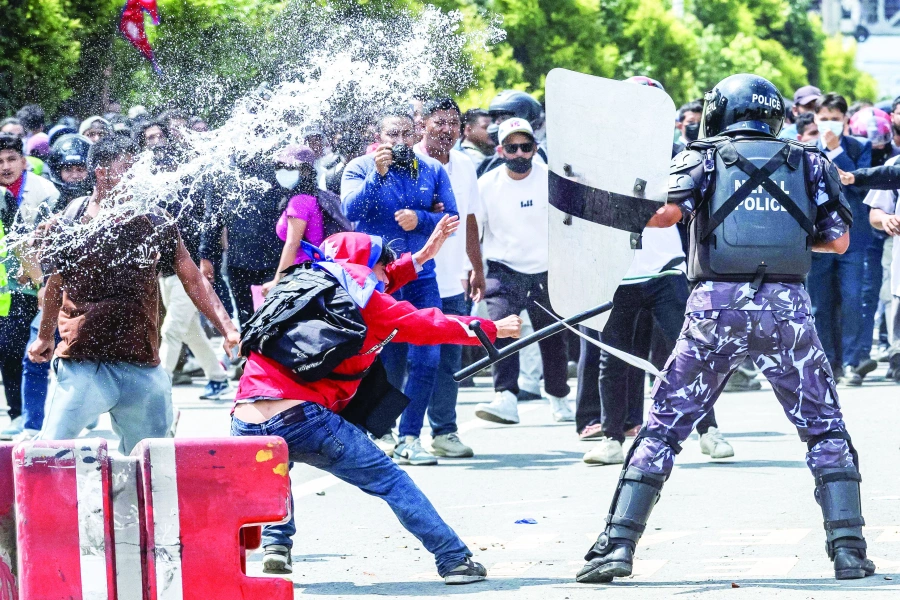
Nepalese politics is on the cusp of a huge transformation, or at least that’s what it seems in the aftermath of the Gen Z revolt. The Gen Z revolt is seen as one of Nepal’s most unprecedented events, one that swiftly dismantled the government in less than forty-eight hours. In retrospect, the events of Sept 8 and Sept 9 feel dreamlike yet overwhelming, much like a strong gust of wind with sweeping effects. What the Gen Z revolt swept away was not, however, something minuscule. It swept away the hubris of those at the helm. The political powerhouses—the CPN-UML, NC, and the Maoists—have such a stronghold in national politics that one would find it hard to believe they would struggle to maintain their popularity. After the political parties conspired with foreign powers to boot out Gyanendra Shah by signing an accord in New Delhi followed by the Comprehensive Peace Agreement, three parties took turns running the government, with no other parties posing significant challenges to them. On the contrary, now these traditional forces not only fear losing relevance but also dread being crushed by new forces in the upcoming elections. Fought against malgovernance, cronyism, and widespread corruption, the Gen Z revolution has successfully instilled fear in traditional forces, with a loud message that the generation doesn’t entertain old, ineffective leaders. In hindsight, it’s clear that the young generation had been silently weighing everyone in power, and it was only a matter of time before their anger burst out.
Youthful Energy
Undoubtedly, the Gen Z revolution will go down as a significant breakthrough that demanded radical reforms from the parties. But how exactly did everything happen? One doesn’t need to be a veteran political analyst to say that the revolution was spontaneous and a response to the Sept 8 massacre. It took months for everyone to realize that the Gen Z groups were diverse and that each group bore its own agenda. On Sept 8 and Sept 9, they looked like they all subscribed to the same political ideology. Strangely, that wasn’t the case. With time, these Gen Z groups have divided, or seem to be returning to their own political schooling. What’s common among the numerous Gen Z groups is the collective cry for change and a dream of being able to survive in the country with dignity. Thanks to this bubbly generation, political leaders can no longer rant about the youth’s apathy towards politics.
RPP Chair Lingden calls for new political understanding among f...
Revamped RSP
Even before the revolt, there was big hype around the 2084 general elections. Political parties had already started reaching public doorsteps, eyeing victory in the elections. The new forces, especially the RSP, were the most hopeful and confident, even with the party chair facing charges for various scandals. But in the post-revolt period, it seems that the RSP’s fate has changed drastically. First, the RSP’s party chair was released from prison on bail. And to the RSP’s delight, the Kathmandu mayor, Balen Shah, who enjoys a huge fan following, joined the RSP just before the elections. It was almost surprising to see the coming together of two contrasting figures. Shah is reclusive, doesn’t interact much with the public, and relies on social media for various announcements. Lamichhane is good with words and can thus win people’s trust. When Kulman Ghising also joined the popular duo of Shah and Lamichhane, forming an unexpected alliance, people speculated that this new triumvirate was a potent alternative force the country had been seeking for a long time. Unsatisfied over leadership and other issues, Ghising walked out of the alliance, bringing a mock smirk to rivals’ faces. With two popular figures in the same party and given its electoral performance in the previous elections, the RSP will surely emerge as a formidable force, and no one will be surprised if it climbs higher than the fourth rank it achieved in the 2022 elections.
This election, all eyes will be on the revamped RSP, which will try to capitalize on the discredited leaders of the traditional parties. However, it would be a mistake to write off the traditional parties, which enjoy nationwide networks and robust institutions. Nepali Congress looks in good shape ahead of the elections, thanks to the dauntless duo of Gagan Thapa and Bishwa Prakash Sharma, who challenged Deuba for the party leadership and subsequently bagged the positions. The Deuba faction isn’t content with the Election Commission’s decision to recognize Thapa’s faction as legitimate for the upcoming elections. The internal rift persists in NC, but right now it seems to be heading ahead in the spirit of the Gen Z movement. The installation of youth leaders in NC is something that the other traditional parties should be imitating. But UML seems to be totally reigned by KP Oli, and its recently concluded convention only stressed his control over the party. The public isn’t particularly happy about this. But Oli still has some chance to regain his credibility. If the likes of the CPN-UML field youth candidates in the upcoming elections, the public will perceive that the old forces have acknowledged the revolution. Failing to recognize the demand for youth leadership will account for the parties’ downfall. The public is ready for the March polls with all the calculations done.
Post-election Analysis
Gaining a majority in the elections and forming the government single-handedly is almost elusive in Nepal’s mixed electoral system. The old forces have their loyal voters. The new forces are plenty in number, which means the votes will be divided. What all these equations suggest is the compulsion for parties to coalesce in order to form the government. This very provision ensures that the old forces will remain in the mix. And when that happens, Nepalese people, including the Gen Z group, will have to stop looking at the old forces with disdain. On the citizens’ part, it requires an assortment of patience, discipline, bravery, and watchfulness in the right mix to steer the nation on the right track. What we can’t afford next is the continued scuffles between parties for power. Whoever wins and leads the government, all that people wish for is a well-functioning state devoid of corruption and cronyism, one that makes people feel they truly matter. This election, let’s tell the parties that they are not each other’s enemies but competitors, assessed by how well they serve the public.


