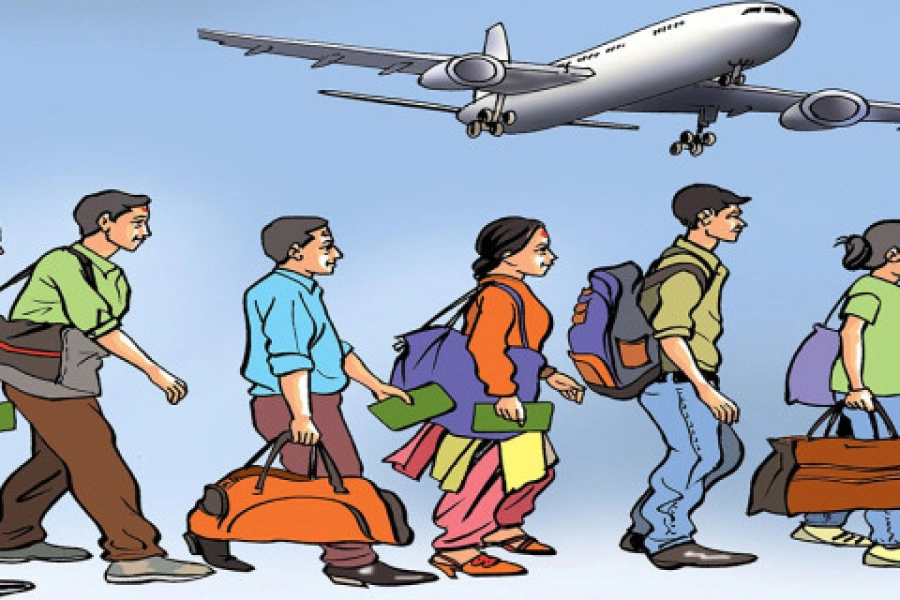
KATHMANDU, May 28: With Nepal’s open border with India allowing travel without labor permits, thousands of Nepalis cross every year in search of work. But behind this ease lies a disturbing reality—some are returning without their organs, victims of a growing kidney trafficking network operating under the guise of foreign employment.
Criminal groups are increasingly targeting vulnerable Nepalis by promising jobs in India, particularly hotel work with attractive salaries.
“You will get a good job in India. I will arrange work in a hotel. You will earn a good salary”—such promises are commonly used to lure job seekers across the border. But instead of employment, many are trapped in illegal organ trafficking networks run by criminals who specifically target the poor, uneducated, and financially distressed.
A man from Sindhuli, struggling with poverty and family breakdown, is one such victim.
He had been working as a daily wage laborer after dropping out of school at an early age due to his family’s financial condition. His personal life remained unstable, and after three marriages that all ended in separation, he was left caring for his young children alone.
“I was ready to do any kind of work for my children,” he told the Anti-Human Trafficking Investigation Bureau (AHTIB).
In search of work, he came to Kathmandu from his village in February 2025 and began working as a laborer in Sunakothi, Lalitpur. After that job ended, he again struggled to find employment.
In May 2025, while moving between Ratnapark and Koteshwor in search of work, he met a man who introduced himself as Sujan Giri.
“He asked about my family situation and said he could arrange a hotel job in India with a monthly salary of 10,000 to 20,000 Indian rupees,” the victim said.
Heart to Heart with Malvika

Shortly afterward, another man, Dil Bahadur Tamang, joined the conversation. The three then took a taxi to Kalanki, where they drank alcohol and discussed the supposed job opportunity.
Soon after, the victim was put on a night bus to Bhairahawa and taken to the Sunauli border. He recalls being repeatedly given alcohol during the journey.
“They kept giving me alcohol. After that, I could not clearly understand what was happening,” he said. “They kept saying I would get a good job in India.”
At the border, Sujan Giri showed documents to Indian security personnel, claiming they were traveling for hotel work, and the group was allowed to pass without obstruction.
From there, he was taken to Chandigarh in a small vehicle and placed in a fourth-floor apartment.
“There I met two new people, Samir and Rakesh,” he said. “The next day, I was taken to a clinic for blood, urine, and X-ray tests. They told me it was just a health check-up.”
He was kept in the apartment for nearly a month, cooking his own meals while supplies were brought by Sujan Giri. Several other Nepalis were also kept in separate rooms under supervision.
Then came the shock.
In August 2025, Sujan told him his kidney would be removed the next day and that he would be paid 600,000 rupees.
“I refused immediately. I told them I came here for a hotel job, not to sell my kidney,” he said.
But refusal was not an option.
According to his complaint, the traffickers told him he had already cost them money and could not back out. “Either repay all expenses or do as we say,” they warned.
He alleges that members of the group—including Shyam Bhandari, Samir Nepali, Rakesh Nepali, Sujan Giri, and Kumar alias Rajkumar Pariyar—then forced him into a vehicle, took him to a clinic, and sedated him.
“When I woke up after a few hours, I was in severe pain on the left side of my abdomen. My left kidney had been removed,” he said.
After a brief stay at the clinic, he was returned to the apartment and later sent back to Nepal with 10,000 rupees for travel expenses. The remaining payment, he claims, was never given.
He also suspects others who returned with him—including Dil Bahadur Tamang, Bir Bahadur Rai, Sabin Rai, and Umesh Nepali—may also have undergone similar procedures.
Back in Sindhuli, his condition worsened, forcing him to seek medical attention. Only then did he reveal the full story to his family, realizing he had been trapped in a trafficking network.
“The traffickers exploited my poverty and desperation. They deceived me, threatened me, and illegally removed my kidney,” he said.
The victim has now filed a complaint with the AHTIB, demanding action and compensation under the Human Trafficking and Transportation (Control) Act, 2007, and the Prevention of Organized Crime Act, 2013.
Authorities say such cases are not isolated.
SSP Krishna Pangeni of the AHTIB said many victims come from economically vulnerable backgrounds and are lured with false promises of jobs abroad.
“Most people come to us only after their health deteriorates or when they do not receive the promised money,” he said.