

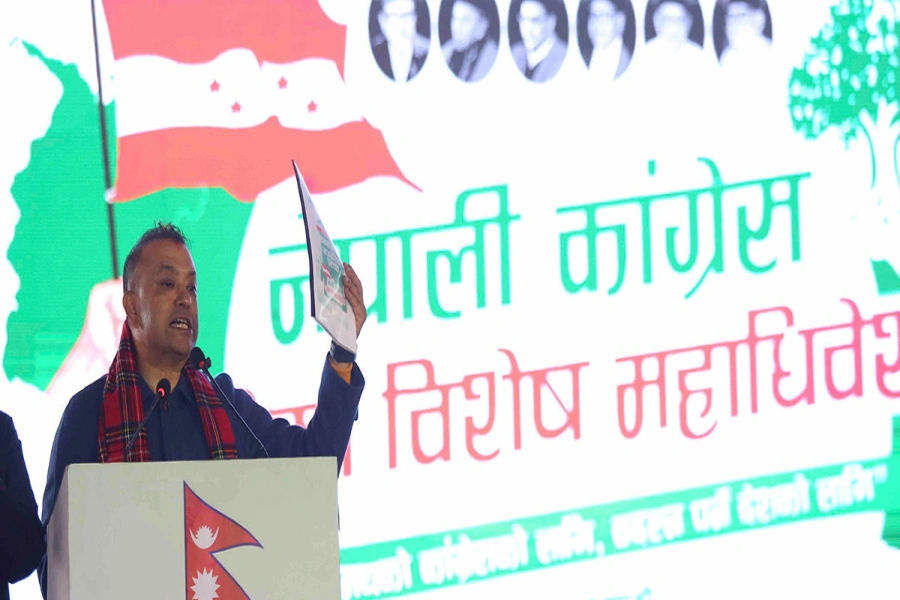
KATHMANDU, Jan 12: Nepali Congress (NC) General Secretary Gagan Thapa has announced plans to form a high-level asset investigation commission to scrutinise the wealth of all individuals who have held public office including former chief justices and retired senior army officials.
Presenting the party’s political report at the NC Special General Convention that began on Sunday at Bhrikutimandap, Kathmandu, Thapa said the proposed commission would investigate the assets of all individuals who have held public positions since 2006.
“A high-level asset investigation commission will be formed to examine the property of every individual who has held public office, whether currently serving or not, since 2006,” Thapa said in the report, “The commission will also be empowered to investigate the assets of former judges, retired army officials, and other high-ranking individuals.”
He said it would be made mandatory for all party members to disclose their assets before assuming any public office at all levels.
Property probe sparks anxiety among former officials

Thapa identified public procurement and the contracting system as the largest hub of corruption in Nepal, citing collusion in bidding processes, inflated project costs, payments without work completion, and repeated benefits to the same contractors as major causes of state resource misuse.
“To address this, all laws related to public procurement will be rewritten, and procurement processes will be made digital, transparent, and citizen-monitoring friendly,” he said. “Mandatory disclosure will be enforced for tender notices, cost estimates, awarded companies, project progress, and payment details.”
He also said laws would be amended to give legal recognition to oversight by civil society, the media, and local communities, from the local level to the federal government.
Thapa said the Commission for the Investigation of Abuse of Authority (CIAA) would be strengthened as a truly independent and autonomous constitutional body, with officials appointed strictly on the basis of competence, capability and integrity.
“The special general convention endorses the proposal that the party will not protect any leader or member at any level accused of corruption or abuse of authority,” the political report states. “Anyone formally charged will be automatically suspended from their position from the date of accusation.”
Thapa described corruption as the root cause of Nepal’s political, administrative, and economic problems, stating that it has slowed development, eroded public trust in services, and increased public frustration toward the state.
He further said the Anti-Corruption Act and the CIAA Act would be amended to clearly define policy-level decisions, while bringing cabinet decisions outside that scope under the CIAA’s jurisdiction.
“The Civil Service Bill will be passed to free the administration from political pressure,” Thapa said. “State institutions will be depoliticised, and this principle will be extended to universities, schools, and all public institutions. Legal initiatives will also be taken to address conflicts of interest.”
Thapa asserted that strengthening political will to combat corruption would be a core policy of the Nepali Congress. As part of this, ministers, lawmakers, and senior political figures would be required to publicly declare their assets before taking oath, with strict mechanisms introduced to compare asset declarations while in office and upon leaving office.





