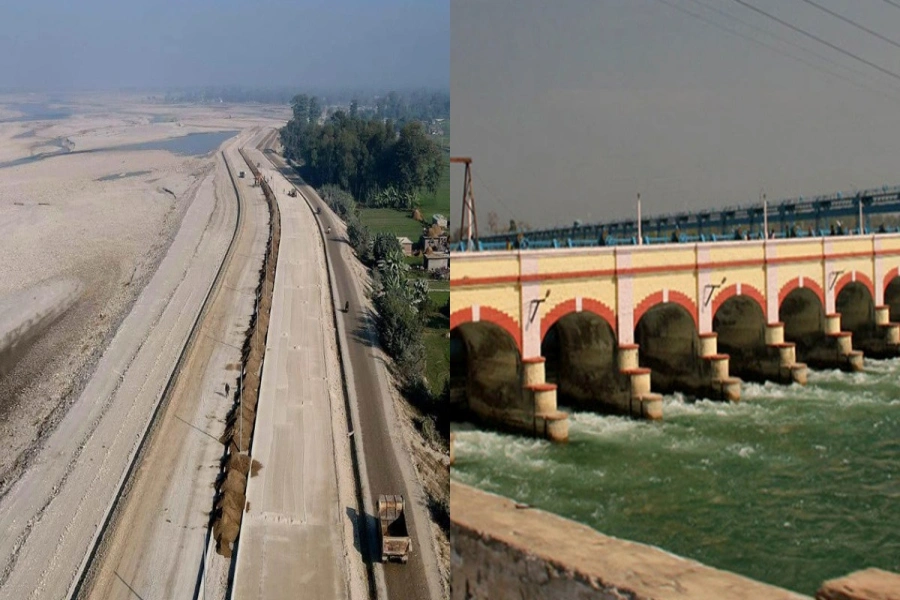
MAHENDRANAGAR, April 1: Although construction of the main canal under the third phase of the Mahakali Irrigation Project—the only national pride project in Kanchanpur district—is progressing rapidly, uncertainty remains over ensuring a regular supply of water.
Information Officer of the Mahakali Irrigation Project Phase III, Yadav Baral, said that the Indian side has already constructed a 1,200-metre main canal from Tanakpur to the Nepal-India border in accordance with the Mahakali Treaty, while the Nepali side has built a 28-kilometre main canal from Brahmadev to Toti Phuleli in Shuklaphanta Municipality.
He said, "The 28-km main canal has been completed, while construction of branch canals in that area is underway. Although India has released water into the main canal from the Mahakali River for testing purposes, it has not been released regularly."
He added that if regular water flow is secured through a bilateral agreement with India, irrigation facilities could benefit up to 5,000 hectares of land in the region.
Damage to irrigation amounts to Rs 2.42 billion

According to him, the project has made multiple requests to the Department of Water Resources and Irrigation to initiate coordination with India regarding the supply of water, but the issue has not yet reached ministerial-level discussions between the two countries.
He mentioned that earlier, Minister for Energy, Water Resources and Irrigation Kulman Ghising had held informal talks with the Indian side on the matter.
"This issue should have been taken to the ministerial level in India, and regular water flow in the canal should be ensured. Due to the lack of concrete action, the main canal constructed with billions in investment is being filled with wood, grass, and debris," he lamented.
The Mahakali Irrigation Project, launched 18 years ago, aims to irrigate 33,520 hectares of land up to Malakheti in Kailali from Kanchanpur.
While construction works continue in four phases between 28 and 48 kilometres under the main canal, with around 60 per cent physical progress achieved so far, the absence of a reliable water supply appears to be a major hurdle.





_20230226123652.jpg)