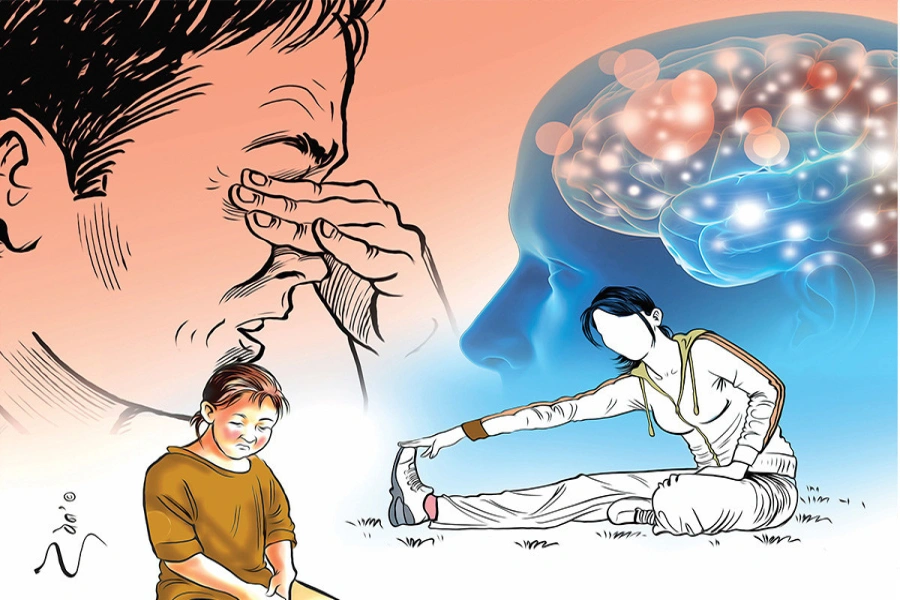
ROLPA, Dec 22: As mental health problems rise worldwide, Nepal is grappling with a deepening crisis—made worse by a shortage of specialists, social stigma, and the unchecked spread of unregulated counseling trainings.
Growing stress levels have pushed mental health concerns into the mainstream, yet treatment in Nepal often begins only when individuals become visibly disturbed. Experts say delayed care has allowed many conditions to worsen unnecessarily.
Outside a handful of urban hospitals, mental health professionals are largely absent from public health facilities. Access to counseling remains limited, and stigma continues to drive people to hide their suffering. Psychologists note that Nepal's decade-long Armed Conflict, repeated natural disasters, the COVID-19 pandemic, and recent unrest during the Gen Z movement on September 8 and 9 have all added to the burden.
Unverified visuals and sensational content circulating on social media have further aggravated anxiety. Psychiatrist Dr Mohan Belbase says some people injured during the Gen Z movement sought treatment again even after physical recovery, highlighting the long-term psychological impact. Despite mental health being part of basic healthcare rights, services remain far from accessible.
Mental Health and Human Rights

According to the Ministry of Health and Population (MoHP), one in ten Nepalis suffers from some form of mental health problem. On average, 19 people die by suicide every day, and nearly 600,000 people live with severe mental illness. Yet the state response remains inadequate.
MoHP Secretary Dr Bikash Devkota said the government has begun addressing the issue, allocating Rs 50,000 to each local unit for mental health programs this fiscal year. He said mental health and non-communicable diseases are now handled by separate departments, and policies are in place to establish psychosocial counseling centers in federal hospitals. Nepal has also launched a National Mental Health Awareness Campaign from December 10 to March 14 under the slogan “Healthy Mind, Healthy Life—Let’s Talk About Mental Health.”
However, even as demand for services grows, unregulated counseling trainings have mushroomed across the country. Numerous institutions are offering courses for a fee, with little oversight. In some cases, online trainings are conducted, and certificates are issued even to individuals who have not completed Grade 12—or even Grades 8 or 9.
Driven largely by profit, training providers have been accused of running courses indiscriminately. Even counselors who claim to have completed the required 780-hour training are reportedly unsure how to handle people with mental health problems.
As questions mount over the credibility of their certificates, many trainees have begun organizing professionally, forming associations to seek state recognition. Training centers accused of violating standards are now lobbying to legitimize their graduates, citing the 780-hour curriculum of the Council for Technical Education and Vocational Training (CTEVT), even as concerns persist over quality and compliance.
CTEVT Information Officer Ek Raj Adhikari acknowledged that some institutions had been granted permission to run trainings but said online delivery and enrolling candidates without Grade 12 education violated official standards. “At least 620 hours must be completed in physical attendance, with 160 hours of on-the-job training,” he said, adding that CTEVT was unaware of some unauthorized programs.
Sudip Ghimire, general secretary of the newly formed Psychosocial Counselors’ Association, said around two dozen institutions were approved to conduct the 780-hour course. However, he claimed local governments often reject their graduates, demanding training from the National Health Training Center (NHTC) instead. “Around 2,500 trained counselors are unemployed, despite the growing need,” he said.
NHTC Director Yeshoda Aryal said her institution maintains strict quality control and issues certificates only after skill-based assessments. She rejected online training and enrollment of unqualified participants, stressing that regulation of CTEVT-affiliated centers falls under CTEVT itself.
Mental health professionals warn that the consequences of weak regulation could be severe. “If unqualified personnel provide mental health services, the risk of harm is real,” said a psychologist working in the field, urging the state to urgently regulate training institutions and ensure competence in such a sensitive sector.