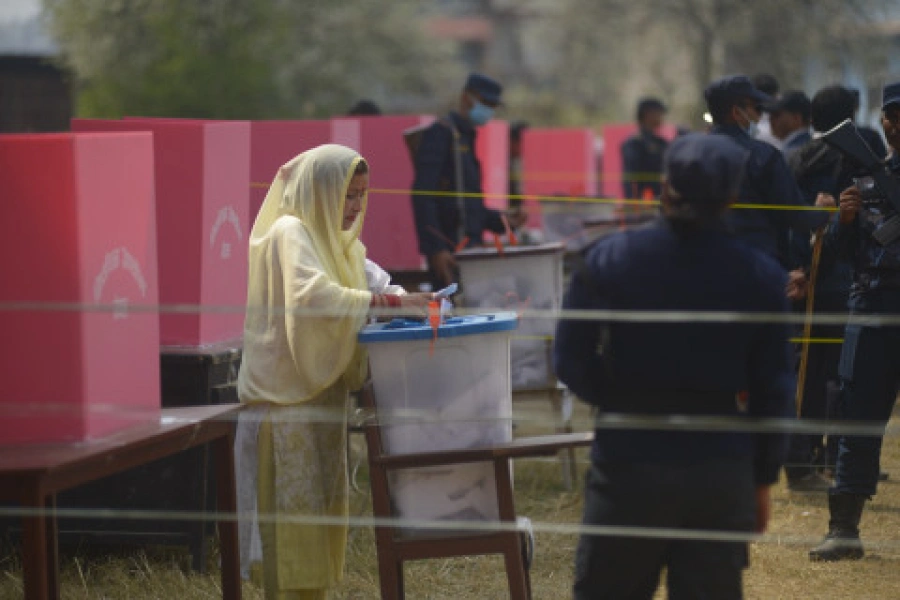
Election campaign finance refers to the income and expenditures of a candidate and a political party in an election contested by them. It is an investment in an uncertain venture, where the purpose is to secure electoral victory. Such an endeavor involves many losers and only a fixed number of winners. Despite a high probability of failure, many aspirants still enter the race.
There is an old saying: “Jite Hastinapurko raj, hare chapramuniko bas.” This translates as: winning brings the throne, while losing brings obscurity or hardship. In politics, despite its high risks, people are drawn to it because of the potential returns in terms of power, social status, and the often-undeclared benefits attached to authority, including monetary gain.
Therefore, people tend to invest in elections in a democracy. Politics is a field where everyone claims social service as their primary motive, while the underlying aim is often to gain state power and implement ideological agendas through policies and programs. The presence of the “Leviathan” or “mortal god” in the state exerts sovereign power that attracts individuals toward it. Knowing that contesting elections is an expensive venture with a low probability of success, people still participate due to both visible and invisible benefits.
We often speak of democracy and the creation of a value-based society for the broader advancement of humanity and civilization. In a liberal democracy, sovereignty rests with the people, who exercise state power through elected representatives. Therefore, electoral integrity is crucial, and campaign finance plays a significant role in upholding democratic values.
In our electoral system, the state neither provides funds for campaigns nor subsidizes media and communication services. Candidates are responsible for arranging their own financial resources. However, they must disclose their assets when filing nominations and submit detailed campaign expenditure reports within 15 days after election results are announced.
Money and life

To contest elections, not only candidates but also political parties require substantial financial resources. Given limited access to funding, parties often depend on corporate donations and contributions from well-wishers. Due to existing loopholes, influential actors sometimes attempt to gain favor with party leaders, becoming a major source of policy distortion in state decision-making. Financial contributions often provide donors greater access to policymaking, increasing the risk of policy corruption. This raises concerns about the undue influence of major donors and interest groups on both parties and candidates they support. It is also considered a serious cause of persistent and widening corruption in governance. Opaque campaign expenditures, especially from hidden channels, obstruct electoral integrity and raise fundamental ethical concerns regarding corruption prevention.
In the 2017 election, money played a significant role. Candidates spent more on campaigns than political parties and the government combined. High spending negatively affected electoral integrity in Nepal. Unequal access to funds among candidates was also a major concern.
A recent study on campaign finance in the federal election for the House of Representatives in 2082, conducted by EOC Nepal, has challenged the long-held belief that higher campaign spending ensures victory. Contrary to a similar 2017 study, the second runner-up in this election spent disproportionately more than the winner. On average, candidates exceeded the spending limit by 118 percent, with average expenditure reaching 72 lakh—significantly higher than the set limit. The winning candidate spent 88 lakh, the second runner-up 2.83 crore, and the third runner-up 1.23 crore. The study shows that higher spending does not guarantee electoral success.
The 2082 federal election took place in an extraordinary environment shaped by the Gen Z movement. The key drivers of this movement included the inability to keep pace with technological change, politicization of state mechanisms that failed to deliver development outcomes, and rising concerns over impunity and corruption. In this complex environment marked by uncertainty, fear, and expectations of transformation, the election was successfully conducted without major disruptions. It also set a new pattern in electoral campaigning, marking a departure from traditional practices.
While financial incentives remained important, they were increasingly insufficient to secure electoral victory. Evidence suggests a weak correlation between spending and outcomes, with growing importance of non-financial factors such as voter perception, party credibility, leadership profile, ethical standing, and youth engagement.
Campaign spending patterns indicate a shift in strategy, moving away from visible expenditures toward indirect and digital campaign methods. While spending may appear reduced, it has not necessarily declined; rather, it has shifted into less visible and harder-to-track channels such as digital promotion, informal networks, and third-party spending.
This election highlights several key changes:
1. Political transformation can generate hope and mobilize citizens voluntarily with enthusiasm.
2. Expensive elections can be a source of corruption.
3. Availability of money may encourage misuse to gain voter support.
4. Greater public scrutiny can help control unethical campaign practices.
5. Digital campaigns can be a double-edged sword if not properly regulated.
In conclusion, while financial resources remain important, they are no longer sufficient on their own to secure victory, as voter awareness and political credibility increasingly shape electoral outcomes. All political parties must take his lessons from the recent election for their electoral success.