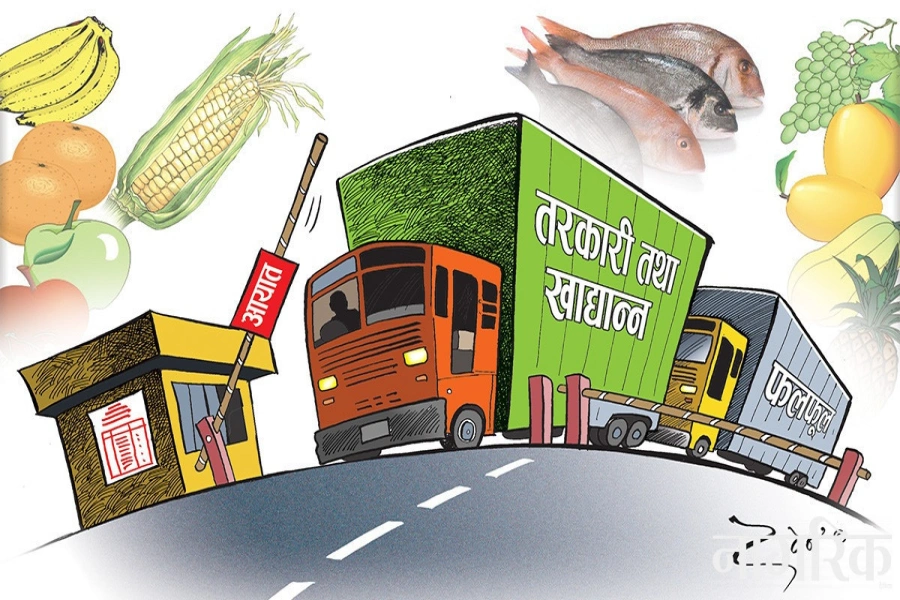
KATHMANDU, Dec 23: Despite government claims of increasing agricultural and livestock production, Nepal’s dependence on imports continues to rise. In just the first five months of the current fiscal year (FY) 2025/26, over Rs 150 billion worth of agricultural and livestock products were imported.
The rise is attributed not only to the growing number of youths going abroad for employment and leaving farmland barren, but also to the lack of modernization and commercialization in agriculture, which has hindered production growth. With domestic production failing to meet demand, Nepali consumers have increasingly relied on imported agricultural products.
According to data released by the Department of Customs (DoC) on Monday, between mid-July and mid-December, imports of food grains, vegetables, fruits, fish, and meat from various countries totaled Rs 154 billion. Of this, Rs 22.72 billion was spent on food grains such as rice, maize, and wheat. Despite government efforts to increase rice production by declaring specific “pocket areas” for cultivation, imports continue.
Vegetables consumed in Nepali kitchens are also heavily imported. In five months, imports included Rs 14.89 billion worth of vegetables and Rs 11.89 billion worth of fruits. Similarly, Rs 63.14 billion of animal and plant-based fats and oils, Rs 10.79 billion of raw materials for the food industry, Rs 4.03 billion of coffee and tea, and Rs 8.39 billion of oilseeds were imported.
Even items that could be produced domestically are being imported, widening the trade deficit. Rice, fish, oil, onions, potatoes, coriander, and other staples are largely sourced from India, China, and other countries. Dependence extends beyond agricultural products to fish and meat. Despite repeated government pledges to increase domestic production and replace imports, results have largely remained on paper.
Groundwater for food security

Although some investments have been made, yields of key food crops remain low. Major staples such as rice, maize, vegetables, fruits, tea, coffee, onions, ginger, garlic, turmeric, cardamom, lentils, chickpeas, beans, meat, and oilseeds have failed to achieve sufficient domestic output, forcing reliance on imports.
The lack of industrialization in agriculture has further increased import dependence. Rising imports have also expanded the trade deficit, which reached Rs 649.68 billion in the first five months of the FY. Compared to the same period last year, the deficit increased by 10.5%, while total foreign trade reached Rs 882.69 billion.
During this period, imports totaled Rs 766.18 billion, while exports were only Rs 116.50 billion. Imports increased by around 16%, and exports grew by 58%. Even though both imports and exports increased, the overall trade deficit widened.
According to the DoC, by mid-December, imports totaled Rs 766.18 billion, 15.83% higher than the same period last FY. Exports, meanwhile, amounted to Rs 116.50 billion, 58.17% higher than the previous year. Although the total size of foreign trade increased by 20%, the trade deficit rose by 10.52%.
Main imported agricultural and related products (up to mid-December)
Food grains: Rs 22.72 billion
Vegetables: Rs 14.89 billion
Fruits: Rs 11.89 billion
Raw materials for food industry: Rs 10.79 billion
Tea and coffee: Rs 4.03 billion
Oilseeds: Rs 8.39 billion
Animal and plant-based fats and oils: Rs 63.14 billion