

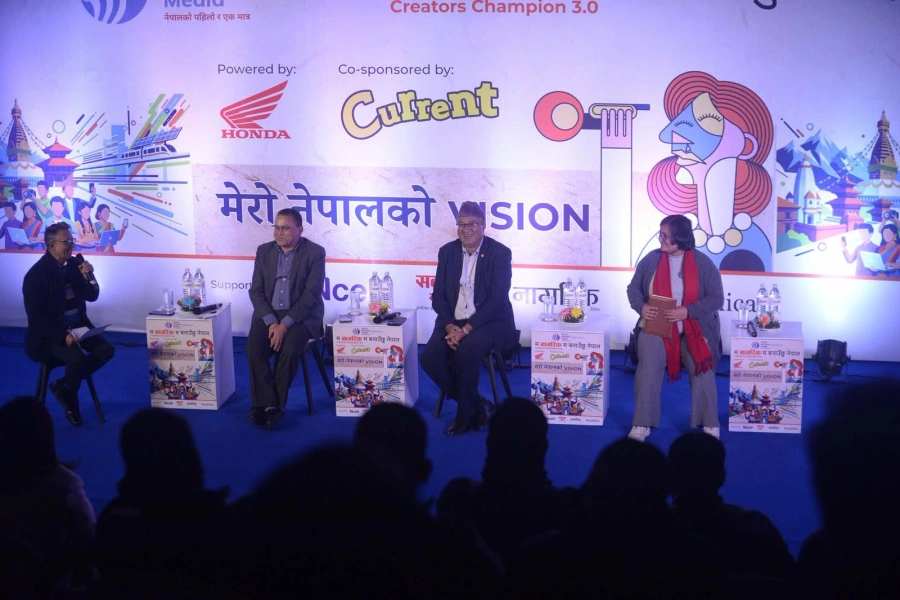
KATHMANDU, Feb 7: Speakers at the Creators Champion 3.0 organised by Nepal Republic Media raised serious concerns over the widening gap between Nepal’s political change and its stalled economic transformation, as well as the growing influence of money and interest groups in politics. The discussion brought together voices from the private sector, journalism and politics to reflect on the promises of the republic and the realities confronting the economy and democratic processes.
The programme examined structural problems within the political system, including the rising role of vested interests in parliament and the escalating cost of elections. Senior journalist Hari Bahadur Thapa and Rastriya Swatantra Party (RSP) leader Ranju Darshana highlighted how opaque financing, interest-driven lawmaking and outdated regulations have undermined public trust, stressing the need for transparency, accountability and reform to align economic and political practices with democratic ideals.
‘Economic revolution still elusive despite political change’
Vice President of the Federation of Nepalese Chambers of Commerce and Industry (FNCCI) Hemraj Dhakal has said that although Nepal’s political revolution has concluded, the economic transformation promised by political parties has yet to materialise.

Speaking at the Creators Champion 3.0 programme organised by Nepal Republic Media, Dhakal expressed dissatisfaction with the working style of the government and political parties, saying their actions have failed to match their commitments.
Media and ad agencies must collaborate to foster growth of adve...

He noted that after the establishment of the republic, political parties declared that the era of political struggle was over and that the country would move towards an economic revolution. “Parties spoke of an economic revolution in their manifestos, but in practice the government has still not effectively opened investment opportunities for the private sector,” Dhakal said.
Dhakal also raised concerns over the repeated targeting of the private sector during protests and movements in recent times. “In almost every small or large protest, the private sector is attacked, which has significantly weakened the morale of businesspeople,” he said, adding that while the objectives of such movements may be positive, the private sector has unfairly borne the brunt.
Despite the challenges, Dhakal said Nepal still holds considerable economic potential. He stressed that meaningful dialogue between the government and the private sector, along with the removal of legal and policy bottlenecks, could create ample opportunities within the country.
Interest groups dominating parliament: Senior Journalist Thapa
Senior journalist Hari Bahadur Thapa said the growing influence of interest groups within parliament has made recent bills increasingly controversial.
“The reason bills have become contentious in recent years is the dominance of interest groups in parliament. Before 2064 BS, such groups were far less prevalent,” Thapa said.
He pointed out that while businesspeople previously influenced politics by providing financial support, many have now entered parliament themselves. “Earlier, businesspeople donated money. Since 2064 BS, they have started coming to parliament directly, largely to influence laws in their favour. This has created serious problems,” he said.

Thapa recalled that brokers began appearing in parliament after the Prado–Pajero scandal of 2051 BS, marking a decline in legislative integrity. He added that not only large business houses but also contractors have gained parliamentary representation, weakening financial discipline among parties and lawmakers.
He further noted that election expenses have surged, particularly with the growing use of social media for campaigning, resulting in significant financial outflows. “This issue needs serious debate,” he said.
RSP leader Ranju Darshana calls for transparent election financing
Rastriya Swatantra Party (RSP) leader Ranju Darshana underscored the need for transparent and well-managed election financing, arguing that candidates must be held accountable for their spending.

Speaking at the same programme, Darshana said, “I am asking for votes as well as funds. I openly request contributions through a QR code. That is completely transparent. Elections should not be turned into a private limited company.”
She argued that the spending ceiling set by the Election Commission is unrealistically low and needs revision. “The Commission has fixed expenditure limits, but they are insufficient. This issue requires serious attention,” she said.
Darshana also called for legal recognition of emerging practices such as crowdfunding. “Crowdfunding in elections is not legally provided for, even though it is being practised. It is time to institutionalise it through law,” she said.
She added that uniform spending limits across districts are impractical, as costs vary significantly. However, she stressed that the culture of winning elections through excessive spending must end. “Elections belong to the people as much as they do to leaders,” she said.








-1200x560-1784036910.webp)


