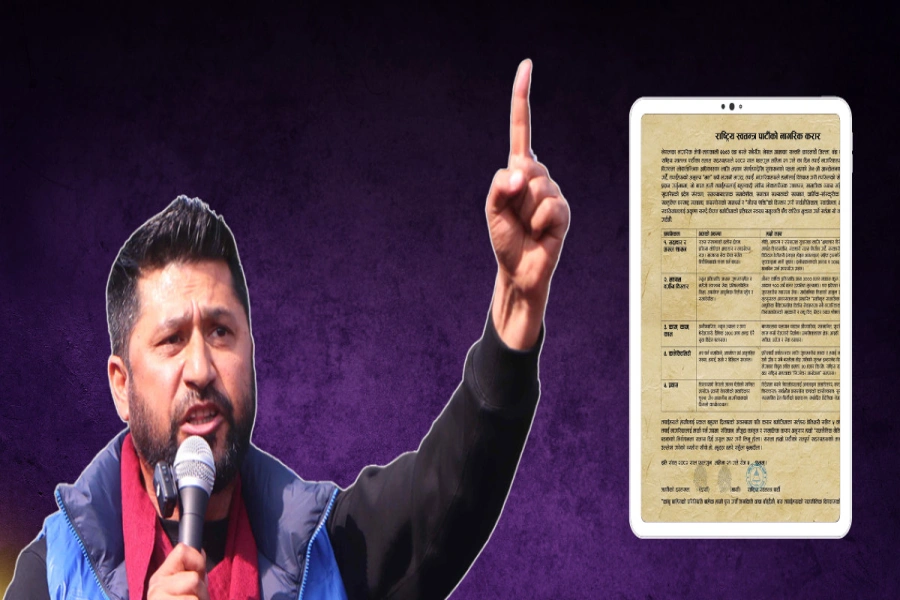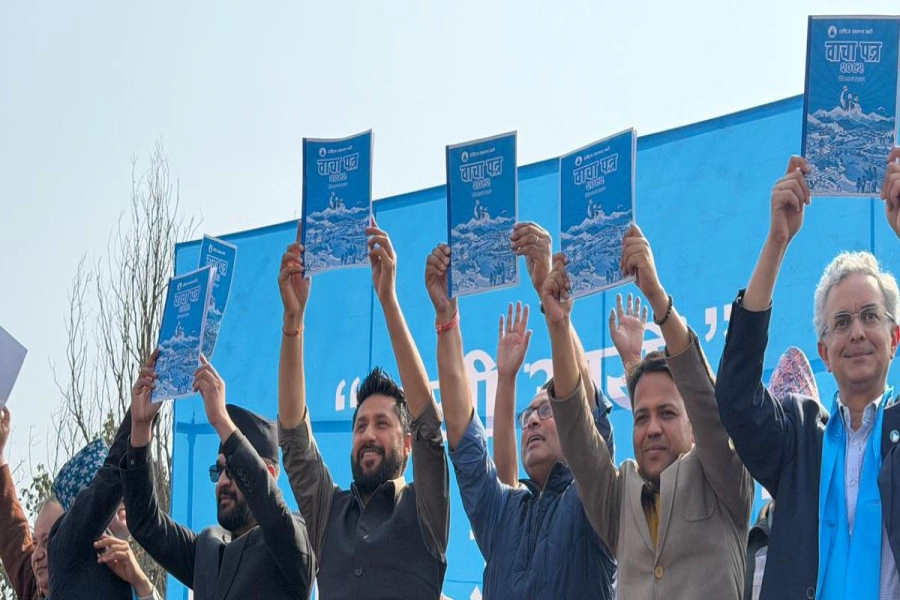
KATHMANDU, Feb 20: The Rastriya Swatantra Party (RSP) has unveiled its election manifesto, titled “100 Policy Foundations for Transformation”, pledging comprehensive reforms to accelerate economic growth and streamline government services. The manifesto was officially presented during a declaration for change event in Surkhet on Thursday.
The announcement was made by RSP leaders, including party chief Rabi Lamichhane, senior leader Balen Shah, vice-chair Dr Swarnim Wagle, and deputy leader DP Aryal. The party emphasized its plan to partner with the private sector to drive national economic development and highlighted its commitment to repealing nearly two dozen outdated or obstructive laws that hinder progress.
According to the manifesto, RSP aims to systematically eliminate bureaucratic hurdles and outdated legislation, reducing production costs, improving the business environment, and attracting domestic and foreign investment to priority sectors of economic growth. The policy decisions for repealing laws will be guided by the 2081 report of the High-Level Economic Reform Advisory Commission as well as recommendations from the Federation of Nepalese Chambers of Commerce and Industry and the Nepal Chamber of Commerce.
Scientists figure out how vampire bats got a taste for blood

The party has set ambitious economic targets, promising to achieve a 7 percent annual growth rate and expand Nepal’s economy to $100 billion within five years. The plan projects that per capita income will surpass $3,000 in the next five to seven years, elevating the country to the status of a respectable middle-income nation.
RSP pledged that the private sector would be treated as a key partner in development. “Businesses will no longer have to knock on government doors repeatedly. We commit to bringing government services directly to your doorstep,” said Dr Wagle. The party promises digital-first, paperless services to enhance citizen trust and accelerate long-pending economic reforms while reducing the tax burden.
The manifesto also outlined measures to ensure social justice alongside a liberal economic approach. While reducing tax burdens, the party reassures that revenues will not decline unduly. Tax laws and regulations will be applied fairly, planned tax evasion will be curbed, and policies will be revised to protect middle-class families, allowing deductions for education, health, and childcare expenses.
To promote both domestic and foreign investment, RSP plans to implement a one-stop service center where entrepreneurs can submit applications in a single location without unnecessary visits to multiple offices. This center will facilitate project site availability, expedite approvals related to forests and environmental concerns, and coordinate with local and relevant government bodies. Legal frameworks and operational guidelines for investment facilitation will be enforced efficiently, and business registration will be made easy, fast, and free through digital platforms.
The party has also committed to restructuring the Revenue Tribunal, abolishing the Department of Revenue Investigation, and establishing a professional unit staffed by chartered accountants for oversight and anti-corruption measures.
In addition, RSP promised to complete national pride projects that have been stagnant for over 12 years within the next two years. A results-oriented, time-bound action plan will ensure effective project leadership, land acquisition, removal of forest-related obstacles, and digital tracking of compensation. Over the next five years, the party plans to expand beyond traditional infrastructure projects, attracting diaspora capital and expertise to establish international-standard sports cities, higher education and research centers, specialized healthcare services, cultural tourism, and ten other diversified projects under a ‘fast-track’ model after detailed project evaluation and cost assessment.