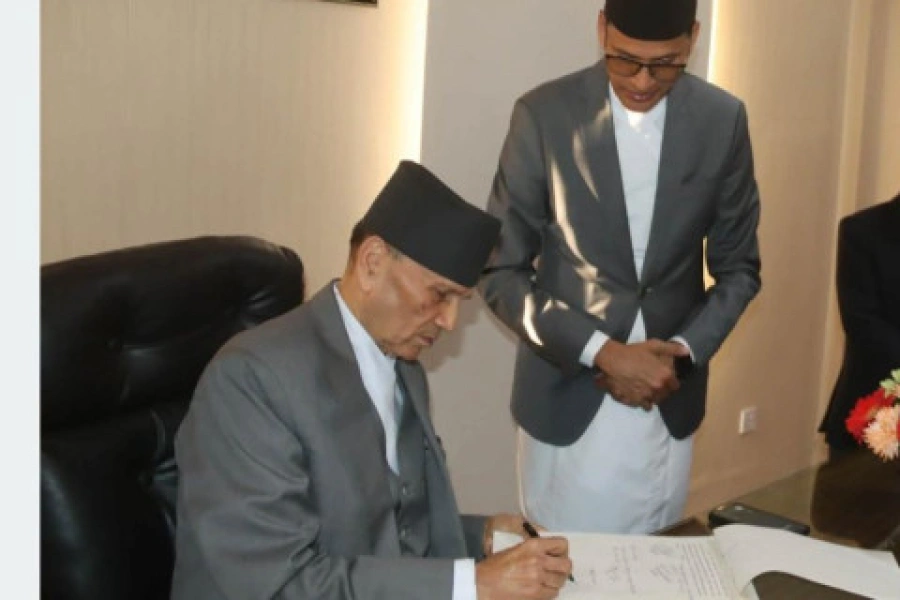
KATHMANDU, Oct 27: Prime Minister Sushila Karki’s decision to appoint former Lieutenant General of Nepali Army Bala Nanda Sharma as Foreign Minister has triggered wide public debate and speculation at a time when the government has less than 69 days left in office and is preparing for House of Representatives (HoR) elections amid diplomatic and political uncertainty.
When Karki assumed office after the Gen Z–led protest in early September, she had publicly committed to forming a small, lean cabinet of 11 members. There was later informal discussion with representatives of the Gen Z movement about expanding the cabinet to 12 to ensure youth representation. However, citing the lack of a suitable candidate, the prime minister decided to retain the cabinet at 11 members.
That stance appeared to shift on December 12, when four new ministers—Kumar Ingnam, Rajendra Singh Bhandari, Madhav Prasad Chaulagain and Shraddha Shrestha—were inducted, expanding the cabinet to 14 members. The subsequent appointment of Sharma as Foreign Minister has further intensified questions about the government’s priorities and timing. Critics have asked why the appointment was made so close to the government’s term expiry, whether there were no civilian candidates capable of handling the foreign affairs portfolio and why Karki reversed her earlier intention to retain the Foreign and Defence portfolios herself.
According to senior government sources, the decision was driven largely by emerging diplomatic challenges following the back-to-back recall of the ambassadors of China and the US to Nepal. With the Indian ambassador also away for medical treatment, key diplomatic missions in Kathmandu are set to be left without senior leadership, creating what experts described as a significant ‘geopolitical vulnerability’ for Nepal.
A section of foreign policy analysts cautioned that the Government of Nepal’s sudden recall of its own envoys, without adequate diplomatic preparation, has disrupted coordination with major powers and weakened Nepal’s ability to communicate its position at a sensitive political juncture. Reportedly, donor agencies, too, have raised concerns about the government’s stability and continuity when approached for support related to elections and post-Gen Z movement reconstruction.
Indian Army Chief General Manoj Pande Conferred Honorary Rank o...

“The government seems to have realised that the absence of a designated foreign minister was becoming increasingly untenable,” said a highly-placed government source familiar with cabinet deliberations, requesting anonymity. “After the Gen Z protest and the formation of an interim government to ensure peaceful democratic transition, Nepal needed a credible interlocutor to engage the international community and reassure partners about political stability and the election roadmap.”
Officials at the Ministry of Foreign Affairs (MoFA) privately acknowledge that operating without a minister severely constrained decision-making, particularly on matters requiring political approval. Ministry officials had reportedly apprised the prime minister of the need for a full-time foreign minister to ensure continuity and credibility in diplomatic engagements.
Beyond diplomacy, security considerations ahead of the HoR elections also appear to have influenced Sharma’s appointment. Political parties are still not convinced of effective security arrangements as several hundreds of police arms looted during the Gen Z protests are yet to be recovered and around 5,000 prisoners who escaped from various prisons during the protests are still at large.
Sources close to the cabinet say the government views Sharma’s stature and experience as critical to ensuring effective coordination among security agencies during the polls. The government plans to mobilise around 150,000 temporary police personnel in addition to Nepal Police and Armed Police Force (APF) members, with the cooperation of the nearly 97,000-strong Nepali Army seen as essential for maintaining a secure election environment.
There is also speculation that Prime Minister Karki may later entrust Sharma with the Defence portfolio. Having served extensively in UN peacekeeping missions, including as Force Commander in the Golan Heights, Sharma is regarded as someone capable of coordinating complex security operations and managing crisis situations.
Sharma’s reputation extends beyond security. A retired three-star general with nearly four decades of service in the Nepali Army, he is widely recognised as the architect of Nepal’army integration process following the end of the Maoist insurgency. As chair of the special committee on army integration, Sharma played a central role in forging consensus among political parties and designing a framework that reduced nearly 30,000 verified Maoist combatants to just over 1,500 eligible for integration into the Nepali Army, while ensuring a dignified exit for the rest. That process is now studied internationally as a model of post-conflict military integration.
Sharma also headed the Crisis Management Centre (CCMC) during the COVID-19 pandemic, overseeing national coordination at a time when state institutions were under immense strain. His experience in peacebuilding, crisis management and inter-agency coordination has earned him respect across party lines.
Prime Minister Karki is also said to be seeking a senior, non-partisan figure who can act as a bridge between her technocrat-heavy cabinet and mainstream political parties. Her cabinet largely comprises individuals with little or no direct interaction with political parties. At present, Minister for Information and Communication Technology Jagadish Kharel and her Chief Political Adviser Ajaya Bhadra Khanal are holding meetings with senior leaders of the Nepali Congress, CPN-UML and the Nepali Communist Party in an effort to rebuild trust with the political parties.
With several ministers reportedly preparing to resign to contest the elections and figures like Kulman Ghising signalling imminent political moves, the prime minister appears keen to have a steady hand in the cabinet to help steer the country during the transition period.
Sharma’s credibility among major political actors is seen as an asset in this regard. Having worked closely with leaders across the spectrum during the peace process, he is viewed as an interlocutor capable of rebuilding trust between the government and established parties at a time when political polarisation remains high.
Although Karki had reportedly wanted to bring Sharma into the cabinet earlier, the decision was delayed due to Sharma’s family issues. He has now been entrusted with the Foreign Ministry, a move that underscores the administration’s reassessment of its priorities amid mounting internal and external pressures.
Upon assuming office, Sharma said his immediate focus would be on restoring Nepal’s international image and strengthening diplomatic coordination. “This is our country. The more we leave things unattended, the more problems arise,” he said. “I am here to rescue the ministry and ensure that Nepal’s interests are represented effectively.”
On elections, Sharma emphasised coordination with neighbouring and friendly countries, noting that Nepal is already in “election mode” and that diplomatic cooperation would be pursued as required.
As Nepal heads towards a crucial electoral phase, Sharma’s appointment places a seasoned crisis manager at the helm of foreign affairs. Whether this late intervention can stabilize diplomacy, reassure international partners and support a credible election process remains to be seen, but for the Karki government, the move signals a clear shift from minimalism to pragmatism in the face of national uncertainty.